On this page
How to identify it
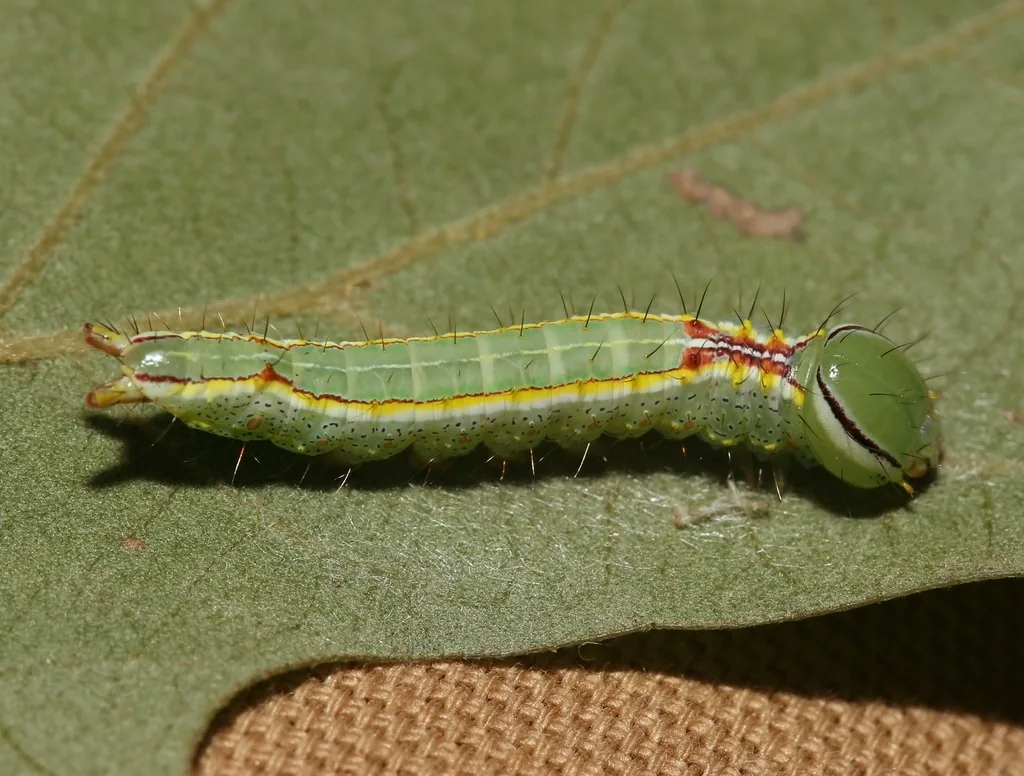
- Grown caterpillars are about 1.5 inches long and green to yellow, often with a pink to dark red stripe on the back that varies widely in shape.[1][2]
- The head has two curved bands on each side, an outer creamy white band and an inner reddish-brown to black one.[1]
- Moths are ashy gray with dark wavy lines on the forewings and a wingspan of 1.5 to 1.75 inches.[1]
Look-alikes
| Look-alike | How to tell them apart |
|---|---|
| Saddled prominent | A close relative with similar habits that often feeds alongside it.[1] |
Where it lives
Eastern North America, west to North Dakota and south to eastern Texas, Louisiana and Mississippi; southwestern Arkansas had a heavy outbreak in 2017.[1][2]
Biology and life cycle
It overwinters as a prepupa in a cocoon under the leaf litter. The North has one generation a year; south of a line from Virginia to Missouri, two have been reported.[1][2]
Females lay clusters of 30 to 300 eggs under leaves; young caterpillars feed in groups and skeletonize leaves, and older ones eat everything between the main veins.[1]
Damage and signs
- All oaks are attacked, with white oak generally preferred; beech, basswood, paper birch and American elm are also hosts.[1]
- Most feeding comes in August or later, so trees can withstand 2 or 3 years of heavy defoliation; outbreaks seldom last more than 2 years.[1]
- In outbreaks the droppings stain sidewalks, porches and cars, and the sound of falling frass can be mistaken for rain.[2]
Health risk
Larvae secrete formic acid when disturbed, and prolonged or repeated handling can blister skin; Arkansas notes the droppings pose no apparent health risk to people or pets.[1][2]
Control
Sanitation
Raking up and disposing of fallen leaves in fall removes many of the overwintering insects.[2]
Biological control
Egg parasitoid wasps may kill 90 percent of the eggs after large outbreaks, and larval parasites, ground beetles, stink bugs and birds such as blue jays and pileated woodpeckers take many more.[1][2]
Pesticides
Spraying large oaks is unnecessary and impractical; the Forest Service notes local treatment may be needed only in residential or recreation areas.[1][2]
Common questions
Sources
- USDA Forest Service (Forest Insect & Disease Leaflets), “Variable Oakleaf Caterpillar (FIDL 67, revised May 1979).” www.fs.usda.gov/foresthealth/docs/fidls/FIDL-67-VariableOakleafCaterpillar.pdf (accessed 2026-10-16)
- University of Arkansas System Division of Agriculture (Cooperative Extension Service), “The variable oakleaf caterpillar returns: noisy, messy but harmless (Sept. 20, 2017).” www.uaex.uada.edu/media-resources/news/2017/september2017/09-20-2017-Ark-variable-oakleaf-caterpillar.aspx (accessed 2026-10-16)
- iNaturalist, “Lochmaeus manteo taxon page (order and family).” www.inaturalist.org/taxa/153443 (accessed 2026-10-06)