On this page
How to identify it
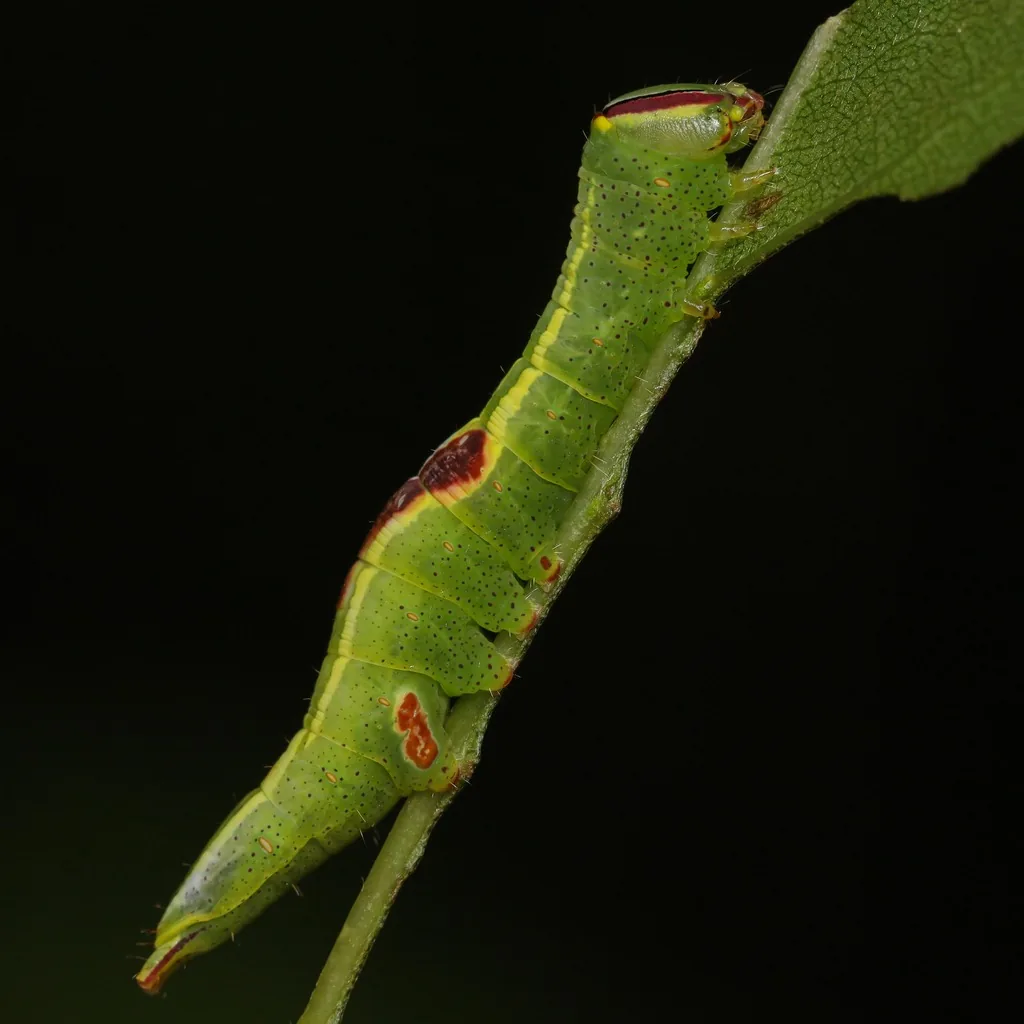
- Grown caterpillars are about 1.1 to 1.5 inches long, smooth and usually green, with a red to purplish saddle-shaped mark on the back and a cream stripe along each side.[1][2]
- Newly hatched caterpillars are reddish-maroon to black, with a pair of antler-like horns behind the head and black spikes on the back that are lost as they grow.[1][2]
- Adults are inconspicuous mottled gray-green to olive moths about 3/4 inch long that rest camouflaged on tree bark by day.[1][2]
Where it lives
Native to the northeastern United States and southeastern Canada, with smaller outbreaks in Michigan and Wisconsin.[1][2]
Biology and life cycle
Pupae overwinter in the leaf litter; moths emerge from late May into early July and lay single eggs under leaves, 200 to 250 per female on average.[1][2]
Young caterpillars skeletonize leaf undersides, leaving translucent lacy patches; older ones eat leaves from the edges and shred them, littering the ground below.[1][2]
The Northeast has one generation a year; UMass notes two are possible over much of the East.[1][2]
Damage and signs
- Favorite hosts are American beech, sugar maple, yellow birch and paper birch; red maple, striped maple and white ash are rarely attacked.[2]
- Most feeding falls between late July and early September, so healthy trees usually cope, but repeated or drought-year outbreaks have killed 10 to 15 percent of trees in parts of New York, Pennsylvania and New England.[1][2]
- Outbreaks come about every 10 years and last 1 to 3 years; one in 1968 to 1971 defoliated nearly 1.5 million acres in six northeastern states.[1][2]
- Defoliated sugar maples produce less sap for maple syrup.[2]
Health risk
Control
Keep them out
During an outbreak, UMass suggests fine netting such as cheesecloth could protect small ornamental plants near forests.[1]
Biological control
Egg parasitoid wasps, shrews, birds, ground beetles, stink bugs, fungi and a virus all help bring outbreaks to an end.[1][2]
Pesticides
Chemical control is not recommended routinely because outbreaks collapse on their own; where needed, Bacillus thuringiensis spares the natural enemies.[1][2]
Common questions
Sources
- UMass Extension Landscape, Nursery and Urban Forestry Program (Landscape Insect & Mite Guide), “Heterocampa guttivitta (Saddled Prominent).” www.umass.edu/agriculture-food-environment/landscape/publications-resources/insect-mite-guide/heterocampa-guttivitta (accessed 2026-10-16)
- USDA Forest Service (Forest Insect & Disease Leaflets), “Saddled Prominent (FIDL 167, Sept. 1987).” www.fs.usda.gov/foresthealth/docs/fidls/FIDL-167-SaddledProminent.pdf (accessed 2026-10-16)
- iNaturalist, “Cecrita guttivitta taxon page (order and family).” www.inaturalist.org/taxa/1372883 (accessed 2026-10-06)