On this page
How to identify it
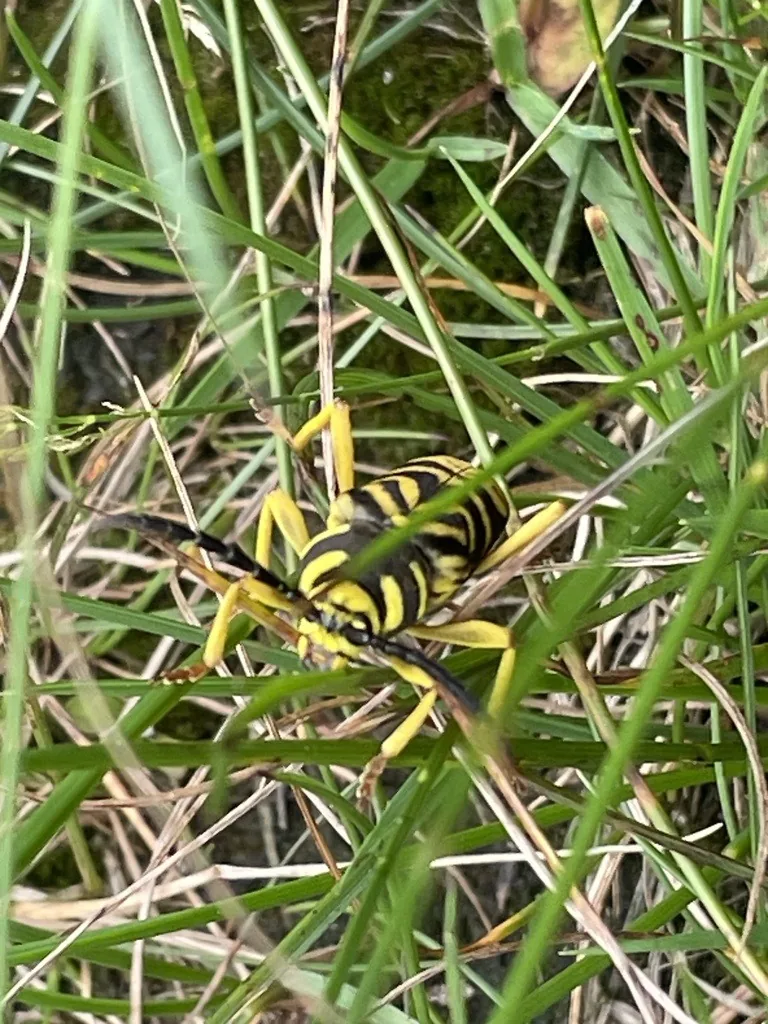
- Adults are stout black beetles about 1 inch long with bright yellow bands, including a W-shaped band near the base of the wing covers, plus yellow legs and black antennae.[1][2]
- Grown larvae are rosy-white, cylindrical grubs up to about 2 inches long, with tiny legs.[1][2]
- Signs include small wet spots of leaking sap or frass on the bark, then long-lasting ridges in the bark and C-shaped cat-face scars where bark falls off old galleries.[1][2]
Look-alikes
| Look-alike | How to tell them apart |
|---|---|
| Locust borer | Similar yellow-and-black coloring, in a different pattern.[1] |
Where it lives
Found throughout the range of sugar maple: most of the eastern United States and adjacent Canada, south into the southern Appalachians, where it is more common at higher elevations, and west to Minnesota.[1][2]
Biology and life cycle
Sugar maple is the only known host. Adults emerge in late spring, and females lay single eggs in bark slits and crevices in summer, mostly on the lower 30 feet of the trunk.[1][2]
Larvae mine under the bark the first year and overwinter, tunnel just under the bark the second year, then bore into the wood to pupate; the life cycle takes two years.[1][2]
Damage and signs
- Galleries can girdle and kill branches, and small trees can snap where a gallery circles the stem.[2]
- Infested trees may lose vigor and grow smaller leaves that drop early, but trees are rarely killed; exposed galleries can let in stain and rot fungi and degrade lumber.[1][2]
- Old roadside trees and trees in sugarbushes are often damaged, and attacks can rise 3 to 8 years after defoliation by forest tent caterpillar or saddled prominent.[1][2]
Health risk
Control
Prevention
Keep maples vigorous with good planting and care; stressed, slow-growing trees are attacked more often.[1]
Traps and physical control
Inspect shade trees for wet spots, frass and bark cracks, and prune dead or dying branches well below the damaged area.[2]
Biological control
Woodpeckers are its main natural enemy and may kill nearly half of a local population.[1]
Pesticides
Because trees are rarely killed, chemical treatment is usually unnecessary in home landscapes.[1]
Common questions
Sources
- UMass Extension Landscape, Nursery and Urban Forestry Program (Landscape Insect & Mite Guide), “Glycobius speciosus (Sugar Maple Borer).” www.umass.edu/agriculture-food-environment/landscape/publications-resources/insect-mite-guide/glycobius-speciosus (accessed 2026-10-16)
- USDA Forest Service (Forest Insect & Disease Leaflets), “Sugar Maple Borer (Forest Pest Leaflet 108, revised Aug. 1971).” www.fs.usda.gov/foresthealth/docs/fidls/FIDL-108-SugarMapleBorer.pdf (accessed 2026-10-16)
- iNaturalist, “Glycobius speciosus taxon page (order and family).” www.inaturalist.org/taxa/204683 (accessed 2026-10-06)