On this page
How to identify it
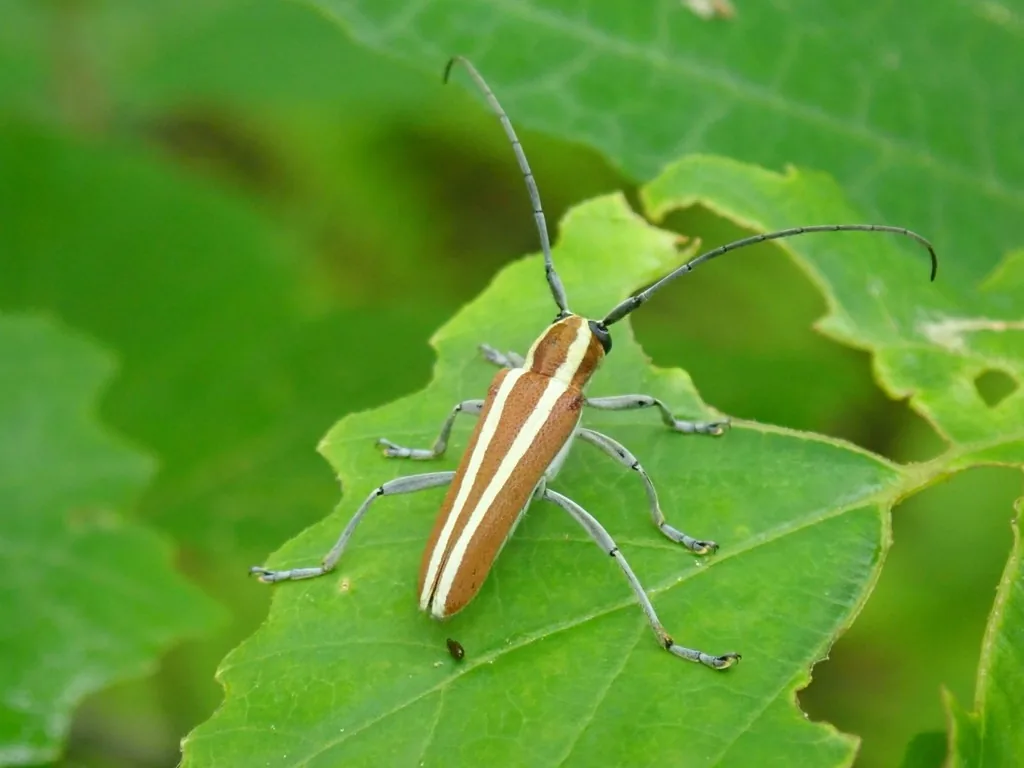
- Adults are about 3/4 inch long, white with three broad brown stripes running the length of the body, and have long antennae.[1][2][3]
- Larvae are fleshy, legless, cream to yellowish-white grubs with brown heads, up to about 1 to 1.25 inches long.[1][2][3]
- Signs are reddish-brown, pigtail-shaped frass and wood shavings at the base of the trunk, dark sap-stained bark and round exit holes about the size of a pencil.[1][2][3]
Look-alikes
| Look-alike | How to tell them apart |
|---|---|
| Flatheaded appletree borer | A smaller, flattened, metallic beetle, about 1/2 inch long, that also attacks many shade and forest trees.[2] |
Where it lives
Native to North America and found throughout most of the United States and Canada; it was found in Germany in 2008.[1][2]
Biology and life cycle
Adults appear from May or June and lay eggs into slits in the bark at night, mostly near the ground, through July or August.[1][2][3]
Larvae tunnel under the bark the first year and deeper into the sapwood the next; the life cycle takes two, sometimes three, years.[1][2][3]
Adults feed a little on leaves and young bark and rarely fly far.[1][2]
Damage and signs
- Hosts are apple, crabapple, pear, quince, hawthorn, serviceberry and mountain-ash.[2][3]
- Most damage is in the trunk from about 6 inches above to 4 inches below the soil; one or two borers can kill a young tree, and trees 5 to 10 years old may snap at the ground.[1][2]
- It attacks healthy and stressed trees alike, and backyard, young and unsprayed trees suffer most.[1][2][3]
Health risk
Control
Prevention
Keep trunks clear of weeds and tall grass, paint the lower two feet of young trunks with white latex paint diluted half with water, or wrap them with screening from June through August.[1][3]
Sanitation
Before planting young trees, remove unmanaged apple, crabapple, hawthorn, serviceberry and mountain-ash within 100 to 200 yards.[3]
Traps and physical control
In late summer, look for sap-stained spots and kill young larvae with a shallow vertical knife cut in the bark, or probe tunnels with a flexible wire.[1][3]
Biological control
Woodpeckers feed on the larvae and at times reduce their numbers.[1]
Common questions
Sources
- UMass Extension Landscape, Nursery and Urban Forestry Program (Landscape Insect & Mite Guide), “Saperda candida (Roundheaded Apple Tree Borer).” www.umass.edu/agriculture-food-environment/landscape/publications-resources/insect-mite-guide/saperda-candida (accessed 2026-10-16)
- University of Missouri Extension, “Insect Borers of Fruit Trees (G7190).” extension.missouri.edu/publications/g7190 (accessed 2026-10-16)
- UNH Cooperative Extension, “Borers in New Hampshire Apple Trees (fact sheet).” extension.unh.edu/resource/borers-new-hampshire-apple-trees-fact-sheet-0 (accessed 2026-10-16)
- iNaturalist, “Saperda candida taxon page (order and family).” www.inaturalist.org/taxa/230387 (accessed 2026-10-06)