On this page
How to identify it
- Full-grown caterpillars are green, about 1 1/2 to 2 1/2 inches, with a swollen front end bearing a pair of yellow, black-ringed eyespots and a band of small bluish dots on each abdominal segment; young caterpillars look like bird droppings.[1][2]
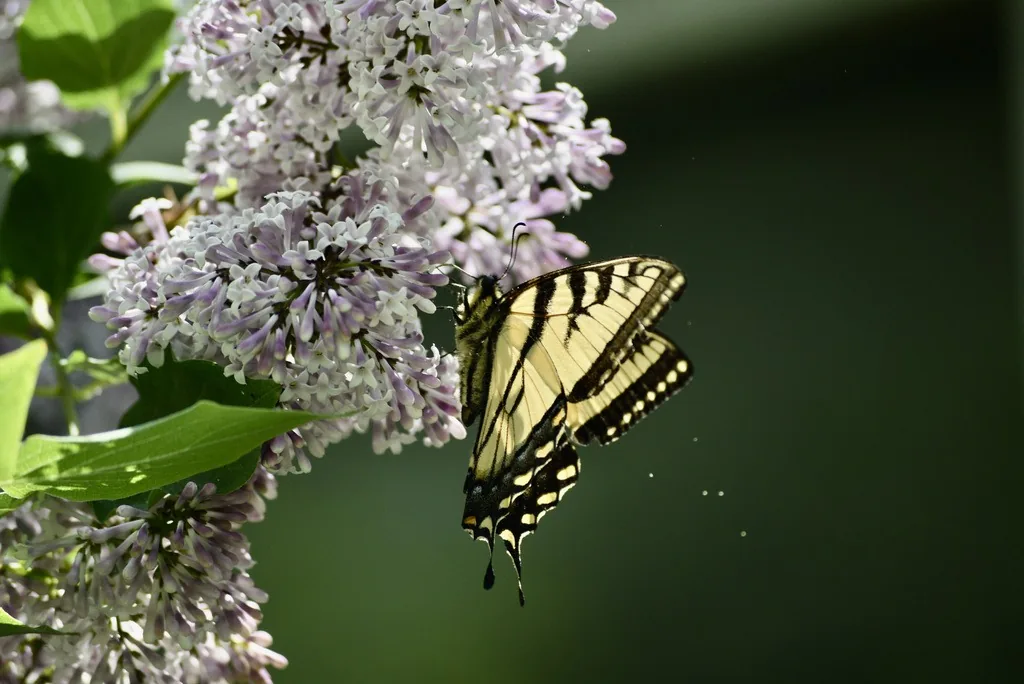
- Adults are yellow with four black bands on the forewings and black wing margins with yellow spots, spanning about 3 to 5 1/2 inches.[1]
- When disturbed, the caterpillar pushes out a forked, orange-red scent gland (osmeterium) that gives off a bad smell.[2]
Where it lives
A widespread eastern butterfly; MU Extension reports caterpillars from May to October.[1][2]
Biology and life cycle
There are two to three generations a year in Missouri and two flights in the North, with three or possibly four in Florida.[1][2]
Damage and signs
Health risk
None; the caterpillar's scent gland only releases an unpleasant odor.[2]
Control
Prevention
Common questions
- What is the green caterpillar with big eyes on my cherry tree?
- Possibly an eastern tiger swallowtail caterpillar; the eyes are false eyespots.[1][2]
- What is the orange forked thing it pushes out?
- An osmeterium, a scent gland that releases a bad smell to deter predators.[2]
- Is it a pest?
- No; it feeds on tree leaves without real harm.[2]
Sources
- University of Florida IFAS Extension (EDIS, Featured Creatures), “Tiger Swallowtail, Eastern Tiger Swallowtail, Papilio glaucus (EENY-061/IN218).” ask.ifas.ufl.edu/publication/IN218 (accessed 2026-10-15)
- University of Missouri Extension (Caterpillars in Your Yard and Garden, IPM1019), “Caterpillars in Your Yard and Garden, page 44: Tiger swallowtail.” extension.missouri.edu/publications/ipm1019-44 (accessed 2026-10-15)
- iNaturalist, “Papilio glaucus taxon page (order and family).” www.inaturalist.org/taxa/1613196 (accessed 2026-10-06)