On this page
How to identify it
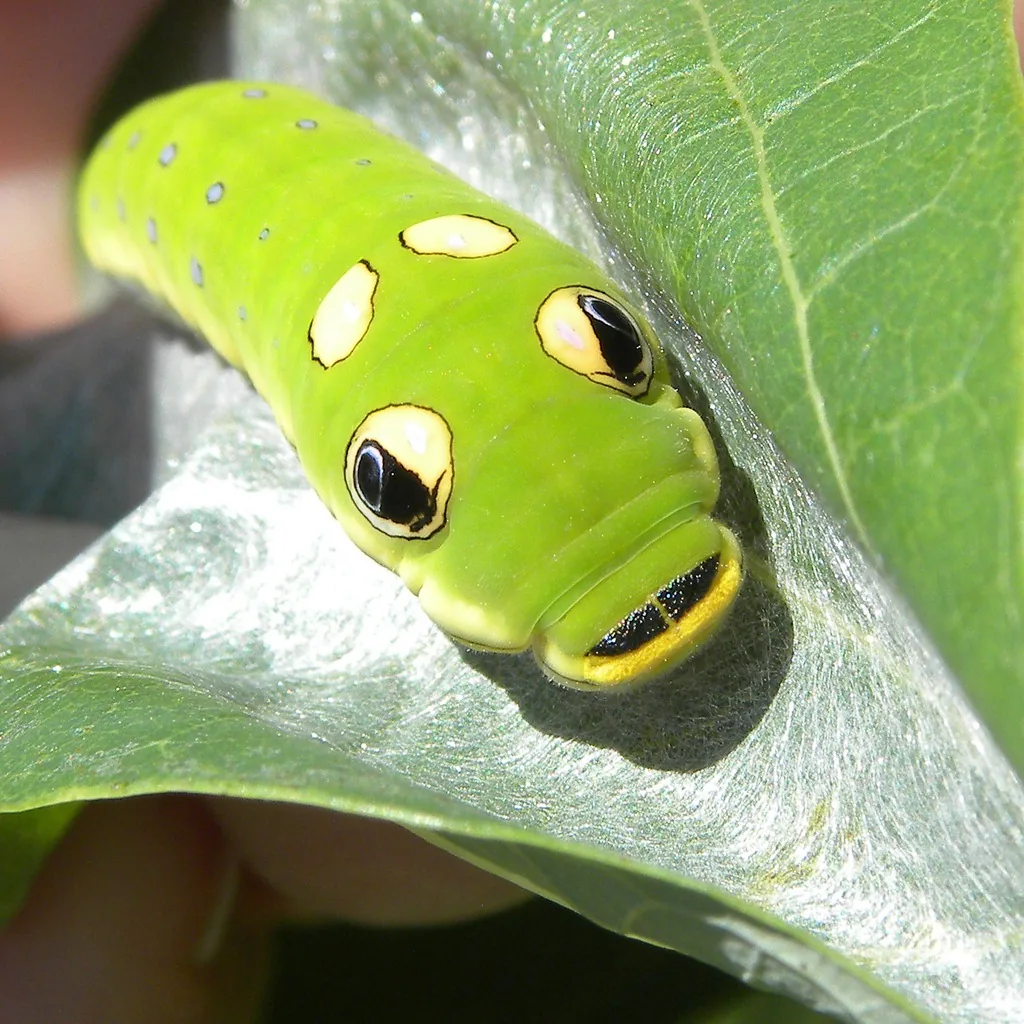
- Older caterpillars are green with small blue spots and two pairs of large false eyespots; young caterpillars look like bird droppings.[1]
- Caterpillars hide in a leaf folded over with silk when not feeding.[1][2]
- The butterfly is black with tails on the hind wings, rows of pale spots along the edges and a blue to blue-green area on each hind wing; wingspan about 3.8 to 4.8 inches.[1][2]
Where it lives
Found throughout the eastern United States from southern Canada to southern Florida and west to Texas, less common west of the Mississippi River.[2]
Biology and life cycle
Eggs are laid singly under leaves; the chrysalis is green or brown (always brown in winter) and hangs from a twig by a silk band.[1][2]
Several generations occur each year.[1]
Damage and signs
Health risk
NC State calls the caterpillars harmless despite their eyespots.[1]
Control
Prevention
No control is needed; NC State advises against spraying.[1]
Common questions
Sources
- NC State Extension, “Spicebush Swallowtail (PDIC Factsheet).” content.ces.ncsu.edu/spicebush-swallowtail (accessed 2026-10-15)
- University of Florida IFAS Extension (EDIS, Featured Creatures), “Spicebush Swallowtail, Papilio troilus (EENY-636/IN1107).” ask.ifas.ufl.edu/publication/IN1107 (accessed 2026-10-15)
- iNaturalist, “Papilio troilus taxon page (order and family).” www.inaturalist.org/taxa/58525 (accessed 2026-10-06)