On this page
How to identify it
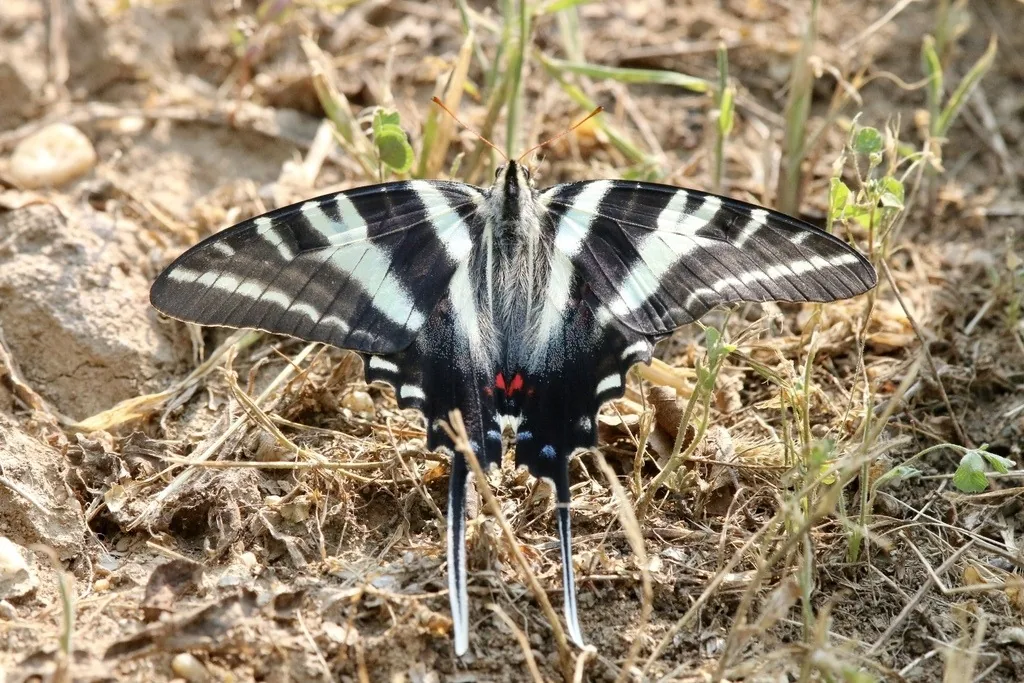
- Adults are white with black stripes, very long hind-wing tails and a red stripe on the underside, spanning about 2 1/2 to 4 inches; spring adults are paler, smaller and shorter-tailed.[1]
- Caterpillars look hump-backed, ringed with yellow-white and green lines and a thick black ring behind the thorax.[2]
Where it lives
Found in the eastern United States where pawpaw grows; MU Extension reports caterpillars from May to November.[1][2]
Biology and life cycle
There are two to three generations a year in Missouri and many flights in Florida from March to December.[1][2]
Females lay eggs singly near the tips of young pawpaw leaves, which the caterpillars prefer.[1]
Damage and signs
Health risk
Control
Prevention
Common questions
Sources
- University of Florida IFAS Extension (EDIS, Featured Creatures), “Zebra Swallowtail, Protographium marcellus (EENY-058/IN215).” ask.ifas.ufl.edu/publication/IN215 (accessed 2026-10-15)
- University of Missouri Extension (Caterpillars in Your Yard and Garden, IPM1019), “Caterpillars in Your Yard and Garden, page 56: Zebra swallowtail.” extension.missouri.edu/publications/ipm1019-56 (accessed 2026-10-15)
- iNaturalist, “Eurytides marcellus taxon page (order and family).” www.inaturalist.org/taxa/83086 (accessed 2026-10-06)