PestControlBasics
Menu

Pipevine Swallowtail

Battus philenor[3]

The pipevine swallowtail is a black swallowtail with iridescent blue hind wings; its purplish caterpillars with orange spots and fleshy filaments feed on Dutchman's pipe (Aristolochia) and are toxic to birds, a protection the butterfly keeps.[1][2]

Group
Insect
Order
Lepidoptera
Family
Papilionidae
US records
29 states
Sources
3 cited
Updated
2026-10-15
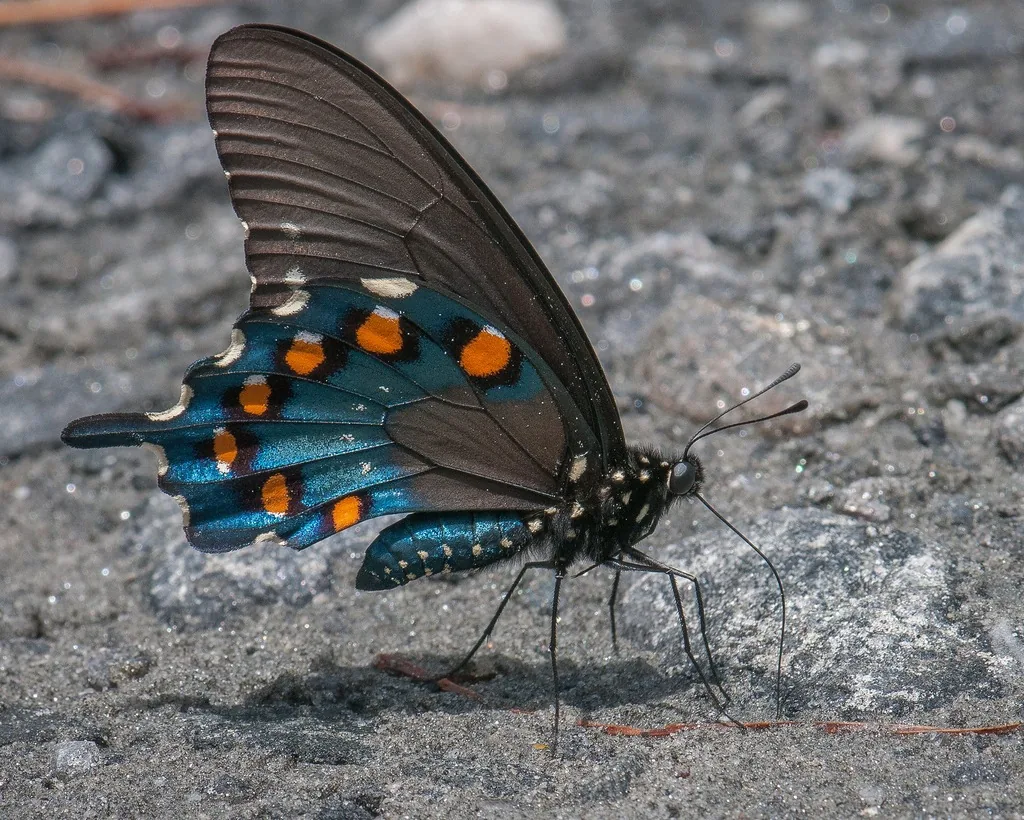
Pipevine swallowtail showing orange spots on the blue iridescent hindwing underside
Pipevine swallowtail showing orange spots on the blue iridescent hindwing underside. (c) Arlo Sitimans, some rights reserved (CC BY) — via iNaturalist, CC BY 4.0
On this page
  1. Identification
  2. Look-alikes
  3. Where it lives
  4. Biology
  5. Damage and signs
  6. Health risk
  7. Control
  8. Related profiles
  9. Common questions
  10. Sources

How to identify it

  • Adults span about 2 3/4 to 5 inches: black with blue or blue-green iridescence on the hind wings (duller in females), tails, and bright orange spots on the hind-wing underside.[1][2]
  • Caterpillars are purple to dark with orange spots and long fleshy filaments.[2]

Look-alikes

Look-alikeHow to tell them apart
MimicsBlack swallowtails, spicebush swallowtails and red-spotted purples look so similar that most birds can't tell them apart.[2]

Where it lives

Found from southern Connecticut south to central Florida and west to Arizona, with an isolated population in northern California.[1]

US map: public records from 29 states since 1990 (GBIF).

Biology and life cycle

Caterpillars take toxins from Dutchman's pipe, and birds that try one avoid others.[2]

Damage and signs

  • Caterpillars feed on Aristolochia (Dutchman's pipe, pipevine) species, often planted as ornamentals; feeding is not a garden concern.[1][2]

Health risk

None to people; the toxins only deter predators that eat it.[2]

Control

Prevention

No control is needed.[1][2]

Common questions

What is the black butterfly with blue wings and orange spots underneath?
Possibly a pipevine swallowtail.[1][2]
What eats Dutchman's pipe in my garden?
Pipevine swallowtail caterpillars, purple with orange spots.[1][2]
Why do other butterflies look like it?
It's toxic to birds, so several species mimic it.[2]

Sources

  1. University of Florida IFAS Extension (EDIS, Featured Creatures), “Pipevine Swallowtail, Battus philenor (EENY-677/IN1170).” ask.ifas.ufl.edu/publication/IN1170 (accessed 2026-10-15)
  2. Mississippi State University Extension (Bug's Eye View), “Pipevine Swallowtail Caterpillar, Vol. 3, No. 17.” extension.msstate.edu/newsletters/bugs-eye-view/2017/pipevine-swallowtail-caterpillar-vol-3-no-17 (accessed 2026-10-15)
  3. iNaturalist, “Battus philenor taxon page (order and family).” www.inaturalist.org/taxa/49972 (accessed 2026-10-06)

Updated 2026-10-15. Built from sourced records. Spot an error? Tell us.