The short answer
- Check the undersides of leaves and the center of each plant every few days for eggs, small green caterpillars and droppings, and pick off or crush what you find.[12][11][1][4]
- Cover young plants with fine-mesh row cover right after planting, edges sealed, so the butterflies and moths can't lay eggs on them.[11][1][2][15]
- If caterpillars keep turning up, spray Bacillus thuringiensis (Bt) or spinosad while the caterpillars are still small, covering the undersides of leaves. Bt only kills caterpillars that eat it.[1][2][11][10][14]
- Skip broad-spectrum insecticides when you can: parasitic wasps, flies and diseases kill many cabbage caterpillars, and wiping them out can make diamondback moth worse.[4][5][6][12]
- Clear crop leftovers after harvest and control mustard-family weeds, which carry these pests between crops.[12][11][10][4]
Cabbage caterpillar profiles
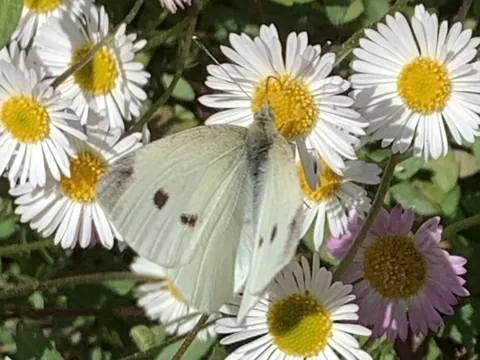 Imported Cabbageworm
Pieris rapae
The imported cabbageworm is the caterpillar of the familiar small white butterfly, the cabbage white. It chews ragged holes in cabbage, broccoli, cauliflower, kale and other cole crops, and it bores into heads as it grows.
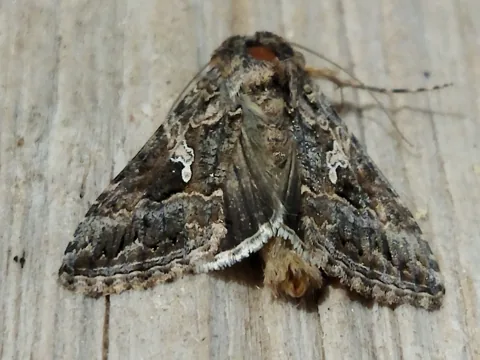 Cabbage Looper
Trichoplusia ni
The cabbage looper is the caterpillar of a gray-brown moth that flies mainly at night. It chews ragged holes in cabbage-family crops and many other vegetables and flowers, and it crawls by looping its body like an inchworm.
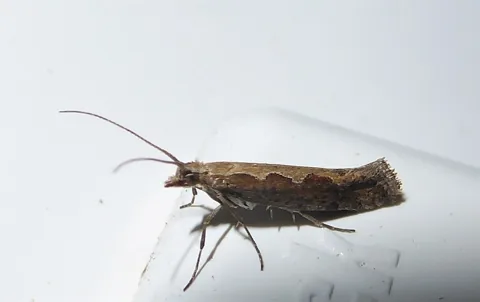 Diamondback Moth
Plutella xylostella
The diamondback moth is a small moth whose caterpillars feed on cabbage, broccoli, kale and other cole crops. Natural enemies often keep it in check in California, but it has developed resistance to many insecticides.
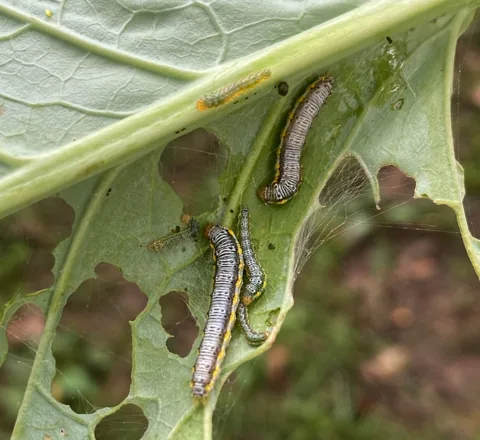 Cross-Striped Cabbageworm
Evergestis rimosalis
The cross-striped cabbageworm is a moth caterpillar that feeds on cabbage, collards, broccoli and other brassicas. Because the moths lay their eggs in clusters, one plant can carry many caterpillars that riddle the leaves and bore into the heads while the plant next to it is left alone.
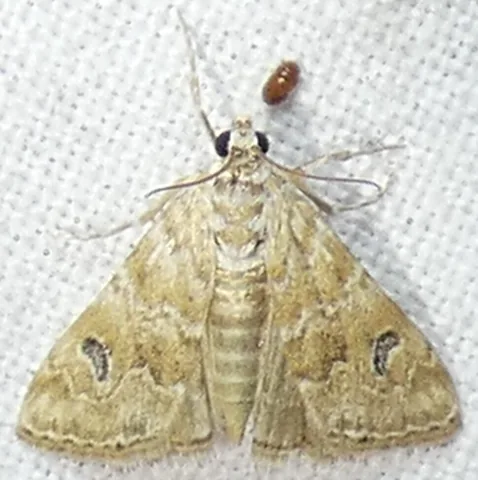 Cabbage Webworm
Hellula rogatalis
Cabbage webworms can bore into the bud of cabbage and broccoli, killing it and preventing a marketable head.
Which caterpillar is it?
The three main pests often show up together, and the same treatments work on all of them, but telling them apart helps you judge how much damage to expect and whether a spray is working. Clemson Extension estimates that one cabbage looper does about as much damage as 5 diamondback moth caterpillars, and an imported cabbageworm about two-thirds as much as a looper.[7][12]
- Imported cabbageworm: velvety green with very fine hairs, up to about 1 inch long, often with a faint yellow stripe down the back. It moves slowly and blends in with the leaf. The adult is the white butterfly seen flying over gardens on warm summer days, with black spots on the forewings (Wisconsin Extension notes females have two per wing, males one).[1][4][11][7]
- Cabbage looper: smooth, light green with thin white lines along the back and sides, and the largest of the three. Sources give 1.25 to 1.5 inches (Clemson), 1.5 inches (UC IPM, Utah State) or 1.5 to 2 inches (UMass). It has only two pairs of fleshy legs in the middle of the body, so it arches its back like an inchworm when it crawls. The adult is a mottled gray-brown moth with a silvery figure-8 mark on each front wing.[5][12][10][7][8]
- Diamondback moth: a small, pale green caterpillar, pointed at both ends, with the two rear legs forming a V. UC IPM gives a mature length of about 0.3 inch; UMass and Clemson say up to 1/2 inch. When disturbed it wriggles hard or drops off the leaf on a silk thread. The adult is a light brown moth under 1/2 inch with a yellow diamond-shaped marking, resting with its wings folded like a tent.[3][6][9][12]
- Others on the same crops: the cross-striped cabbageworm (black and white bands across the back, eggs laid in groups) and the cabbage webworm (lengthwise stripes, spins webs in the tender new growth). See their profiles below.[12]
Reading the damage
Damage is often easier to spot than the caterpillars themselves, so use the holes and droppings to find where to look.[7][11]
- Large, ragged holes in leaves, heads bored into, and green to greenish-brown droppings (frass) on the leaves and in the head point to imported cabbageworm or cabbage looper. Imported cabbageworm favors the center of the plant and the forming head as it grows.[1][2][7][11][10]
- Small holes, or "windowpanes" where the caterpillar ate the underside but left a clear film of the upper leaf surface, are typical of diamondback moth. Its feeding is spread across the foliage rather than packed into the head.[9][12][6]
- Chewed growing points on young plants can stunt them; diamondback moth damage there is the most serious kind, UC IPM says.[3][6]
- Hatching and timing: imported cabbageworm eggs hatch in 4 to 10 days depending on temperature (Lincoln University) or within a week (Wisconsin), and its larvae feed for about 2 to 3 weeks. Diamondback moth caterpillars mature in about 10 to 14 days, so their numbers can build fast.[13][11][1][3][12]
Step 1: Check your plants
Clemson Extension advises scouting every few days so caterpillars can be removed soon after they hatch; Wisconsin Extension suggests looking at least weekly through the season, even before you see damage. A magnifying glass helps, because newly hatched larvae are tiny.[12][11][13]
- Turn leaves over. All three lay eggs one at a time, often on leaf undersides (imported cabbageworm also lays on top of leaves): imported cabbageworm eggs are pale yellow to orange and stand on end like a tiny football, looper eggs are dome-shaped with fine ridges, and diamondback eggs are minute and very hard to see.[1][2][3][4][7]
- When you see white butterflies fluttering over the garden, check a few days later for eggs and small caterpillars on the undersides of leaves.[4]
- Look in the center of the plant and along the leaf midribs for larger caterpillars, and open chewed heads if you find holes.[4][5]
- Pay close attention to seedlings and to cabbage and broccoli as they start forming heads. Leafy crops like kale and collards need checking from the start, since every leaf is eaten.[4][7]
- Timing differs by pest. In New England, cabbage loopers don't overwinter and usually arrive on migrating moths in late July or August; diamondback moth also blows in from the south each year. In northern Utah most looper pupae can't survive winter either.[8][9][10]
- Count caterpillars rather than judging by damage alone; Wisconsin Extension notes larval counts are a better measure of how bad an infestation is.[11][13]
Step 2: Pick them off
In a home garden, handpicking is a real control, not just a stopgap. UC IPM lists it first for imported cabbageworm and loopers, and Clemson calls it effective in small plantings as long as you scout often.[1][2][12]
- Pick caterpillars off and squash them, or knock them into a container of soapy water.[11]
- Crush the tiny, pale eggs you find on leaves at the same time.[11]
- Look carefully: imported cabbageworms blend into green foliage, and diamondback caterpillars drop on a silk thread when the leaf is touched.[11][9][12]
- Leave cocoons and pupae alone if they look parasitized (see natural enemies below). Pupae no longer feed, so destroying them does nothing to protect this crop.[12][3]
Step 3: Keep the egg-layers off with row covers
Lightweight row cover fabric or fine mesh netting laid over the plants stops the butterflies and moths from reaching them to lay eggs. Wisconsin Extension calls this most effective in home gardens and other small plantings, and UC IPM lists it for all three pests.[11][1][2][12]
A row cover only works if no insects are trapped under it. Kentucky Extension warns that pests that do get in can develop and reproduce there without natural enemies, so the job is to make a tight seal and keep checking.[15]
- Put it on as soon as you seed or transplant.[15][16]
- Bury the edges completely, or hold them down with boards, poles or water-filled hose; Kentucky stresses the cover must be sealed along every edge. Tape any holes.[16][15]
- Leave enough slack for the plants to grow.[16]
- Lift it now and then to pull weeds and look for caterpillars that got in; wind can work the edges loose.[16][15]
- Start with clean plants. Seedlings grown indoors are low-risk, but check transplants from elsewhere for eggs and caterpillars before covering them.[11]
- Rotate where you grow cabbage-family crops. Some pests overwinter in the soil, and Wisconsin Extension warns that using row covers without crop rotation can keep them right next to the crop.[16][6]
Step 4: Spray Bt or spinosad when needed
Bacillus thuringiensis (Bt) is a soil bacterium sold as a spray. UC IPM rates Bt and spinosad as very effective on imported cabbageworm and diamondback moth and effective on loopers, especially when the caterpillars are small; Utah State says the same for loopers. Wisconsin Extension singles out Bt kurstaki as particularly useful for small imported cabbageworms in home gardens.[1][3][2][10][11]
NPIC explains how Bt works: a caterpillar has to eat it, the toxin is activated only in the high-pH (pH 9.0 to 10.5) gut of an insect larva, and the larva dies within 1 to 5 days. Young larvae are the most affected. UC IPM notes Bt is caterpillar-specific, so it spares the natural enemies that control these pests.[14][5]
- Spray when you find eggs and small caterpillars, not big ones. Wisconsin Extension and UC IPM both say to target early (small) stages.[11][5]
- Cover the plant well, including the undersides of leaves where the caterpillars feed.[11][7]
- Expect it to fade: NPIC reports that sunlight breaks down Bt spores quickly, with over 80% unable to grow after one hour of sun in one study.[14]
- Don't spray pupae or the adult butterflies and moths. Clemson notes that only actively feeding larvae should be targeted, since pupae and adults don't damage the plant.[12]
- Use a product labeled for the crop and pest, and follow the label's waiting period before harvest.[10][12]
- Other sprays: Wisconsin Extension lists insecticidal soaps, horticultural oils such as neem oil and pyrethrins as organic options, and pyrethroids and carbaryl as conventional ones. Broad-spectrum products also kill the beneficial insects, so Clemson calls chemical control a last resort.[11][12][4]
Let natural enemies help
Cabbage caterpillars have many natural enemies, and extension services agree they often keep numbers down. UC IPM says natural enemies generally keep cabbage loopers below damaging levels until heading unless broad-spectrum sprays disrupt them, and that killing natural enemies can sometimes increase diamondback moth.[5][6][11][12]
In Massachusetts, a small wasp brought from China in 1988 to attack imported cabbageworm, Cotesia rubecula, has become well established. Surveys in 2007 and 2009 found parasitized caterpillars at 100% of the sites sampled, with an average of 75% parasitism.[7]
- Parasitic wasps and flies: UC IPM names egg parasites (Trichogramma), larval parasites and tachinid flies for cabbageworm and loopers, and Diadegma insularis for diamondback moth. Diadegma pupates inside the diamondback cocoon; you can recognize a parasitized pupa by a broad stripe around it.[4][5][3]
- Disease: a natural virus sometimes wipes out loopers, turning infected caterpillars into dark, liquid-filled sacks hanging from the leaves. UC IPM notes virus can also control cabbageworms.[5][1]
- If you find many parasitized or diseased caterpillars, UC IPM suggests waiting a few days before treating and checking again.[5]
- Clemson suggests planting small flowers around the garden, such as sweet alyssum, parsley, dill, cilantro, buckwheat and fennel, to attract parasitic flies and wasps.[12]
- Spiders and other general predators also eat these caterpillars.[12][2]
Clean up between crops
Imported cabbageworm overwinters as a pupa on plant debris, and loopers and diamondback moth can move from old plantings to new ones, so cleanup cuts down next season's start.[11][13][8][9]
- Remove or till in crop leftovers right after harvest.[12][8][9][10]
- Control mustard-family weeds, which host these caterpillars; UC IPM suggests destroying culls and mustard-type weeds several weeks before planting.[4][3][12][10]
- Do a fall cleanup, or turn the soil in spring.[11]
- Commercial guidance from UC IPM also suggests planting cabbage-family crops at the same time rather than in staggered blocks side by side, so diamondback moth can't keep moving to younger plants.[6]
How much damage is too much?
Young cole crops can lose a fair amount of leaf without hurting the harvest. UC IPM says plants between thinning or transplanting and heading tolerate considerable leaf damage, while once heads form even a few caterpillars can ruin them. UC IPM also says older plants are not usually badly damaged by diamondback moth.[4][5][3]
Farm thresholds give a sense of scale, though sources set them differently. From heading to harvest, UC IPM treats when more than 10% of sampled plants carry a caterpillar; UMass treats at 20% or more, and uses 10 to 15% for kale, collards and mustard all season. Wisconsin uses 10% from early heading to harvest.[4][8][9][11]
Why diamondback moth can be hard to kill
Diamondback moth has developed resistance to many insecticides, including microbial ones. It was the first insect reported with resistance to Bt in the field.[9][6][17]
- Switch between products that work in different ways rather than spraying the same one again and again. UC IPM advises not applying more than two insecticides with the same mode of action within a 10- to 14-day period.[9][6]
- UMass says the aizawai strain of Bt and newer materials usually give better control of resistant diamondback moth than older products.[9]
- UMass also suggests buying locally grown transplants, so you don't bring in diamondback moths that are already resistant.[9]
Common questions
- What kills cabbage worms naturally?
- Handpicking, row covers to stop egg-laying, and sprays of Bacillus thuringiensis (Bt) or spinosad on small caterpillars. Parasitic wasps, flies and a natural virus also kill many of them.[1][2][11][5]
- Does Bt harm beneficial insects?
- Bt has to be eaten and acts only in a caterpillar's high-pH gut, and UC IPM says it spares natural enemies. It will kill butterfly caterpillars that eat treated leaves, so spray only the crop that needs it.[14][5]
- Why do I still have holes after spraying Bt?
- Bt works best on small caterpillars that eat sprayed leaves, takes 1 to 5 days to kill, and breaks down in sunlight. Diamondback moth may also be resistant.[14][11][9]
- Do row covers really keep cabbage worms off?
- Yes, if they go on at planting and every edge is sealed. They stop the butterflies and moths from laying eggs. Check under them now and then, since any caterpillars that get in are protected from their enemies.[11][15][16]
- What are the white butterflies over my cabbage?
- Most likely cabbage white butterflies, the adults of the imported cabbageworm. A few days after you see them, look for eggs and small caterpillars under the leaves.[11][13][4]
Photo credits
- Imported Cabbageworm: (c) eebee, some rights reserved (CC BY) — via iNaturalist, CC BY 4.0
- Cabbage Looper: (c) SteveM4560, some rights reserved (CC BY) — via iNaturalist, CC BY 4.0
- Diamondback Moth: (c) Aalbert Rebergen, some rights reserved (CC BY) — via iNaturalist, CC BY 4.0
- Cross-Striped Cabbageworm: Dianne Kadonaga, public domain (CC0), via iNaturalist
- Cabbage Webworm: kcthetc1, public domain (CC0), via iNaturalist
Sources
- University of California Statewide IPM Program, “Imported Cabbageworm (Home and Landscape).” ipm.ucanr.edu/PMG/GARDEN/VEGES/PESTS/importcabwrm.html (accessed 2026-11-10)
- University of California Statewide IPM Program, “Loopers (Home and Landscape).” ipm.ucanr.edu/PMG/GARDEN/VEGES/PESTS/loopers.html (accessed 2026-11-10)
- University of California Statewide IPM Program, “Diamondback Moth (Home and Landscape).” ipm.ucanr.edu/PMG/GARDEN/VEGES/PESTS/diabackmth.html (accessed 2026-11-10)
- University of California Statewide IPM Program, “Imported Cabbageworm (Cole Crops Pest Management Guidelines).” ipm.ucanr.edu/agriculture/cole-crops/imported-cabbageworm/ (accessed 2026-11-10)
- University of California Statewide IPM Program, “Cabbage Looper (Cole Crops Pest Management Guidelines).” ipm.ucanr.edu/agriculture/cole-crops/cabbage-looper/ (accessed 2026-11-10)
- University of California Statewide IPM Program, “Diamondback Moth (Cole Crops Pest Management Guidelines).” ipm.ucanr.edu/agriculture/cole-crops/diamondback-moth/ (accessed 2026-11-10)
- UMass Amherst Center for Agriculture, Food, and the Environment, “Imported Cabbageworm.” www.umass.edu/agriculture-food-environment/vegetable/fact-sheets/imported-cabbageworm (accessed 2026-11-10)
- UMass Amherst Center for Agriculture, Food, and the Environment, “Cabbage Looper.” www.umass.edu/agriculture-food-environment/vegetable/fact-sheets/cabbage-looper (accessed 2026-11-10)
- UMass Amherst Center for Agriculture, Food, and the Environment, “Diamondback Moth.” www.umass.edu/agriculture-food-environment/vegetable/fact-sheets/diamondback-moth (accessed 2026-11-10)
- Utah State University Extension, Utah Plant Pest Diagnostic Lab, “Cabbage Looper.” extension.usu.edu/planthealth/ipm/notes_ag/veg-cabbage-looper (accessed 2026-11-10)
- University of Wisconsin-Madison Extension, Wisconsin Horticulture, “Imported Cabbageworm.” hort.extension.wisc.edu/articles/imported-cabbageworm/ (accessed 2026-11-10)
- Clemson Cooperative Extension, Home & Garden Information Center, “Cabbage, Broccoli & Other Cole Crop Insect Pests (HGIC 2203).” hgic.clemson.edu/factsheet/cabbage-broccoli-other-cole-crop-insect-pests/ (accessed 2026-11-10)
- Lincoln University Cooperative Extension, “Imported Cabbageworm: Lifecycle, Damage and Pest Management in Missouri.” www.lincolnu.edu/cooperative-extension-and-research/publication-files/imported-cabbageworm-lifecycle-damage-and-pest-management-in-missouri-2022-33-fs-a.pdf (accessed 2026-11-10)
- National Pesticide Information Center, “Bacillus thuringiensis (Bt) General Fact Sheet.” npic.orst.edu/factsheets/btgen.html (accessed 2026-11-10)
- University of Kentucky Entomology, “Row Covers for Insect Management (ENTFACT-322).” entomology.ca.uky.edu/files/ef322.pdf (accessed 2026-11-10)
- University of Wisconsin-Madison Extension, Wisconsin Horticulture, “Floating Row Cover.” hort.extension.wisc.edu/articles/floating-row-cover/ (accessed 2026-11-10)
- Current Opinion in Insect Science (PubMed 27436736), “Crickmore N. Bacillus thuringiensis resistance in Plutella - too many trees? Curr Opin Insect Sci 2016;15:84-88.” pubmed.ncbi.nlm.nih.gov/27436736/ (accessed 2026-11-10)