On this page
How to identify it
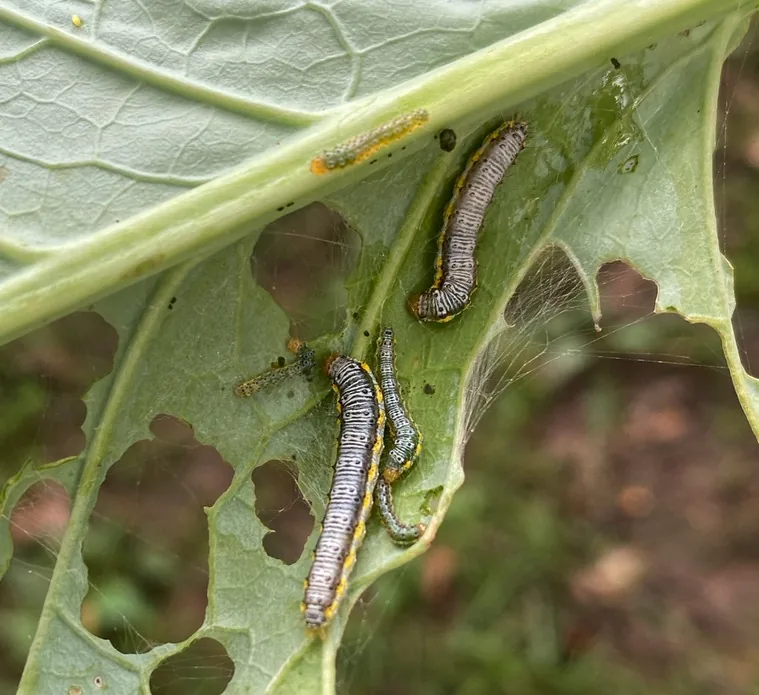
- Grown caterpillars are bluish gray with narrow black bands across the back and a yellow line along each side, and reach about 1 inch (25 mm) long.[1][2][3]
- Newly hatched caterpillars are gray and sparsely hairy and don't show the stripes yet.[2][3][1]
- The eggs are flat and yellow and are laid in overlapping clusters, like fish scales, on the undersides of leaves: 3 to 25 per batch according to UConn and Clemson, 20 to 30 according to the Arkansas Arthropod Museum.[2][3][4]
- Adults are moths with straw-colored forewings marked with purplish-brown bands and whitish, partly transparent hind wings with a dark band near the edge.[1]
Look-alikes
| Look-alike | How to tell them apart |
|---|---|
| Imported cabbageworm | Its eggs are laid singly rather than in clusters, and its feeding leaves round or ragged holes with deposits of wet green or brownish frass.[4] |
| Diamondback moth | Its small caterpillars wiggle vigorously when disturbed and may drop off the plant on a silk thread.[4] |
Where it lives
Common in the southeastern United States and Central America; the Arkansas Arthropod Museum lists it from southern New York, West Virginia, Illinois, Colorado and Washington south to Florida, Texas and Mexico, and UConn reports it has become a significant brassica pest in Connecticut.[1][2][4]
Biology and life cycle
Moths lay their egg clusters on the undersides of leaves; the eggs hatch in 2 to 10 days, and the caterpillars feed for 2 to 3 weeks before pupating in a small, sand-covered cocoon at or near the soil surface.[2][1]
Adults emerge 9 to 11 days later and live 1 to 3 weeks; a full life cycle takes about 60 days, with three to four generations a year in the Southeast.[2][1]
Damage and signs
- Young caterpillars feed on the undersides of leaves, making pinholes; older ones prefer the terminal buds and can burrow into developing heads, and heavy infestations can skeletonize plants.[2][1][4]
- Hosts include cabbage, broccoli, Brussels sprouts, collards, cauliflower, kale, turnips, rutabaga and bok choy; in field tests Brussels sprouts and collards were the most preferred and cabbage and kale the least.[2][1][3]
- Numbers are usually low, but in some years populations become dense and destructive.[2]
Health risk
It feeds only on plants; none of the sources reports any harm to people or pets.[2][1]
Control
Prevention
Check the tops and bottoms of leaves weekly for egg clusters, caterpillars and damage; UConn suggests treating when 5 percent of plants are infested.[4]
Biological control
Several parasitoids attack it, and UConn recommends selective insecticides that spare parasitic wasps.[1][4]
Pesticides
Foliar insecticides control it; choose a product that lists the crop and caterpillar pests on its label and follow the label.[1][4]
Common questions
- What are the striped caterpillars eating my collards?
- Bluish-gray caterpillars with black cross-bands and a yellow side stripe, often many on one plant, are cross-striped cabbageworms.[1][2][3]
- Why are there so many caterpillars on one cabbage plant?
- Cross-striped cabbageworm moths lay their eggs in clusters rather than singly, so one plant can end up with many caterpillars.[2][4]
Sources
- University of Florida IFAS, Department of Entomology and Nematology, “Cross-striped Cabbageworm, Evergestis rimosalis (Vegetable Pests III image gallery).” entnemdept.ufl.edu/projex/gallery/dl/Vegetable_Pests_III/text/cross-striped_cabbageworm.htm (accessed 2026-10-17)
- University of Arkansas Arthropod Museum, “Cross-striped cabbageworm (Arthropod Museum).” arthropod.uark.edu/cross-striped-cabbageworm/ (accessed 2026-10-17)
- Clemson Cooperative Extension, Home & Garden Information Center, “Cabbage, Broccoli & Other Cole Crop Insect Pests (HGIC factsheet).” hgic.clemson.edu/factsheet/cabbage-broccoli-other-cole-crop-insect-pests/ (accessed 2026-10-17)
- UConn Integrated Pest Management Program, “Vegetable Pest Alert: July 11th, 2025.” ipm.cahnr.uconn.edu/vegetable-pest-alert-july-11-2025 (accessed 2026-10-17)
- iNaturalist, “Evergestis rimosalis taxon page (order and family).” www.inaturalist.org/taxa/359686 (accessed 2026-10-06)