On this page
How to identify it
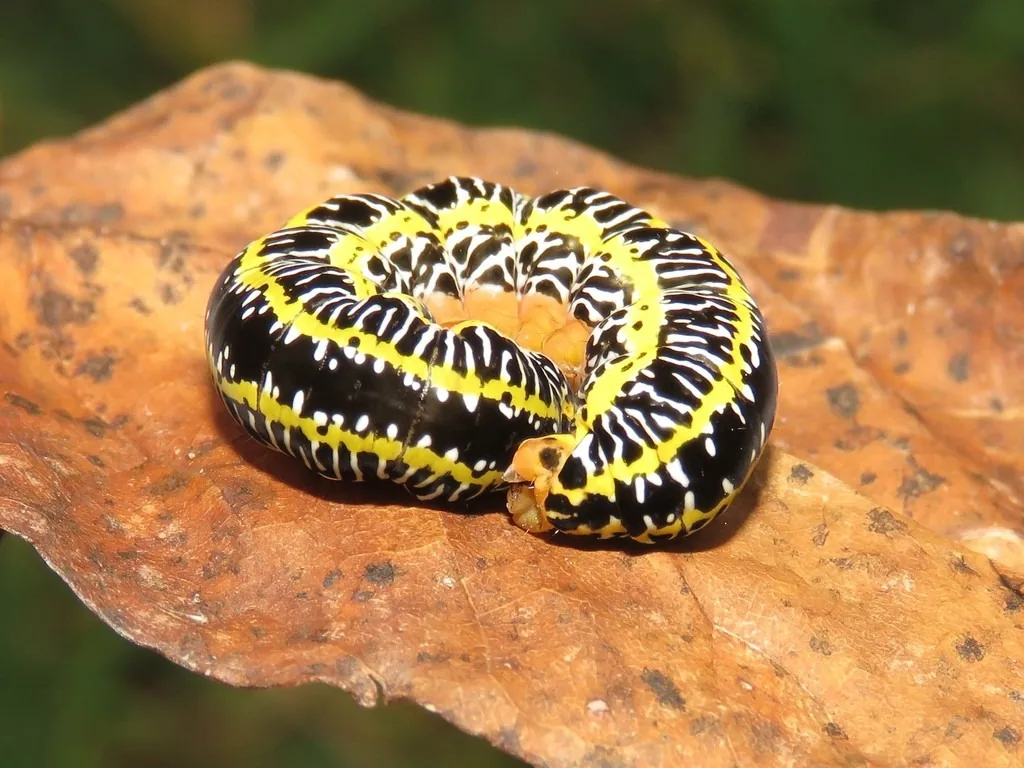
- Grown caterpillars have bold black and cream-to-bright-yellow stripes running the length of the body, a reddish-brown to orange head and brown to orange legs.[1][4]
- They reach about 1 1/2 inches long (35 to 40 mm).[2][3][4]
- Newly hatched caterpillars are whitish with black spots.[1]
- The adult moth is chestnut or reddish brown with whitish hind wings edged in light brown and a light gray abdomen, with a wingspan of 35 to 40 mm.[1][4]
Look-alikes
| Look-alike | How to tell them apart |
|---|---|
| Cutworms and armyworms | Oregon State notes that variegated cutworms and other leaf-feeding cutworms and armyworms often occur at the same time as zebra caterpillars.[4] |
Where it lives
Reported by extension services from Utah and Oregon to Minnesota and Ohio; Minnesota sees it in early summer and again in late summer, and Ohio State calls it a fairly common pest of cole crops.[1][4][2][3]
Biology and life cycle
There are two to three generations a season, starting in May and again in midsummer; adults lay masses of up to 100 eggs on the foliage.[1][2]
Young caterpillars feed in groups, then disperse over the plant or to other plants; mature caterpillars drop and pupate in the soil, where the insect overwinters.[1][4]
Damage and signs
- Young caterpillars skeletonize the foliage, and larger ones can defoliate plants, although Minnesota notes they are typically not an important problem in gardens.[1][2]
- Hosts include cabbage, broccoli, asparagus, spinach, potato and tomato, flowers such as aster and hydrangea, field-grown hemp and some trees; Ohio State has also seen them feeding heavily on roses.[2][1][3]
Health risk
It feeds only on plants; none of the sources reports any harm to people or pets.[1][2]
Control
Prevention
Scout from late spring to the end of the season, especially for groups of young caterpillars skeletonizing leaves.[1]
Pesticides
Treatment is rarely needed in home gardens; if caterpillars are numerous, use a product labeled for caterpillars on that crop and follow the label.[2][1]
Common questions
- What is the black-and-yellow striped caterpillar on my cabbage?
- A caterpillar up to about 1 1/2 inches long with bold black and yellow lengthwise stripes and a reddish-brown head is likely a zebra caterpillar.[2][1][4]
- Is the zebra caterpillar harmful?
- It can strip leaves, especially when young caterpillars feed in groups, but in home gardens it is usually not a serious problem.[1][2]
Sources
- Utah State University Extension, “Zebra Caterpillar (hemp pest IPM).” extension.usu.edu/planthealth/ipm/notes_ag/hemp-zebra-caterpillar (accessed 2026-10-17)
- University of Minnesota Extension (What insect is this?), “Zebra caterpillar (What insect is this?).” apps.extension.umn.edu/garden/diagnose/insect/garden/caterpillars/large/zebracaterpillar.html (accessed 2026-10-17)
- Ohio State University Extension (Buckeye Yard & Garden onLine), “Stripes of a Different Kind - The Zebra Caterpillar.” bygl.osu.edu/node/1704 (accessed 2026-10-17)
- Oregon State University, Integrated Plant Protection Center, “Zebra Caterpillar (IPM on Peppermint, IPMP3.0).” hopper.science.oregonstate.edu/mint/zebraid.htm (accessed 2026-10-17)
- iNaturalist, “Melanchra picta taxon page (order and family).” www.inaturalist.org/taxa/224556 (accessed 2026-10-06)