On this page
How to identify it
- Caterpillars are yellow-green to green with a yellow-brown to orange mottled head, a pale stripe down the middle of the back and six black spots on each abdominal segment, three on each side in a triangle, each with stiff hairs.[1][2][3]
- Missouri gives the full-grown length as 0.5 to 0.75 inch; the Crop Protection Network and the Northern Plains guide say about 1 inch.[1][2][3]
- Look for leaves tied together with silk webbing, with the caterpillars feeding inside the shelter.[2][1]
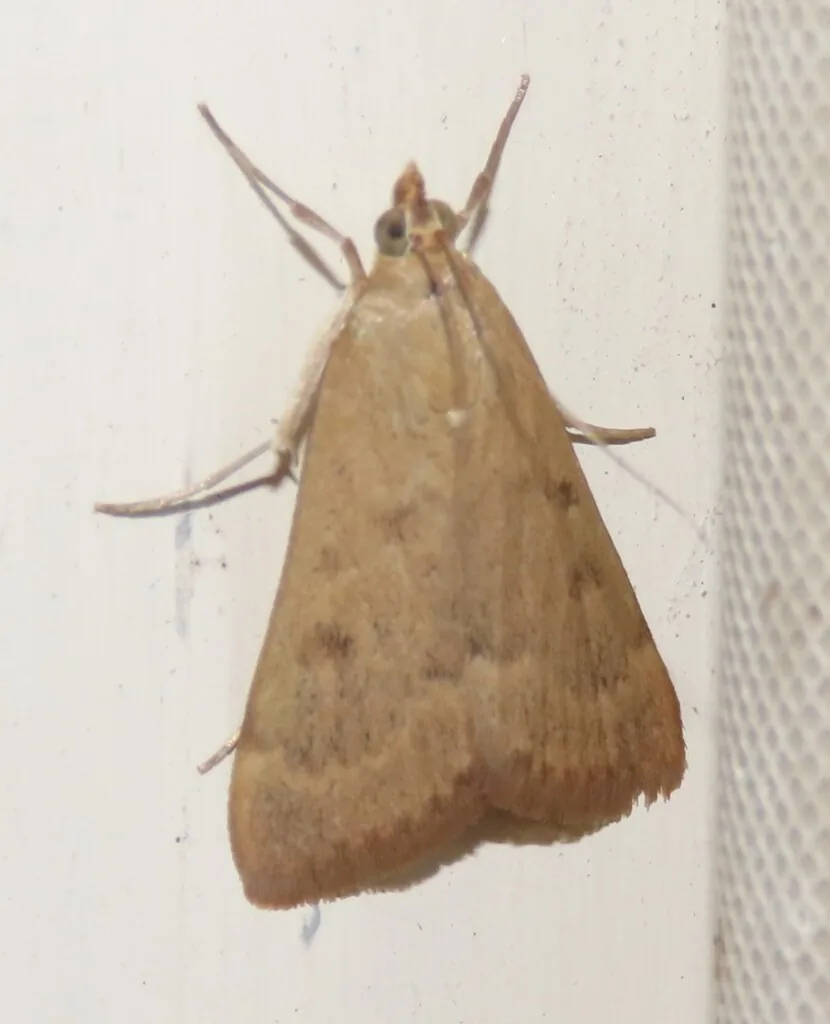
- The adult moth is yellowish brown with irregular grayish markings and a wingspan of about 3/4 inch.[3]
Look-alikes
Where it lives
Native to North America and found in gardens, field crops and weedy areas; in the Northern Plains it overwinters as pupae in the soil, while in warmer Gulf Coast states it may overwinter as caterpillars.[3][1]
Biology and life cycle
Adults emerge and mate in spring; the eggs hatch in 3 to 7 days, and the caterpillars feed on the undersides of leaves for about three weeks, spinning silk webbing, before they pupate.[3]
Caterpillars are present from late spring to fall, with two to three generations a year in Missouri.[1]
Damage and signs
Health risk
It feeds only on plants; none of the sources reports any harm to people or pets.[1][3]
Control
Prevention
Keep an eye on plantings next to weedy areas or recently cut alfalfa, where webworms are most likely to move in.[2][3]
Pesticides
The Crop Protection Network refers growers to their local extension specialist for current treatment recommendations; follow the label of any product used.[2]
Common questions
Sources
- University of Missouri Extension, “Caterpillars in Your Yard and Garden (IPM1019), page 18: garden webworm.” extension.missouri.edu/publications/ipm1019/18 (accessed 2026-10-17)
- Crop Protection Network (multi-state university extension collaboration), “Webworms in Soybean.” cropprotectionnetwork.org/encyclopedia/webworms-in-soybean (accessed 2026-10-17)
- Northern Plains IPM Guide (hosted on Bugwood wiki), “Webworms on soybean (Northern Plains Integrated Pest Management Guide; B. Hadi, J. Knodel, K. Ostlie, R. J. Whitworth, J. P. Michaud, P. E. Sloderbeck).” wiki.bugwood.org/NPIPM:Webworms_on_soybean (accessed 2026-10-17)
- iNaturalist, “Achyra rantalis taxon page (order and family).” www.inaturalist.org/taxa/204077 (accessed 2026-10-06)