On this page
How to identify it
- Caterpillars are smooth, hairless and plump, mottled brown-gray to gray-black on top, with a row of conspicuous yellow spots down the middle of the back and a dark W mark near the tail.[1][2][3]
- Below the dark breathing holes runs an orange-brown line, and the underside is light tan.[1]
- Full-grown caterpillars are 1.5 to 2 inches long, and they curl into a C when disturbed.[1][4][3]
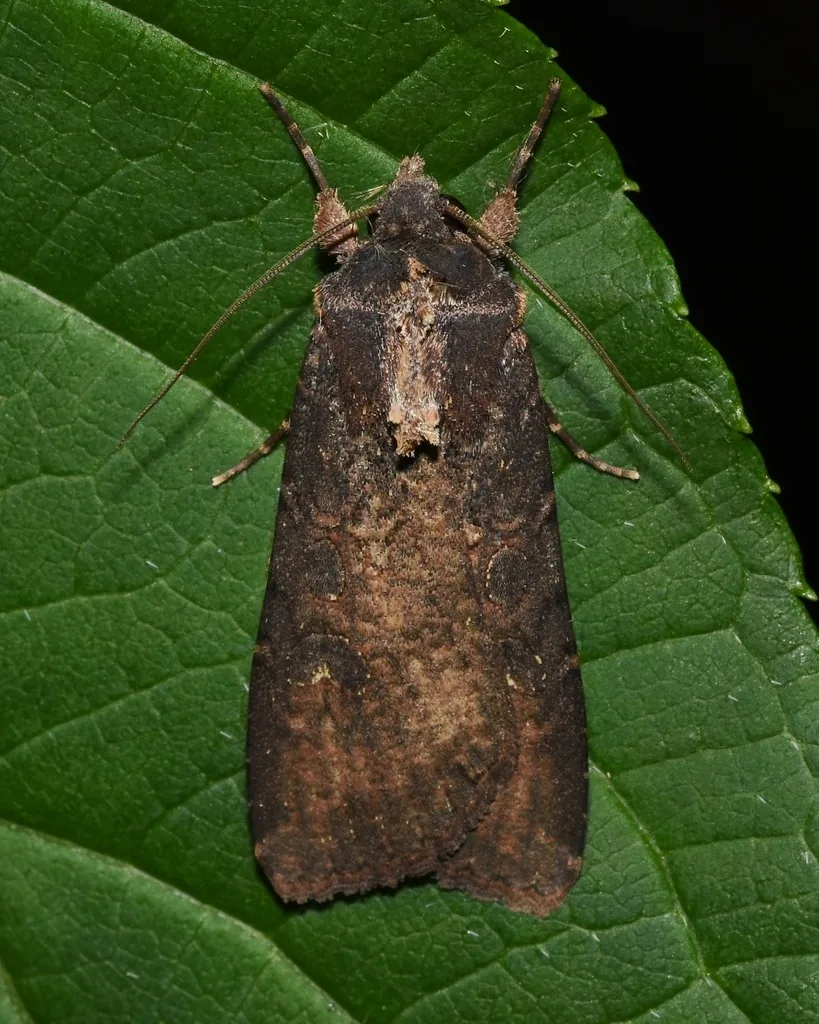
- The moth, called the pearly underwing, has brown forewings with lighter circle- and kidney-shaped spots and dull white hind wings.[3]
Look-alikes
| Look-alike | How to tell them apart |
|---|---|
| Other cutworms | Most cutworms cut stems at ground level; the variegated cutworm also climbs plants at night to feed on leaves, buds, flowers and fruit.[2][3] |
Where it lives
Found from alfalfa fields to home gardens, and reported by extension services from Utah to Minnesota, Iowa, Missouri and Massachusetts; some adults migrate north from southern areas each spring.[2][3][4][1][5]
Biology and life cycle
Moths appear in early spring and lay their eggs on plant stems and leaves.[2]
There are two to four overlapping generations a year, starting in early spring, July and late summer; mature caterpillars pupate in the soil.[1][3][2]
It overwinters as pupae in the soil or as caterpillars in protected spots, and possibly as adults.[3]
The caterpillars feed at night, so gardeners often see the damage without ever seeing the culprit.[2]
Damage and signs
- Seedlings are often cut off at, or just above or below, the soil line, with most garden damage in spring; on older plants, leaves, buds, flowers and fruit are chewed, including shallow or deep holes in fruit in mid to late summer.[4][2][5]
- Nearly all fruits, vegetables and ornamentals can be damaged, including asparagus, beans, carrots, celery, corn, cucumbers, lettuce, peas, peppers, potatoes, radishes, tomatoes, apple and cherry trees, and hostas.[2][4]
Health risk
It feeds only on plants; none of the sources reports any harm to people or pets.[2][1]
Control
Prevention
Spots with a history of cutworm damage tend to have it again, so check those first.[5]
Traps and physical control
In a home garden, rake around the base of damaged plants with your fingers to find the cutworms hiding in the soil, and remove them.[2]
Pesticides
For larger problems, treat the soil around damaged plants with a garden spray or dust labeled for cutworms; UMass suggests treating tomatoes when 1 percent of the plants are infested.[2][5]
Common questions
- What is eating holes in my hostas and tomatoes at night?
- Night feeding on leaves, buds and fruit with no caterpillar in sight by day is typical of variegated cutworms; dig gently around the base of damaged plants to find them.[2][5]
- Why is it called the climbing cutworm?
- Unlike most cutworms, which cut stems at ground level, it climbs plants at night to eat foliage, flowers, buds and fruit.[2][3]
Sources
- University of Missouri Extension, “Caterpillars in Your Yard and Garden (IPM1019), page 48: variegated cutworm.” extension.missouri.edu/publications/ipm1019/48 (accessed 2026-10-17)
- Iowa State University Extension and Outreach, “Cutworm, Variegated (Horticulture and Home Pest News).” hortnews.extension.iastate.edu/cutworm-variegated (accessed 2026-10-17)
- Utah State University Extension, “Variegated Cutworm (hemp pest IPM).” extension.usu.edu/planthealth/ipm/notes_ag/hemp-variegated-cutworm (accessed 2026-10-17)
- University of Minnesota Extension (What insect is this?), “Variegated cutworm (What insect is this?).” apps.extension.umn.edu/garden/diagnose/insect/garden/caterpillars/large/variegatedcutworm.html (accessed 2026-10-17)
- UMass Extension Vegetable Program, “Variegated Cutworm (Vegetable Program fact sheet).” www.umass.edu/agriculture-food-environment/vegetable/fact-sheets/variegated-cutworm (accessed 2026-10-17)
- iNaturalist, “Peridroma saucia taxon page (order and family).” www.inaturalist.org/taxa/179339 (accessed 2026-10-06)