The short answer
- Check the legs first. Sawfly larvae have six or more pairs of fleshy prolegs on the abdomen; moth and butterfly caterpillars have two to five pairs.[1][7][2]
- Skip Bt (Bacillus thuringiensis kurstaki). It only works on moth and butterfly caterpillars and does not kill sawfly larvae.[1][2][3][5]
- For a few groups, pick them off into soapy water, crush them, shake them onto the ground and step on them, knock them off with a strong spray of water, or prune out the infested twig.[1][2][8][6]
- If you need to spray, do it while the larvae are small, half their full size or less. Insecticidal soap, horticultural oil, neem oil and spinosad all work on young larvae when the spray hits them.[1][3][4][5]
- Because sawflies feed in groups, you can usually spot-treat the colonies instead of the whole plant. Once larvae are full grown, the damage is done and spraying isn't worth it.[1]
Sawfly profiles
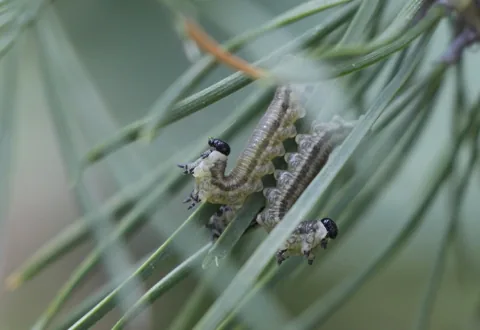 Pine Sawflies
Diprionidae (e.g., Neodiprion sertifer, the European pine sawfly)
Pine sawflies are wasp relatives whose caterpillar-like larvae feed in groups on pine needles. The European pine sawfly is the most common on pines in Pennsylvania, and several other species, such as the redheaded pine sawfly, attack pines too.
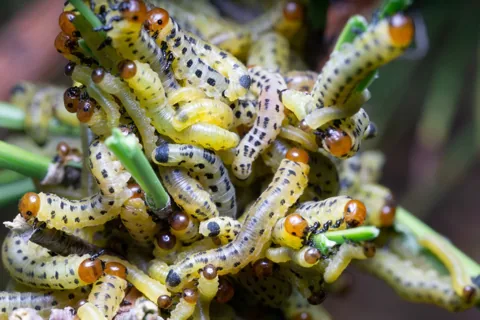 Redheaded Pine Sawfly
Neodiprion lecontei
The redheaded pine sawfly is a native sawfly whose larvae feed in groups on pine needles and can defoliate ornamental and forest pines and kill small trees.
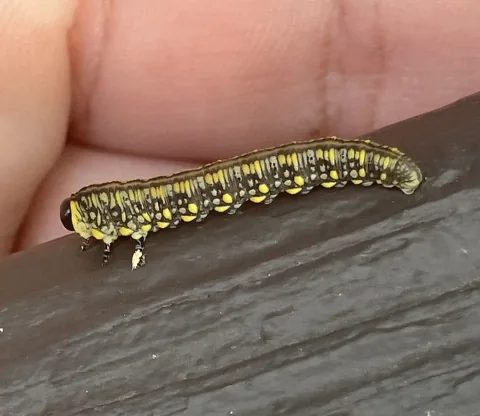 Introduced Pine Sawfly
Diprion similis
The introduced pine sawfly is a European sawfly whose larvae feed on pine needles, especially eastern white pine, often stripping the upper half of the tree.
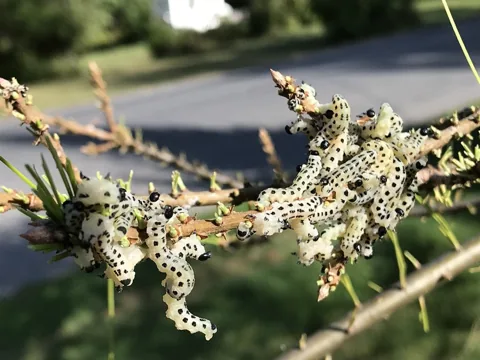 White Pine Sawfly
Neodiprion pinetum
The white pine sawfly is a sawfly whose pale yellow, black-spotted larvae feed in groups on eastern white pine and other pines in summer, eating both old and new needles.
 Rose Slugs (Rose Sawflies)
Cladius difformis (bristly roseslug; listed by iNaturalist as Cladius pectinicornis), Endelomyia aethiops and Allantus cinctus
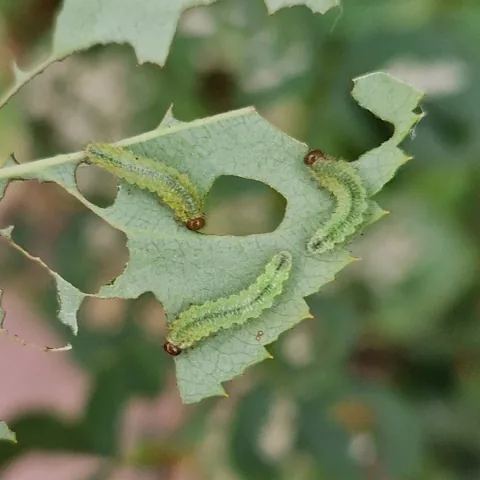
Rose slugs, or roseslugs, are the larvae of sawflies, wasp relatives that feed on rose leaves. The bristly roseslug causes the most trouble because it keeps producing new generations all season, while other rose sawflies feed mainly early on.
 Pear Slug
Caliroa cerasi (pear sawfly, cherry slug)
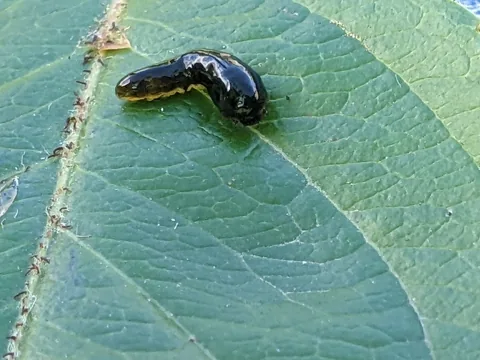
Pear slugs aren't slugs at all. They're sawfly larvae coated in olive-green slime that skeletonize cherry and pear leaves.
 Dogwood Sawfly
Macremphytus tarsatus
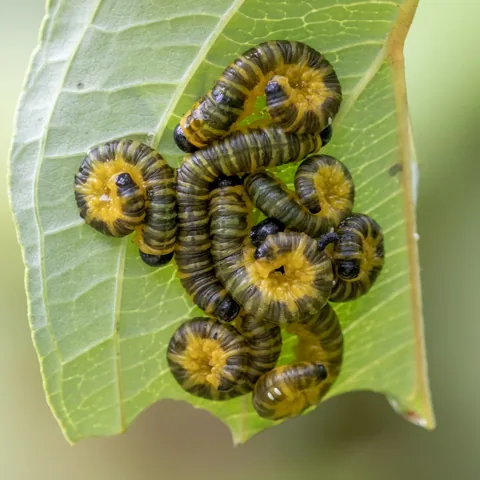
Dogwood sawfly larvae feed in groups on dogwood leaves and change looks as they grow, from white and waxy, like bird droppings, to cream with black spots and finally yellow and black; full-grown larvae may bore into soft wood to overwinter.
 Elm Sawfly
Cimbex americana (also spelled Cimbex americanus)
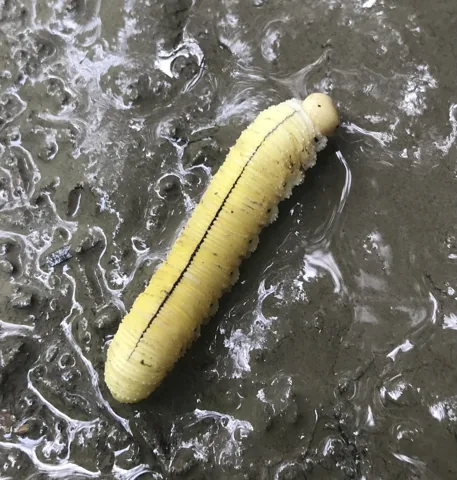
The elm sawfly is one of North America's largest sawflies: a metallic blue, non-stinging wasp relative whose large, wrinkly, yellowish-white larvae feed on elm and willow leaves.
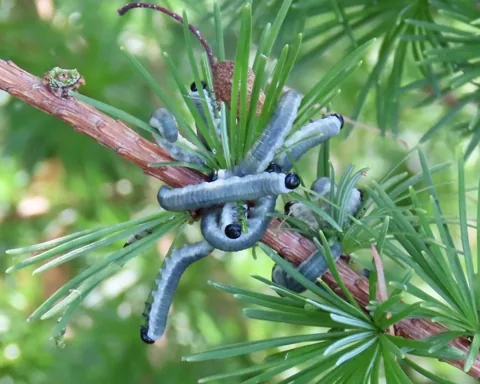 Larch Sawfly
Pristiphora erichsonii
The larch sawfly is a sawfly whose larvae feed in groups on the needles of tamarack and other larches.
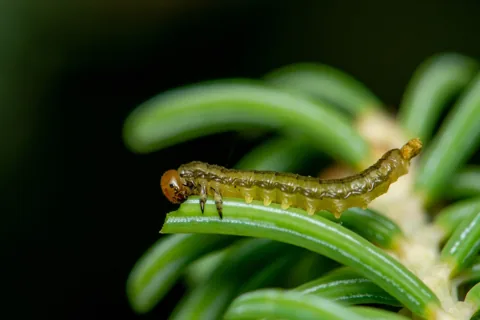 Yellowheaded Spruce Sawfly
Euura alaskensis (formerly Pikonema alaskensis)
The yellowheaded spruce sawfly is a native sawfly whose larvae defoliate spruce, especially open-grown yard trees, windbreaks and young plantations. Three or four years of heavy feeding in a row can kill a tree.
No photo yet
Azalea Sawfly
Euura azaleae (formerly Amauronematus azaleae)
Azalea sawflies are wasp relatives whose green larvae eat azalea leaves from the edges in late spring.
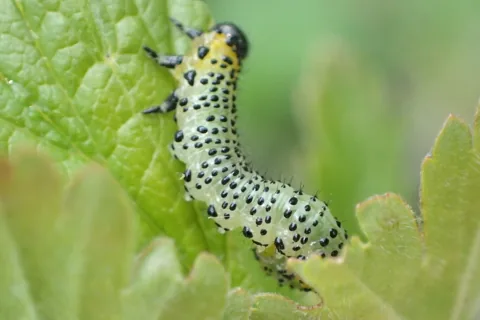 Imported currantworm
Euura ribesii (formerly Nematus ribesii)
The imported currantworm is the larva of a sawfly that feeds on currant and gooseberry leaves; when numerous, the larvae can strip a bush down to the larger veins within a few days.
Sawfly or caterpillar?
Sawflies are in the same insect order as ants, bees and wasps. The name comes from the female's saw-like egg-laying organ, which she uses to cut slits in needles, leaves or tender shoots and slip her eggs inside. The adults are small, stout, non-stinging and seldom noticed. The larvae are what you'll see.[1][2][7]
Getting the ID right matters for one practical reason: Bt, which works well on moth and butterfly caterpillars, is not effective against sawfly larvae.[2][1]
- Count the prolegs: these are the fleshy, leg-like stubs on the abdomen, behind the three pairs of true legs. Sawfly larvae have six or more pairs; caterpillars have five or fewer. Illinois Extension's memory trick is that a sawfly has enough prolegs to spell 'sawfly.' Penn State counts seven pairs on European pine sawfly, and UC IPM counts seven on pear slug.[1][7][2][6][4]
- Look at the eyes: Illinois Extension notes that caterpillar eyes are tiny and hard to see, while sawfly larvae have relatively large eyes.[7]
- Body: Minnesota Extension describes sawfly larvae as smooth with little or no hair and no more than an inch long when grown, while caterpillars can be smooth, hairy or spiny and may grow bigger. The elm sawfly is the exception, at 1 1/2 to 2 inches.[1]
- Group behavior: most sawfly larvae feed in clusters, and when disturbed a whole group may raise and arch their bodies at once.[1]
- Slug sawflies: roseslugs, pear slug and scarlet oak sawfly have small prolegs that are easy to miss. Pear slug larvae are coated in an olive-green slime that makes them look like tiny slugs, wider at the head end.[1][4][9]
- Not a hover fly larva: on roses, don't confuse roseslugs with the beneficial hover fly (syrphid) larvae that eat aphids. UC IPM says syrphid larvae sit among aphids, don't chew leaves and have no true legs; roseslugs sit near chewed or scraped leaves and have three pairs of short legs behind the head.[3]
What the damage looks like, and how much it matters
On conifers, young sawfly larvae chew the surface of the needles, leaving them dry, twisted and straw-colored. Older larvae eat whole needles. Except for tamarack and other larches, conifers don't regrow needles that have been eaten. Under heavily infested pines, the ground can be covered with sawdust-like droppings.[1][6][2]
On broadleaf trees and shrubs, larvae often chew in from the leaf edge down to the midrib. Slug sawflies instead scrape away the tissue on one side of the leaf between the veins. This 'windowpane' damage is whitish at first and later turns brown.[1][3][5]
How serious this is depends on the plant. Minnesota Extension says healthy, mature deciduous plants can usually handle a season of sawfly feeding and regrow leaves, though newly planted trees and shrubs, and plants stripped several years in a row, are more at risk. On roses, UC IPM says feeding makes foliage unsightly and severe feeding may cut back the next bloom, but it doesn't threaten an otherwise healthy rose. On pear and cherry, heavy feeding may reduce fruit size that season and the next.[1][3][4]
Evergreens are a bigger worry, and sources don't fully agree on how much. Minnesota Extension says European pine sawfly doesn't kill trees because it eats only old needles; Kentucky Extension says trees are seldom killed in a single season but can die after two or three years of heavy defoliation in a row. Species that eat new needles are more dangerous: introduced pine sawfly feeding after the winter buds form can kill branches or whole trees, three or four straight years of yellowheaded spruce sawfly can kill a spruce, and redheaded pine sawfly can kill small pines outright.[1][2][10]
Common sawflies in yards and gardens
Dozens of sawfly species feed on landscape plants. These are the ones homeowners run into most; the timing in each is what tells you when to look.[1][2]
- European pine sawfly: gray-green larvae with shiny black heads and light and dark stripes, 18 to 25 mm (3/4 to 1 inch) long. They prefer mugo, Scots, red and jack pine and eat only last year's needles, so new growth survives. Eggs spend the winter in the needles and hatch in spring; larvae feed from late April to mid-June in Kentucky and from mid-May through June in Minnesota, and Penn State says grown larvae drop to the ground in late May and early June. One generation a year.[6][1][2]
- Redheaded pine sawfly: a reddish head and a yellowish body with six rows of black spots, 3/4 to 1 1/4 inches long when grown, depending on the source. It feeds on both new and old needles, often from the top of a young tree down, and is one of the most damaging pine sawflies. Generations vary by region: Kentucky reports two a year and North Carolina four or five, while in Minnesota larvae feed from mid-June to late July.[1][2][10]
- Introduced and white pine sawflies: both favor eastern white pine. Introduced pine sawfly larvae are black with many yellow and white spots and have two generations, in late spring and late summer. White pine sawfly larvae are pale yellow with four rows of black spots and feed from late June into August.[1][2]
- Roseslugs: the European (or common) roseslug is light green with an orange-brown head, about 1/2 inch long, and scrapes the upper leaf surface in May and June; it has one generation a year. The bristly roseslug has fine bristles, feeds first on the leaf underside, then chews holes and skeletonizes leaves, and keeps going all season, from April to October in Georgia, with six or more generations a year in Illinois. Sources give its size as about 3/4 inch (UC IPM, Georgia) or about 1/2 inch (Illinois). The curled rose sawfly coils while it feeds and chews leaf edges.[1][7][3][5]
- Pear slug (pear sawfly, cherryslug): slimy, olive-green, slug-shaped larvae that skeletonize the upper side of pear, cherry, plum, hawthorn, cotoneaster, mountain ash and quince leaves. Grown larvae are about 3/8 inch (UC IPM, NC State) or 1/2 inch (Minnesota). There are usually two generations, and in California the second, summer generation does most of the damage.[4][9][1]
- Dogwood sawfly: larvae change looks as they grow. One early stage is covered in white waxy fluff, and older larvae are cream to yellow with black spots, about 1 inch long. They feed in groups on dogwood leaves from July to September. Grown larvae bore into soft or rotting wood to overwinter, including logs, landscape timbers, decks and even lawn furniture.[1][8]
- Willow sawfly: black or greenish-black larvae with large yellow spots, about 3/4 inch, on willow, cottonwood, aspen and other poplars. In Minnesota they feed in May and June, and a second generation feeds from July to the end of summer.[1]
- Others: Minnesota Extension also describes larch, yellowheaded spruce, azalea, blackheaded ash, dusky birch, mountain-ash, scarlet oak and columbine sawflies. Elm sawfly, the largest North American sawfly, rarely needs any control.[1]
Removing sawflies without spraying
Natural enemies, disease, starvation and bad weather usually keep sawfly numbers down, according to Kentucky Extension. UC IPM says fungal and viral diseases, birds, parasitic wasps, predatory beetles and small mammals commonly kill sawflies and can make outbreak populations decline soon. What a homeowner can add is catching colonies early, before they grow big enough to strip a branch.[2][3]
- Inspect early: start looking before larvae are due to appear (see the calendar below). On pines, Penn State says tufts of dry, straw-like needles on last year's growth in late April and early May are the first sign and may be the best time to act.[1][6][2]
- Pick or crush: small numbers can be picked off and dropped into a pail of soapy water, or crushed on the plant.[1][3][5]
- Shake: small larvae can be shaken off and stepped on. NC State suggests this for dogwood sawfly and for redheaded pine sawfly colonies on small ornamental pines.[8][10][2]
- Prune: a twig carrying a colony can be clipped off and destroyed, if losing it won't spoil the plant's shape.[2][6][3]
- Hose: a forceful stream of water knocks larvae off. Illinois says to spray both upper and lower leaf surfaces; Georgia suggests spraying roses three times a week to dislodge bristly roseslugs.[1][4][7][5]
- Work the soil for bristly roseslug: these larvae pupate in the soil, and Georgia Extension says tilling around roses several times during the season, and again in late fall, may destroy pupae and reduce next year's numbers.[5]
- Keep plants healthy: well-sited, watered and fertilized trees and shrubs suffer less from sawfly feeding. Penn State adds that northern Scots pine cultivars resist European pine sawfly better than southern ones.[1][6]
Low-impact sprays for young larvae
Size is everything. Treat when larvae are half their full size or less. If they're full grown, the damage is already done. NC State says soap and oil work on dogwood sawflies under an inch long but warns that older ones are very tough.[1][8]
UC IPM says sawfly larvae are relatively easy to kill if they are thoroughly sprayed with almost any insecticide, including the gentle ones below.[3][4]
- Insecticidal soap and horticultural oil: effective on small numbers of young larvae, with little effect on natural enemies. They only kill larvae the spray actually touches and leave no residue, so you may need to repeat.[1][5][2]
- Neem (azadirachtin) and spinosad: Minnesota Extension says these keep working for one or two weeks, so larvae feeding on treated foliage are still affected.[1][3][2]
- Spinosad and bees: UC IPM says spinosad stays toxic to bees for several hours after the spray dries, so don't use it on plants in bloom.[3][4]
- Spot-treat the groups: since most sawflies feed in clusters, spraying just the colonies cuts the amount of insecticide used.[1][2]
- Not Bt: Bacillus thuringiensis kurstaki is specific to moth and butterfly caterpillars and doesn't kill sawfly larvae. This applies to roseslugs, pear slug and pine sawflies alike.[1][2][3][4][5][7]
Pyrethroids, carbaryl and systemics: where advice splits
Extension services don't agree on the stronger products. Minnesota Extension says contact residual insecticides such as permethrin, bifenthrin, lambda-cyhalothrin and carbaryl work best on young larvae and usually take one application, and Kentucky and Illinois list similar products. UC IPM tells home gardeners to avoid broad-spectrum, persistent insecticides such as carbaryl, malathion and pyrethroids on roses and pear, because they harm bees and natural enemies and some wash into surface water and hurt aquatic life.[1][2][7][3][4]
Soap, oil, neem and spinosad all work on young larvae, and Minnesota Extension itself suggests low-impact methods when the host plant is in bloom, so on a home landscape the gentler products are the place to start.[3][1]
- Systemic soil treatments: for trees hit year after year, Minnesota Extension says imidacloprid or dinotefuran applied to the soil in fall will control European pine sawfly and yellowheaded spruce sawfly larvae the next spring. Georgia Extension says a spring soil drench of either can reduce bristly roseslug numbers on roses, applied to the soil with mulch pulled back.[1][5]
- Protect pollinators: Minnesota Extension warns against systemics on bee-attractive trees and shrubs such as linden, crabapple, sugar maple, serviceberry, pagoda dogwood and nannyberry viburnum. Apply only after flowering, and don't drench the soil next to flowering plants. Evergreens aren't in that bee-attractive group.[1]
- Bloom on the target plant: azaleas, roses, columbine and pear-slug hosts may be in flower when larvae are active. Illinois notes that single-flowered roses can offer pollen and nectar, and anything that kills roseslugs will likely kill pollinators too, so keep sprays off the flowers.[1][7][5]
- Tall trees: Minnesota Extension suggests hiring a licensed applicator when treating a tree yourself isn't practical.[1]
- Read the label: the plant and pest must be listed, and Kentucky's product suggestions apply only in Kentucky. Check with your local extension office for your state.[1][2]
When to look: a sawfly calendar
Timing shifts with latitude and with an early or late spring, so start checking a little before these windows.[1]
- Fall to mid-April: look for rows of eggs in pine needles. Penn State says each European pine sawfly female lays 6 to 8 eggs in each of about 10 to 12 needles in September and October, usually on that year's needles near branch tips.[6]
- Late April to June: European pine sawfly larvae on last year's pine needles. Penn State suggests treating in early to mid-May while they're small.[6][2][1]
- May to June: European roseslug, azalea, columbine and willow sawfly larvae (Minnesota and Illinois timing).[1][7]
- Mid-June through summer: redheaded pine sawfly (mid-June to late July in Minnesota), white pine sawfly (late June to August), and pear slug, whose second generation starts in early August in Minnesota.[1][2]
- July to September: dogwood sawfly, second-generation willow and introduced pine sawflies.[1][2]
- April to October: bristly roseslug, in repeated generations, in the Southeast.[5]
Common questions
- Does Bt kill sawflies?
- No. Bt (Bacillus thuringiensis kurstaki) only works on moth and butterfly caterpillars. Sawfly larvae are related to bees and wasps, and Bt doesn't affect them.[1][2][3][7]
- How do I tell a sawfly larva from a caterpillar?
- Count the fleshy prolegs on the abdomen: sawfly larvae have six or more pairs, caterpillars five or fewer. Sawfly larvae also have relatively large, easy-to-see eyes.[1][7][3]
- What is the best spray for sawflies?
- On young larvae, insecticidal soap, horticultural oil, neem oil or spinosad. Spray the larvae directly and keep spinosad off plants in bloom.[1][3][5]
- Will sawflies kill my pine tree?
- Usually not in one season, but repeated heavy defoliation can. Species that eat new needles, such as redheaded and introduced pine sawflies, are the most dangerous, especially on small trees.[2][1][10]
- What are the slimy green worms on my cherry or pear leaves?
- Probably pear slug, a sawfly larva coated in olive-green slime that skeletonizes the upper side of leaves. Hose it off or spray it with soap, oil, neem or spinosad.[4][9][1]
- Why do my roses have see-through patches on the leaves?
- Roseslugs scrape away one leaf surface between the veins, leaving whitish windowpanes that turn brown. Bristly roseslugs feed from below and later chew holes.[1][3][5]
- Can dogwood sawflies damage my deck?
- Grown larvae bore into soft or rotting wood to spend the winter, and Minnesota and NC State Extension list decks, landscape timbers, logs and lawn furniture.[1][8]
Photo credits
- Pine Sawflies: Liubov Ilminska, public domain (CC0), via iNaturalist
- Redheaded Pine Sawfly: (c) Jack Forrester, some rights reserved (CC BY) — via iNaturalist, CC BY 4.0
- Introduced Pine Sawfly: (c) River Ahlquist, some rights reserved (CC BY) — via iNaturalist, CC BY 4.0
- White Pine Sawfly: (c) Kenneth Burdick, some rights reserved (CC BY) — via iNaturalist, CC BY 4.0
- Rose Slugs (Rose Sawflies): (c) Gabriele Pradelli, some rights reserved (CC BY) — via iNaturalist, CC BY 4.0
- Pear Slug: (c) Alexandria 'Alex' Wenninger, some rights reserved (CC BY) — via iNaturalist, CC BY 4.0
- Dogwood Sawfly: (c) Dan Vickers, some rights reserved (CC BY) — via iNaturalist, CC BY 4.0
- Elm Sawfly: (c) Allison Zon, some rights reserved (CC BY) — via iNaturalist, CC BY 4.0
- Larch Sawfly: (c) Susanne Primdahl, some rights reserved (CC BY) — via iNaturalist, CC BY 4.0
- Yellowheaded Spruce Sawfly: (c) Ramsey Sullivan, some rights reserved (CC BY) — via iNaturalist, CC BY 4.0
- Imported currantworm: (c) Connie Taylor, some rights reserved (CC BY) — via iNaturalist, CC BY 4.0
Sources
- University of Minnesota Extension, “Sawflies (J. Hahn, J. Lloyd; reviewed 2026).” extension.umn.edu/yard-and-garden-insects/sawflies (accessed 2026-11-10)
- University of Kentucky Entomology, “ENTFACT-410: Pine Sawflies (L. Townsend; revised 3/26).” entomology.mgcafe.uky.edu/ef410 (accessed 2026-11-10)
- University of California Statewide IPM Program, “Rose Sawflies (Roseslugs).” ipm.ucanr.edu/home-and-landscape/rose-sawflies-roseslugs/ (accessed 2026-11-10)
- University of California Statewide IPM Program, “Pear Sawfly.” ipm.ucanr.edu/PMG/GARDEN/FRUIT/PESTS/pearslug.html (accessed 2026-11-10)
- University of Georgia Cooperative Extension, “Bristly Roseslugs: Biology and Management, C1329.” fieldreport.caes.uga.edu/publications/C1329/bristly-roseslugs-biology-and-management/ (accessed 2026-11-10)
- Penn State Extension, “European Pine Sawfly (G. A. Hoover, N. Barr).” extension.psu.edu/european-pine-sawfly (accessed 2026-11-10)
- University of Illinois Extension, “Why are there holes in my roses? Roseslugs (K. Johnson, Good Growing, June 2024).” extension.illinois.edu/blogs/good-growing/2024-06-07-why-are-there-holes-my-roses-roseslugs (accessed 2026-11-10)
- NC State Extension, “Dogwood Sawfly.” content.ces.ncsu.edu/dogwood-sawfly (accessed 2026-11-10)
- NC State Extension, “Pearslug.” content.ces.ncsu.edu/pear-slug (accessed 2026-11-10)
- NC State Extension, “Redheaded Pine Sawfly.” content.ces.ncsu.edu/redheaded-pine-sawfly (accessed 2026-11-10)