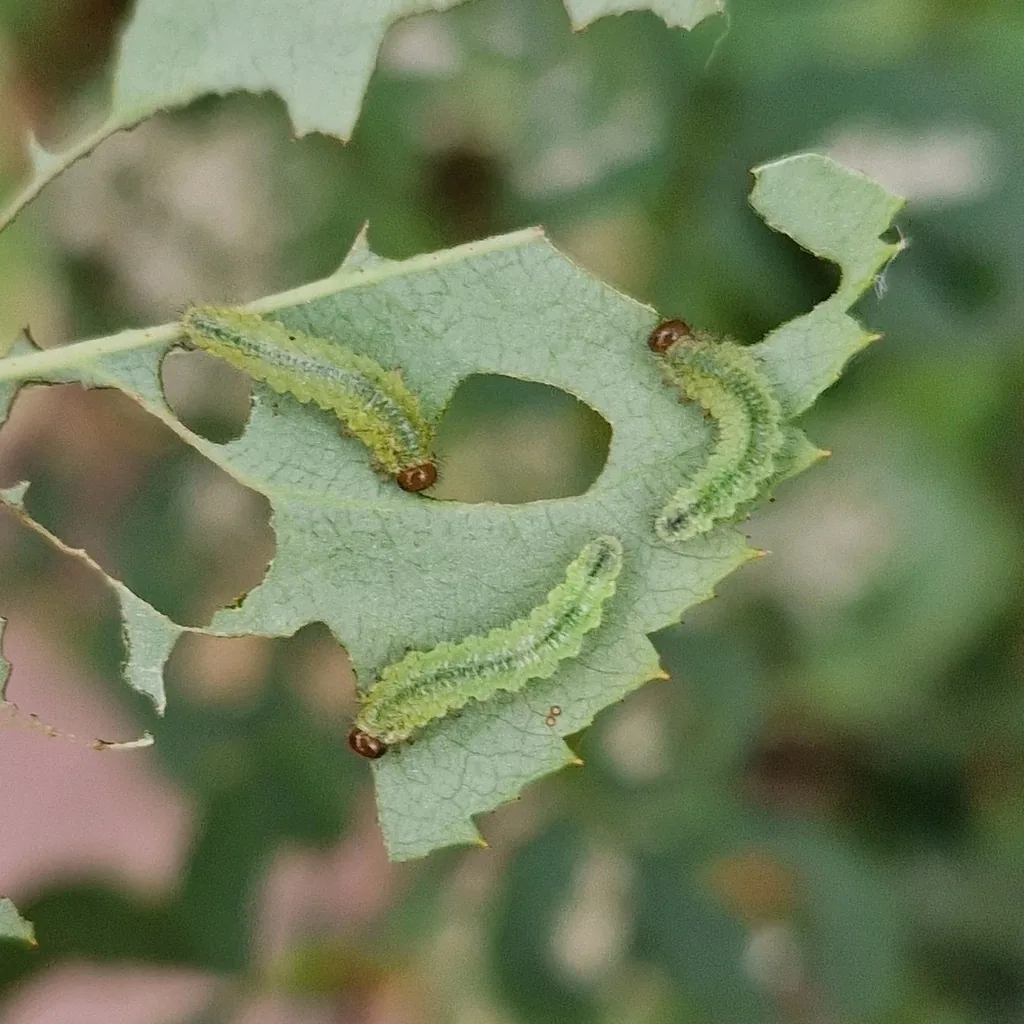
How to identify it
- Bristly roseslug larvae are pale to lime green with a brown or orange head, grow to about 3/4 inch, and are covered in tiny hairlike bristles.[1][2]
- Sawfly larvae have prolegs on at least six abdominal segments and relatively large eyes; caterpillars have five or fewer pairs of prolegs and tiny eyes.[1][3]
- The common or European roseslug is smaller, about 1/2 inch and green, and it scrapes the upper leaf surface.[1][3]
- The curled rose sawfly is green with pale spots or bumps and often coils its body while feeding.[1][3]
- Adults are stout, mostly black sawflies about 3/8 to 2/3 inch long, with a broad waist rather than the narrow waist of most wasps.[1][2]
Look-alikes
| Look-alike | How to tell them apart |
|---|---|
| Caterpillars | Caterpillars have five or fewer pairs of prolegs, and Bt kills them; roseslugs have more prolegs and Bt has no effect on them.[3][1] |
| Hover fly (syrphid) larvae | Syrphid larvae have no true legs, live among aphids, and eat them instead of chewing leaves; leave them alone, since they are beneficial.[1] |
| Japanese beetle | Japanese beetles often get blamed for chewed rose leaves in summer, but roseslugs are small green larvae usually found on the leaf undersides.[3][2] |
| Pine sawflies | Related sawfly larvae that feed on pine needles instead of rose leaves; like roseslugs, they have more prolegs than caterpillars.[4] |
Where it lives
The bristly roseslug, native to Europe and accidentally introduced to the U.S., is common in Georgia and found in Illinois; in California it is the most common rose sawfly, mainly in cooler coastal areas.[2][3][1]
Biology and life cycle
Females use a sawlike egg-laying tool to insert eggs into rose leaves or leaf stalks.[3][2][1]
Young bristly roseslugs feed on the lower leaf surface, and mature larvae drop to pupate in a cocoon in the soil or in plant debris.[2][3]
The bristly roseslug can have six or more generations a year, so feeding builds from spring until frost and can be worst late in the season.[3][2]
The common roseslug and curled rose sawfly feed mainly early in the season; the common roseslug has one generation and the curled rose sawfly two.[3]
Bristly roseslugs spend the winter as pupae in earthen cells in the soil.[2]
Damage and signs
- Young larvae scrape away one leaf surface, leaving pale see-through windowpanes that later collapse into irregular holes.[2][1]
- Older bristly roseslugs chew through the leaf between the veins, leaving skeletonized leaves, and heavy infestations can cause leaf drop.[2][3]
- Mature curled rose sawfly larvae bore into stems or pruned twig ends to pupate.[1][3]
- Feeding makes roses look ragged and severe damage may reduce later blooming, but it doesn't threaten otherwise healthy roses.[1]
Health risk
Rose slugs are a plant problem only: the larvae feed on rose leaves, and even heavy feeding mainly affects how the plants look and bloom.[1][2]
Control
Prevention
Check the undersides of rose leaves regularly from April until frost, since that is where larvae feed.[2]
Traps and physical control
Handpick larvae or clip off infested leaves when only part of the plant is affected.[1][2]
A forceful spray of water on both leaf surfaces can knock off and kill small larvae.[3][2]
Tilling soil around roses, including in late fall, can destroy bristly roseslug pupae.[2]
Biological control
Birds, parasitic wasps, predaceous beetles and diseases often keep sawflies low, so avoid broad-spectrum sprays that kill these natural enemies.[1]
Pesticides
Larvae are easy to kill with thorough sprays of horticultural oil, insecticidal soap, neem oil or spinosad, but these leave no residue, so repeat as needed.[1][2]
Bt sprays don't work, because roseslugs are not caterpillars.[1][2][3]
Don't spray open flowers; spinosad stays toxic to bees for hours after drying, and UC IPM advises against persistent broad-spectrum insecticides such as pyrethroids on roses.[1][3]
Common questions
- What is eating holes in my rose leaves?
- If the leaves have see-through windowpanes and holes and small green larvae sit on the undersides, roseslugs are the likely cause.[2][3]
- Are rose slugs actually slugs?
- No. They are the larvae of sawflies, which are relatives of bees, ants and wasps.[3][1]
- Why didn't Bt kill my rose slugs?
- Bt only works on true caterpillars, the larvae of moths and butterflies, and sawfly larvae aren't affected.[1][3]
Sources
- University of California Statewide IPM Program, “Rose Sawflies (Roseslugs).” ipm.ucanr.edu/home-and-landscape/rose-sawflies-roseslugs/ (accessed 2026-10-06)
- University of Georgia Cooperative Extension, “Bristly Roseslugs: Biology and Management (Circular 1329, May 2025).” fieldreport.caes.uga.edu/publications/C1329/bristly-roseslugs-biology-and-management/ (accessed 2026-10-06)
- University of Illinois Extension, “Why are there holes in my roses? Roseslugs (Good Growing, June 7, 2024).” extension.illinois.edu/blogs/good-growing/2024-06-07-why-are-there-holes-my-roses-roseslugs (accessed 2026-10-06)
- University of Kentucky Entomology, “ENTFACT-410: Pine Sawflies.” entomology.mgcafe.uky.edu/ef410 (accessed 2026-10-06)
- iNaturalist, “Cladius pectinicornis taxon page (order and family).” www.inaturalist.org/taxa/628325 (accessed 2026-10-06)