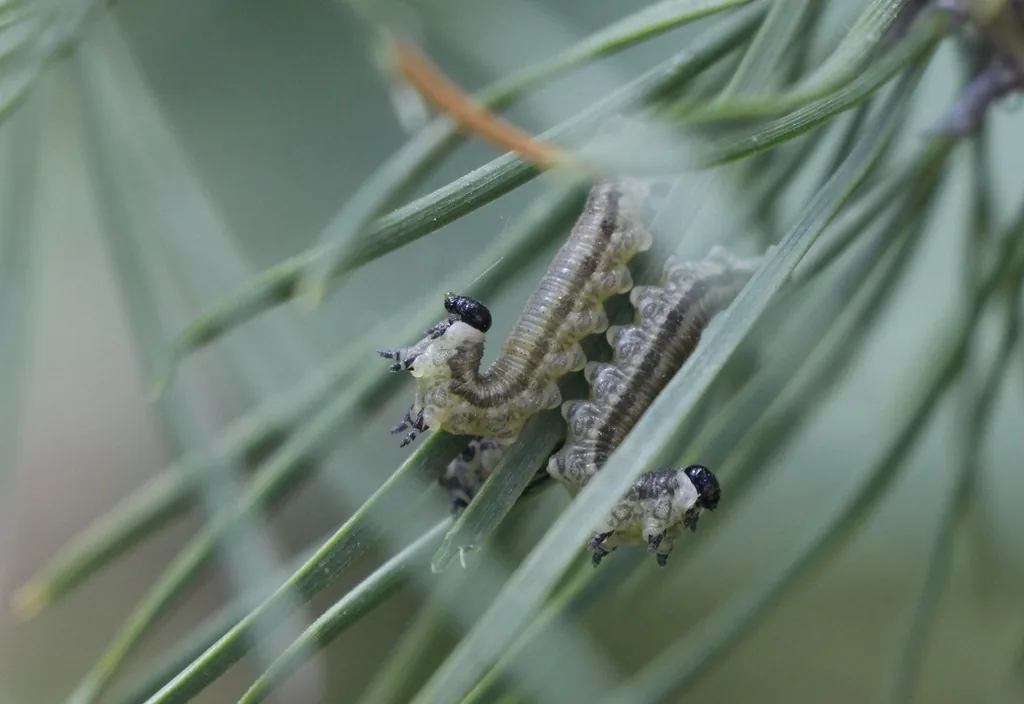
How to identify it
- Mature European pine sawfly larvae are grayish green, about 3/4 to 1 inch long, with shiny black heads and dark and light stripes running along the body.[1][2]
- Sawfly larvae have more than five pairs of fleshy prolegs on the abdomen, while true caterpillars have two to five pairs.[2]
- Other pine species look different: the redheaded pine sawfly has a red head and rows of black spots on a yellow-white body.[2]
- Eggs show as an evenly spaced row of light brown spots along a pine needle; adults are wasplike, brown to black and under 1/2 inch long.[1]
Look-alikes
| Look-alike | How to tell them apart |
|---|---|
| Caterpillars (moth and butterfly larvae) | Caterpillars have 2 to 5 pairs of abdominal prolegs and sawfly larvae have more, which matters because Bt kills caterpillars but not sawflies.[2] |
Where it lives
Introduced from Europe in 1925, the European pine sawfly ranges from Ontario to Missouri and from New England west to Iowa; native pine sawflies also occur, including several in Kentucky.[1][2]
Biology and life cycle
In September and October, females slit pine needles with a sawlike tip on the abdomen and lay about 6 to 8 eggs per needle.[1]
European pine sawfly has one generation a year: eggs overwinter, larvae feed from late April to mid-June, then drop to the ground and pupate in brown cocoons.[1][2]
Larvae feed in groups on the previous year's needles and sometimes the bark of new shoots, moving to another tree if they run out of food.[1]
Some species, like the redheaded and introduced pine sawflies, have two generations a year.[2]
Damage and signs
- Young larvae eat the needle surface, leaving tufts of dry, straw-like needles; older larvae eat whole needles from tip to base.[1]
- Preferred hosts include mugo, Scots, red and jack pine; white, Austrian, ponderosa and pitch pine are attacked when growing nearby.[1]
- Trees seldom die after one season, but two to three straight years of heavy defoliation can kill them.[2][1]
Health risk
The harm is to pines: larvae strip needles and leave trees thin and unsightly, especially mugo pine in landscapes and Scots pine Christmas trees.[1]
Control
Prevention
Check pines for eggs in needles from fall to mid-April, then look for straw-colored needle tufts in late April and early May, when larvae are small.[1]
Northern Scots pine cultivars resist attack better than southern ones, and removing unwanted host pines removes a source of new infestations.[1]
Traps and physical control
If only a few colonies are within reach, handpick them, shake them off, or prune out the branch and destroy them.[2][1]
Biological control
Natural enemies, disease, starvation and weather usually hold sawflies down, though predators often fail to control them in landscapes and nurseries.[2][1]
Pesticides
Bt doesn't work on sawflies. Insecticidal soap can work when it hits the larvae directly, and registered insecticides such as spinosad, azadirachtin and carbaryl can be used on small larvae.[2][1]
Common questions
- Why didn't Bt kill the caterpillars on my pine?
- They are probably sawfly larvae, not caterpillars. Bt targets moth and butterfly larvae and isn't effective against sawflies.[2]
- Will pine sawflies kill my pine tree?
- Rarely after one year, since larvae mostly eat old needles; repeated heavy defoliation over two or three years can kill trees.[1][2]
Sources
- Penn State Extension, “European Pine Sawfly (updated June 24, 2026).” extension.psu.edu/european-pine-sawfly (accessed 2026-10-06)
- University of Kentucky Entomology, “ENTFACT-410: Pine Sawflies.” entomology.mgcafe.uky.edu/ef410 (accessed 2026-10-06)
- iNaturalist, “Neodiprion sertifer taxon page (order and family).” www.inaturalist.org/taxa/494066 (accessed 2026-10-06)