On this page
How to identify it
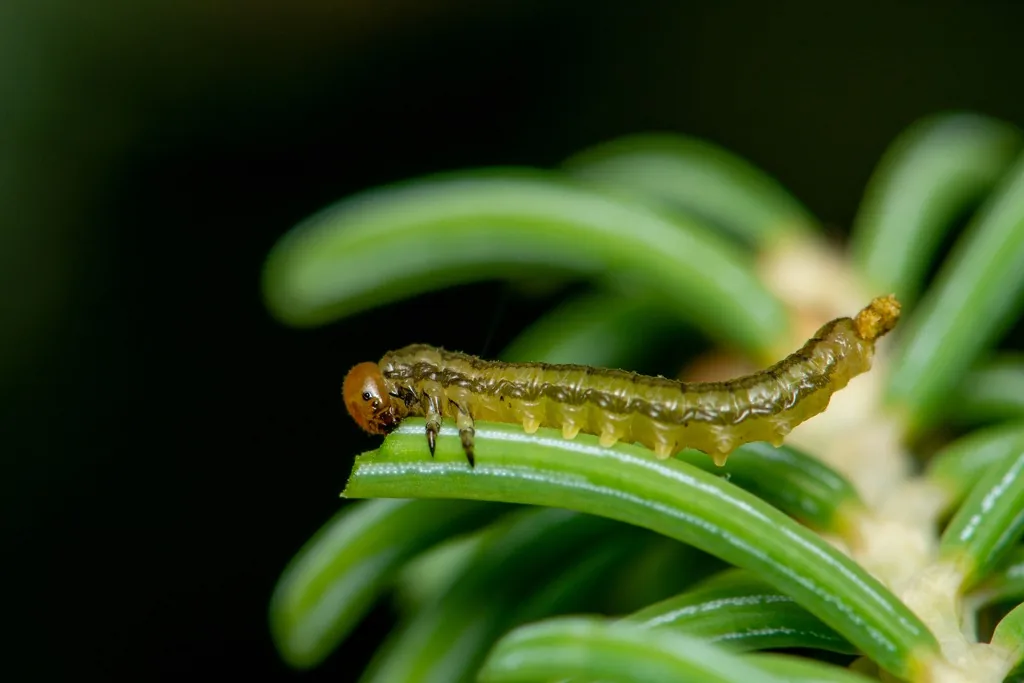
- Larvae grow to about 3/4 inch, with a yellow to reddish-brown head and a glossy olive-green body marked with six gray-green stripes.[1][2][3]
- Disturbed larvae arch both ends of the body and give off a drop of liquid from the mouth.[1]
- Adults look like small flies with four shiny, clear wings and a body ranging from straw yellow to nearly black.[1]
Where it lives
From Maine and New Brunswick west through the Great Lakes states to Wyoming and Idaho, and north to British Columbia and Alaska.[1]
Biology and life cycle
It spends the winter as a prepupa in a cocoon in the soil; adults emerge from late May to mid-June and lay eggs in slits in the new needles.[1][2]
Larvae feed for four to six weeks, from late May or June into July, then drop to the ground to spin cocoons; there is one generation a year.[1][2][3]
Damage and signs
- It attacks only spruce: white spruce is preferred, and black, blue, red, Norway and Engelmann spruce are also eaten.[1][2][3]
- Larvae eat new needles first, then old ones; open-grown trees, windbreaks, shade trees and young plantings are hit hardest, while closed forests are usually spared.[1][2]
- Three or four years of heavy defoliation in a row can kill a tree, and the Forest Service reported losses of up to 90 percent in open stands.[1][2]
Health risk
Control
Biological control
Parasitic wasps and flies attack the eggs and larvae and small mammals likely eat cocoons, but they rarely hold numbers down when weather favors the sawfly.[1]
Pesticides
Check spruces in spring and treat larvae with an insecticide if needed; UMN notes a fall soil application of imidacloprid or dinotefuran can prevent larvae the next spring where infestations keep returning.[2]
Common questions
Sources
- USDA Forest Service (Forest Insect & Disease Leaflets), “Yellow-Headed Spruce Sawfly (Forest Pest Leaflet 69, revised March 1971).” www.fs.usda.gov/foresthealth/docs/fidls/FIDL-69-YellowHeadedSawfly.pdf (accessed 2026-10-16)
- University of Minnesota Extension, “Sawflies (Yard and Garden Insects).” extension.umn.edu/yard-and-garden-insects/sawflies (accessed 2026-10-16)
- University of Minnesota Extension (What insect is this?), “Yellowheaded spruce sawfly.” apps.extension.umn.edu/garden/diagnose/insect/trees-shrubs/caterpillars/small/yellowheadedsprucesawfly.html (accessed 2026-10-16)
- iNaturalist, “Euura alaskensis taxon page (order and family).” www.inaturalist.org/taxa/1354475 (accessed 2026-10-06)