On this page
How to identify it
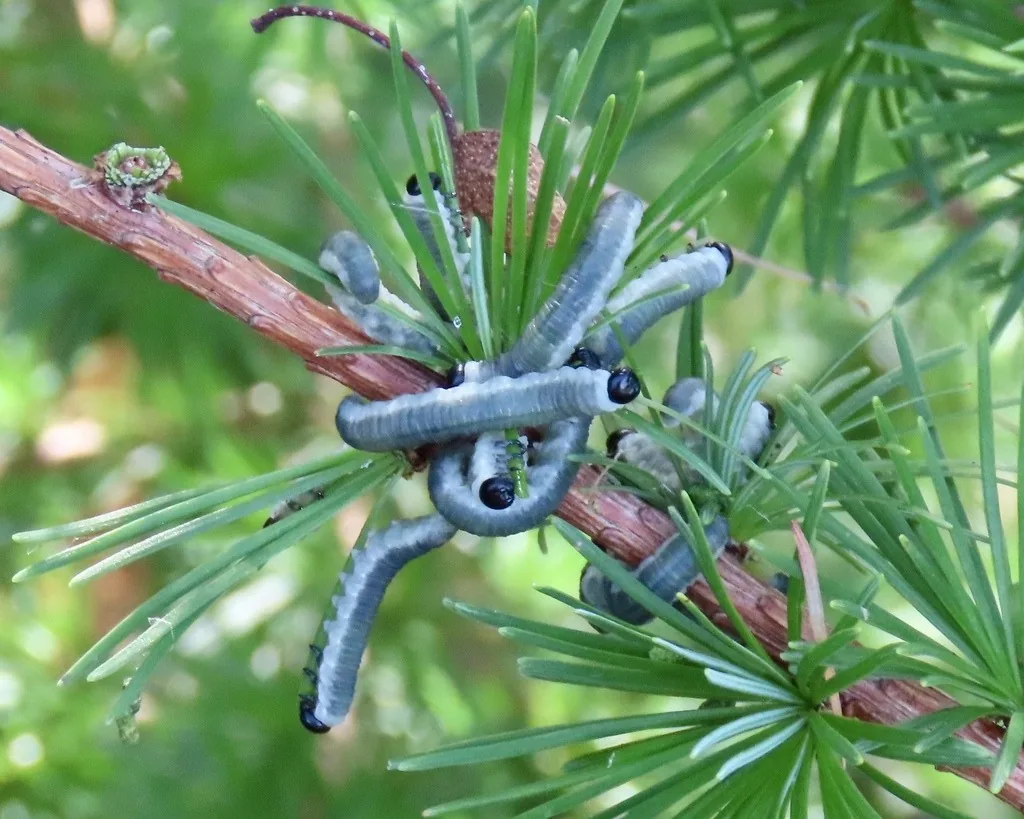
- Grown larvae have shiny jet-black heads and bodies that are gray-green on the back and whitish underneath; UMN gives about 16 mm.[1][2]
- New shoots curl where females have laid rows of eggs under the bark, and the curl stays visible for several years.[1][2]
- Adult females are black with a broad orange band on the abdomen.[1]
Where it lives
Reported in North America since 1880 near Boston and now found from Maine to Washington and in Alaska, south to Maryland and West Virginia.[1]
Biology and life cycle
Larvae overwinter as prepupae in tough brown cocoons in the duff; adults emerge from mid-May into June, nearly all of them females that reproduce without mating.[1][2]
Each female lays 20 to 200 eggs in the new terminal twigs; larvae hatch in early June and feed in colonies on the older needles for about three weeks.[1][2]
Because adults emerge over about six weeks, all larval stages can be on a tree at once, and feeding can run into September; there is one generation a year.[1][2]
Damage and signs
- Hosts are tamarack, western and subalpine larch and planted European, Japanese and other larches.[1][2]
- Larvae eat needles on the older parts of twigs and can strip a tree, but complete defoliation is rare because they skip the new shoots.[1][2]
- Larches refoliate and survive many years of defoliation, though growth nearly stops; small trees can die after a few heavy years, and tamarack on thin bog soils after about 7.[1][2]
Health risk
Control
Biological control
Small mammals eat many larvae in bogs, and parasitoid wasps, including strains and species released from Europe, help suppress outbreaks.[1]
Pesticides
UMN suggests checking larches in early summer and treating larvae only if needed; the 1971 Forest Service leaflet notes overlapping broods can require two applications.[1][2]
Common questions
Sources
- USDA Forest Service (Forest Insect & Disease Leaflets), “Larch Sawfly (Forest Pest Leaflet 8, revised March 1971).” www.fs.usda.gov/foresthealth/docs/fidls/FIDL-08-LarchSawfly.pdf (accessed 2026-10-16)
- University of Minnesota Extension, “Sawflies (Yard and Garden Insects).” extension.umn.edu/yard-and-garden-insects/sawflies (accessed 2026-10-16)
- iNaturalist, “Pristiphora erichsonii taxon page (order and family).” www.inaturalist.org/taxa/454773 (accessed 2026-10-06)