On this page
How to identify it
- Larvae live in cigar-shaped cases the color of a dead needle, made from a mined needle lined with silk; grown larvae are about 6 mm long.[1][2]
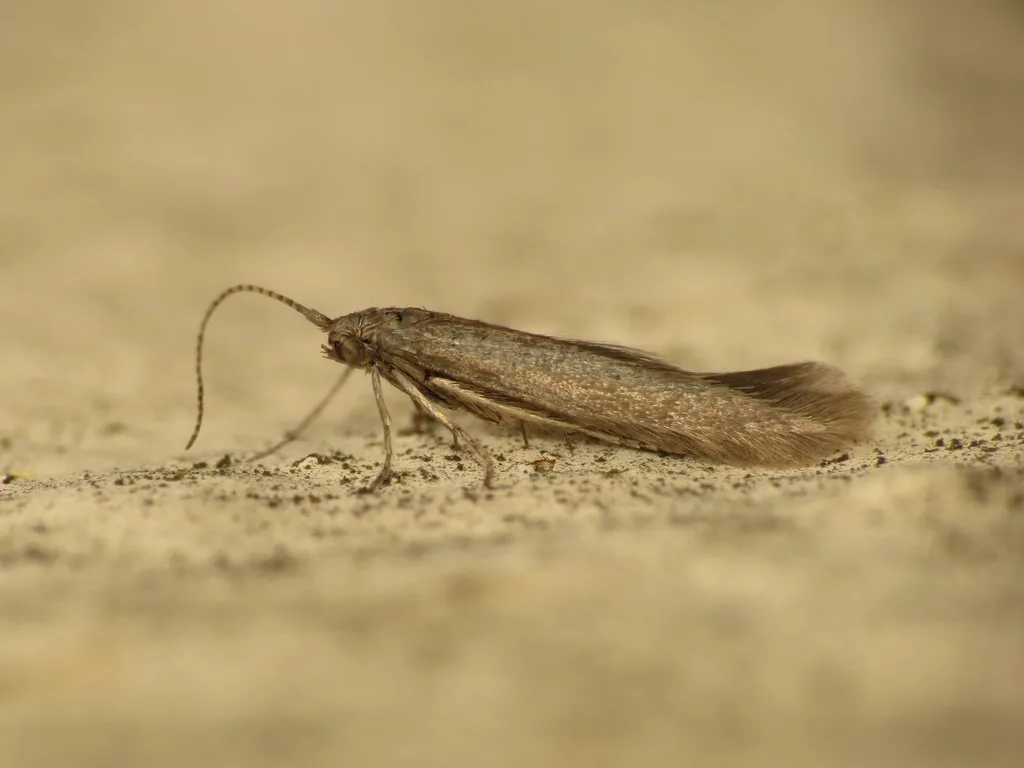
- Adults are small silvery-gray moths with a wingspan of about 8 mm.[1]
- Damaged needles look bleached or scorched and then turn brown; heavily fed trees look bronzed or burnt reddish-brown by early summer.[1][2]
Where it lives
Introduced from Europe and found near Northampton, Massachusetts, in the late 1800s; it spread through eastern larch forests and was found on western larch in Idaho in 1957.[1][2]
Biology and life cycle
There is one generation a year. Moths lay single eggs on needles in midsummer, and the hatching larvae mine into the needles for several weeks.[1][2]
In fall the larvae build their cases and overwinter attached near buds, then resume feeding in spring 2 to 3 weeks after budbreak and pupate inside their cases.[1][2]
Damage and signs
- All North American larches and European larch can be damaged; feeding is heaviest on the new needles in spring.[1][2]
- Larch can grow new needles, but repeated heavy defoliation slows growth and causes dieback and death; UMass warns of losses after two or more years, while the Forest Service says at least 5 years of severe defoliation are typically needed.[1][2]
Health risk
Control
Biological control
Parasitoid wasps imported from Europe, mainly Agathis pumila, brought outbreaks under control by the late 1940s in the East and the 1970s in the West, though outbreaks have returned since 2000; birds, spiders and ants also eat it.[1][2]
Pesticides
Because larch tolerates defoliation, sprays are rarely needed; for high-value trees the Forest Service times them shortly after budbreak and advises consulting tree care professionals.[2]
Common questions
Sources
- UMass Extension Landscape, Nursery and Urban Forestry Program (Landscape Insect & Mite Guide), “Coleophora laricella (Larch Casebearer).” www.umass.edu/agriculture-food-environment/landscape/publications-resources/insect-mite-guide/coleophora-laricella (accessed 2026-10-16)
- USDA Forest Service (Forest Insect & Disease Leaflets), “Larch Casebearer (FIDL 96, FS-1179, revised Aug. 2021).” www.fs.usda.gov/foresthealth/docs/fidls/FIDL-96-LarchCasebearer.pdf (accessed 2026-10-16)
- iNaturalist, “Coleophora laricella taxon page (order and family).” www.inaturalist.org/taxa/217344 (accessed 2026-10-06)