On this page
How to identify it
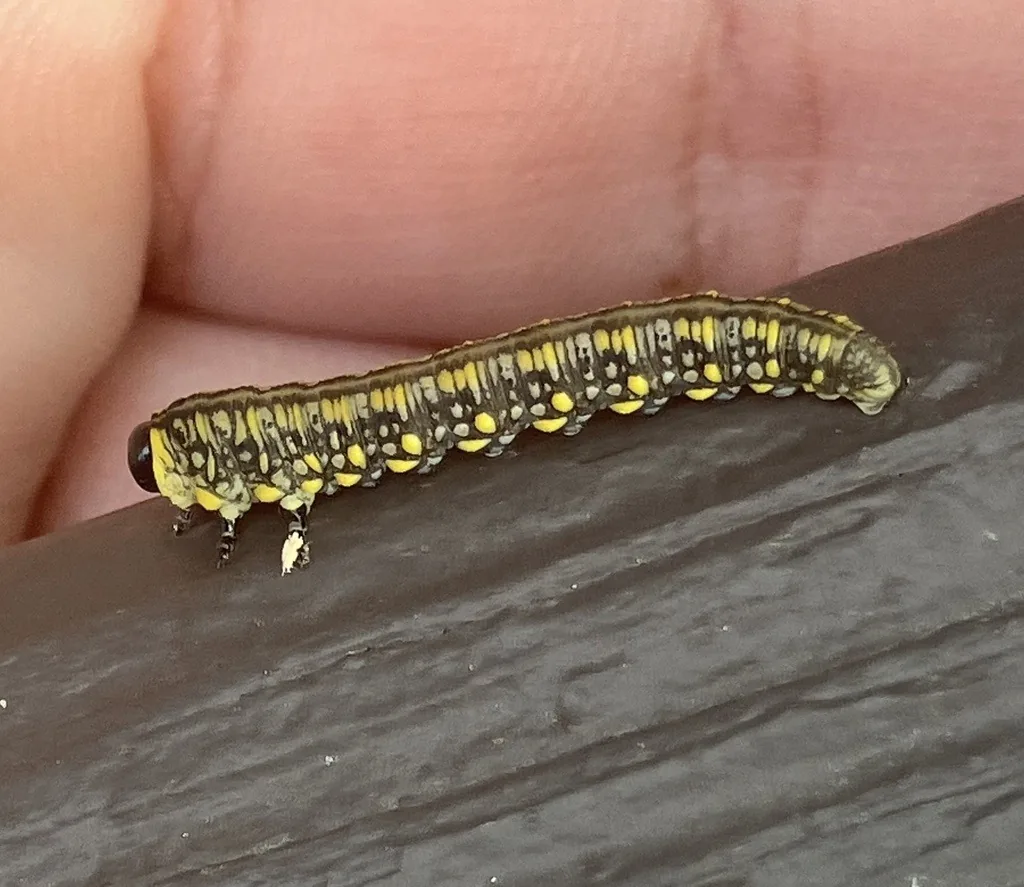
- Full-grown larvae are about an inch long, whitish with yellow and black spots and a shiny black head.[1]
- Females are stocky and yellow and black; males are smaller, blackish, with feathery antennae.[1]
- Sawfly larvae can be told from moth caterpillars by their prolegs: moth and butterfly caterpillars have 5 or fewer pairs of fleshy abdominal prolegs with tiny hooks.[2]
Look-alikes
| Look-alike | How to tell them apart |
|---|---|
| European and redheaded pine sawflies | Other sawfly larvae feed on the same hosts, so confirm by looking at the larvae themselves.[2] |
Where it lives
First found in the U.S. at New Haven, Connecticut, in 1914, it is established in New England and as far south as North Carolina.[1][2]
Biology and life cycle
Females slit pine needles and lay eggs end to end inside, sealing the wound with froth; mature larvae spin tough cocoons on needles, twigs or bark.[1]
There are two generations a year in the North and three in North Carolina, with heavy overlap; larvae are present from about May into early October.[1][2]
Young larvae feed in groups; older larvae feed alone and eat whole needles, even bark once needles are gone.[1][2]
Damage and signs
Health risk
Control
Traps and physical control
Wearing gloves, pick off young larvae while they still feed in groups and drop them into soapy water.[2]
Biological control
Parasitic wasps, especially Monodontomerus dentipes, keep it largely under control in North Carolina; cold winters also kill many second-generation larvae.[1][2]
Pesticides
Bt (Bacillus thuringiensis kurstaki) does not work on sawfly larvae; NC State says most landscape-labeled insecticides control it. Follow the label.[1][2]
Common questions
- What are the spotted caterpillars eating my white pine?
- Possibly introduced pine sawfly larvae.[1][2]
- Will Bt kill pine sawflies?
- No; Bt kurstaki only kills moth and butterfly caterpillars, not sawfly larvae.[2]
- When should I look for them?
- Watch for feeding from May; in Massachusetts, reports often pick up in late June.[2]
Sources
- NC State Extension, “Introduced Pine Sawfly (PDIC Factsheet).” content.ces.ncsu.edu/introduce-pine-sawfly (accessed 2026-10-15)
- UMass Extension Landscape, Nursery and Urban Forestry Program (Landscape Insect & Mite Guide), “Diprion similis (Introduced Pine Sawfly).” www.umass.edu/agriculture-food-environment/landscape/publications-resources/insect-mite-guide/diprion-similis (accessed 2026-10-15)
- iNaturalist, “Diprion similis taxon page (order and family).” www.inaturalist.org/taxa/62626 (accessed 2026-10-06)