On this page
How to identify it
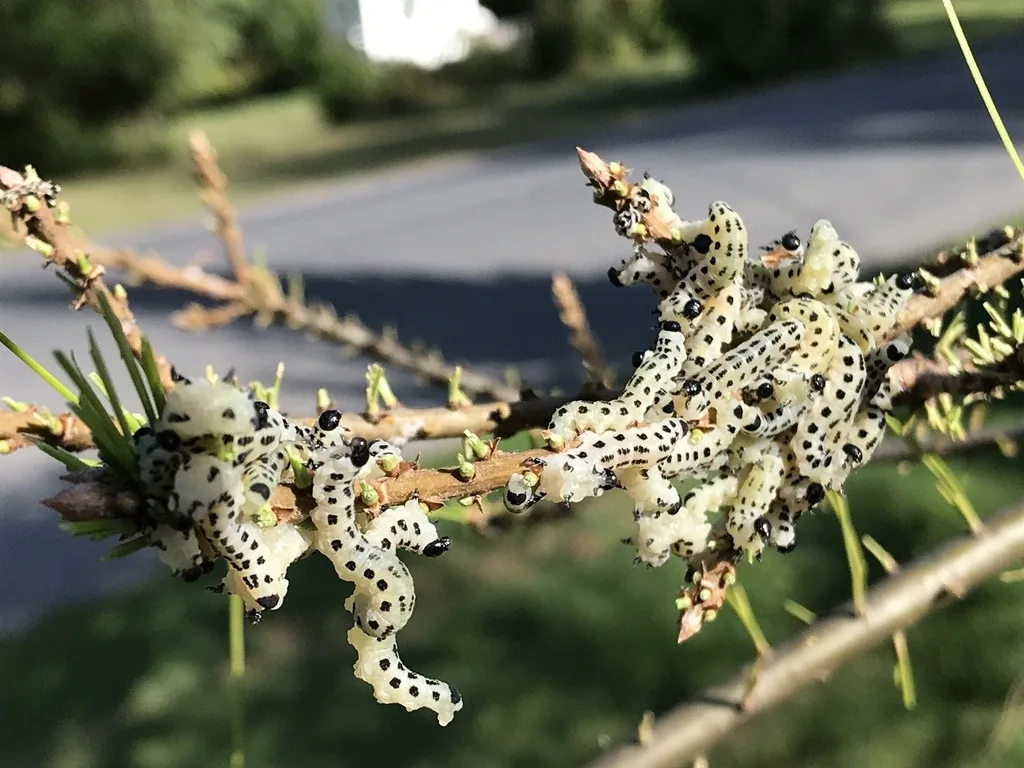
- Larvae are pale yellow to light cream with a shiny black head and four rows of black spots running the length of the body, plus a black spot at the tail end.[1][2]
- Full-grown larvae are about 1 inch (25 mm) long.[1]
- Larvae feed in groups, stripping one branch before they move to the next.[1][2]
- Like other sawfly larvae, they have six or more pairs of fleshy prolegs on the abdomen; moth and butterfly caterpillars have two to five pairs.[1]
Look-alikes
| Look-alike | How to tell them apart |
|---|---|
| Redheaded pine sawfly | Also yellow with rows of black spots, but it has a reddish-brown head and six rows of spots, and it prefers red and jack pines under 15 feet tall.[1] |
| European pine sawfly | Larvae are gray-green with black heads and light stripes, and they feed from mid-May through June on mugo, Scots, red and jack pines.[1] |
Where it lives
Covered as a pest of landscape and forest pines by University of Minnesota and University of Maine Extension; eastern white pine is its main host.[1][2]
Biology and life cycle
Larvae spend the winter as prepupae in cocoons in the soil, pupate in spring, and adults emerge several weeks later.[1][2]
Females cut tiny slits in the needles with their saw-like egg-laying organ and lay their eggs inside in spring; a female can produce sons from unfertilized eggs but daughters only after mating.[1][2]
UMN gives the larval feeding period as late June to early August, and UMaine says feeding is heaviest from July through early September; there is usually one generation a year.[1][2]
Young larvae eat only the outer part of a needle, while older larvae eat whole needles.[2]
Damage and signs
Health risk
Adult sawflies don't sting, and the larvae feed only on pines; neither source reports any harm to people or pets.[1][2]
Control
Prevention
Check pines for colonies of larvae in early summer, while they are still small.[1]
Pesticides
If treatment is needed, target the larvae with a product labeled for sawflies on pine and follow the label.[1]
Common questions
- What are the yellow, black-spotted larvae eating my white pine?
- Groups of pale yellow larvae with shiny black heads and rows of black spots feeding on white pine in summer are white pine sawfly larvae.[1][2]
- Are white pine sawflies caterpillars?
- No. They are larvae of sawflies, which are related to wasps and bees, and they have more pairs of prolegs than moth caterpillars.[1]
Sources
- University of Minnesota Extension, “Sawflies (Yard and Garden Insects).” extension.umn.edu/yard-and-garden-insects/sawflies (accessed 2026-10-17)
- University of Maine Cooperative Extension, “White Pine Sawfly (Home and Garden IPM fact sheet).” extension.umaine.edu/home-and-garden-ipm/fact-sheets/common-name-listing/white-pine-sawfly/ (accessed 2026-10-17)
- iNaturalist, “Neodiprion pinetum taxon page (order and family).” www.inaturalist.org/taxa/326712 (accessed 2026-10-06)