On this page
How to identify it
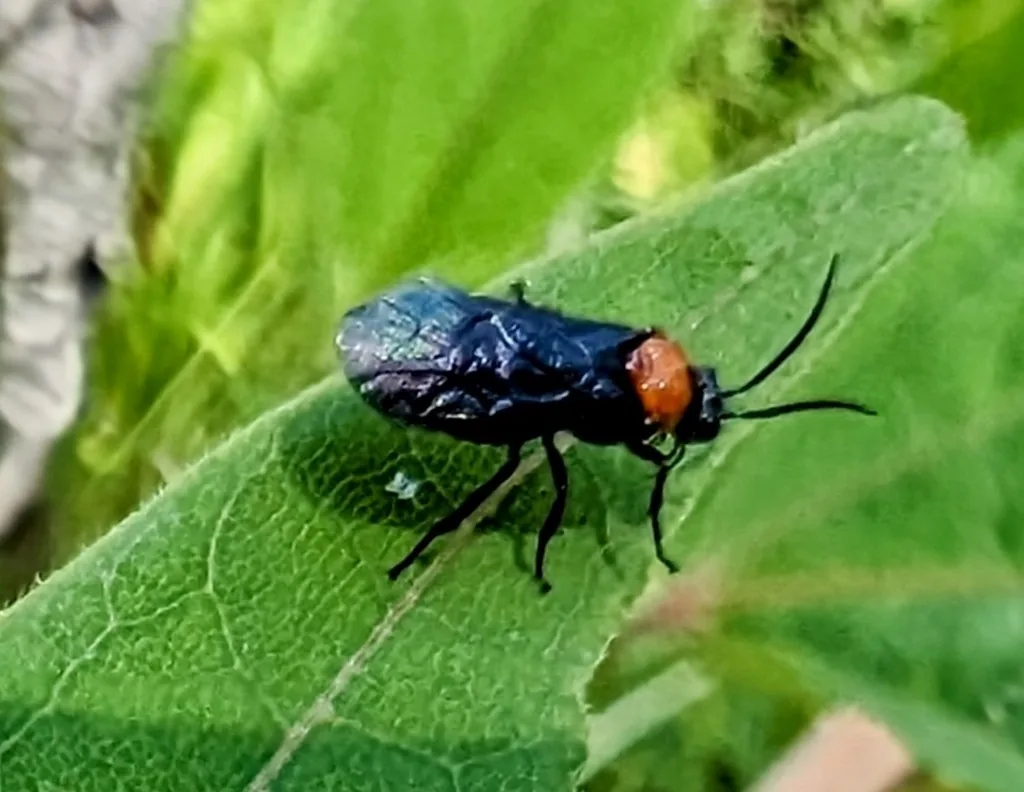
- Adults are tiny, less than 1/4 inch, black and fly-like with a reddish-brown to orange thorax.[1][3]
- The spiny green larvae are less than 3/8 inch long when grown and feed on leaf undersides, so they are easy to overlook.[2][3]
- Like other sawfly larvae they have six to eight pairs of prolegs, more than caterpillars.[2]
Look-alikes
| Look-alike | How to tell them apart |
|---|---|
| Columbine sawfly | Another sawfly of herbaceous perennials, feeding on columbine instead of mallows.[2] |
Where it lives
Reported from North Carolina, Mississippi and Connecticut; larvae have been found from May to October.[1][2][3]
Biology and life cycle
Females insert eggs into leaves, usually near the tip; there are multiple generations a year.[3]
Mature larvae spin tough brownish cocoons, usually at the base of the host plant.[1]
Damage and signs
Health risk
None to people or pets; sawflies don't sting.[2]
Control
Prevention
Check leaf undersides from late spring on; adults gathering on leaves warn that larvae will soon follow.[3]
Pesticides
Larvae are not hard to control with labeled landscape insecticides, but several sprays may be needed through summer; avoid spraying open blossoms to protect pollinators.[1][3]
Common questions
Sources
- NC State Extension, “Hibiscus Sawfly (PDIC Factsheet).” content.ces.ncsu.edu/hibiscus-sawfly (accessed 2026-10-16)
- UConn Integrated Pest Management Program, “Sawflies on Herbaceous Perennials (2020).” ipm.cahnr.uconn.edu/sawflies-on-herbaceous-perennials/ (accessed 2026-10-16)
- Mississippi State University Extension, “Bug-Wise No. 7: Hibiscus Sawfly (May 3, 2004).” extension.msstate.edu/sites/default/files/newsletter/bw0704.pdf (accessed 2026-10-16)
- iNaturalist, “Atomacera decepta taxon page (order and family).” www.inaturalist.org/taxa/130013 (accessed 2026-10-06)