On this page
How to identify it
Look-alikes
| Look-alike | How to tell them apart |
|---|---|
| Columbine leafminer | The other common columbine pest; its maggots tunnel inside the leaves instead of eating them from the edge.[1] |
Where it lives
A European species first found in North America in Ottawa in 1963 and in New York in 1985; it has spread west to Minnesota.[1][2]
Biology and life cycle
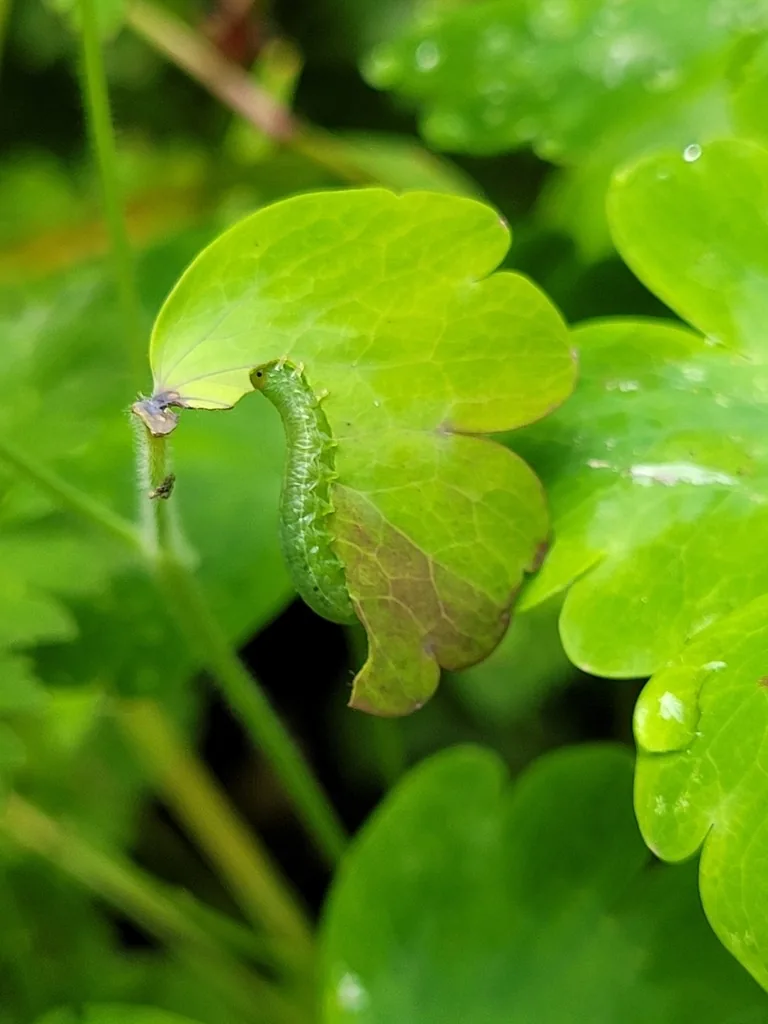
Females lay eggs on leaves in late spring; larvae are active from about April to June and drop off to pupate in brown cocoons in the leaf litter.[1][2]
There is one generation a year.[1]
Damage and signs
Health risk
Control
Sanitation
If most leaves are gone, cut the plant to the ground and destroy the remains.[1]
Traps and physical control
Inspect plants in spring and pick or knock larvae into soapy water.[1]
Pesticides
Insecticidal soap kills small larvae it covers; Bt does not work because sawflies are not true caterpillars.[1]
Common questions
Sources
- University of Wisconsin-Madison Extension, “Common Columbine Pests: Columbine Leafminer and Columbine Sawfly.” hort.extension.wisc.edu/articles/common-columbine-pests-columbine-leafminer-and-columbine-sawfly/ (accessed 2026-10-16)
- University of Minnesota Extension (What insect is this?), “Columbine sawfly.” apps.extension.umn.edu/garden/diagnose/insect/garden/caterpillars/medium/columbinesawfly.html (accessed 2026-10-16)
- iNaturalist, “Pristiphora rufipes taxon page (order and family).” www.inaturalist.org/taxa/447107 (accessed 2026-10-06)