How to identify it
- Adults are about an inch long, deep metallic blue, with smoky translucent wings and orange, knobbed antennae; females have yellow spots along the sides of the abdomen.[1][2]
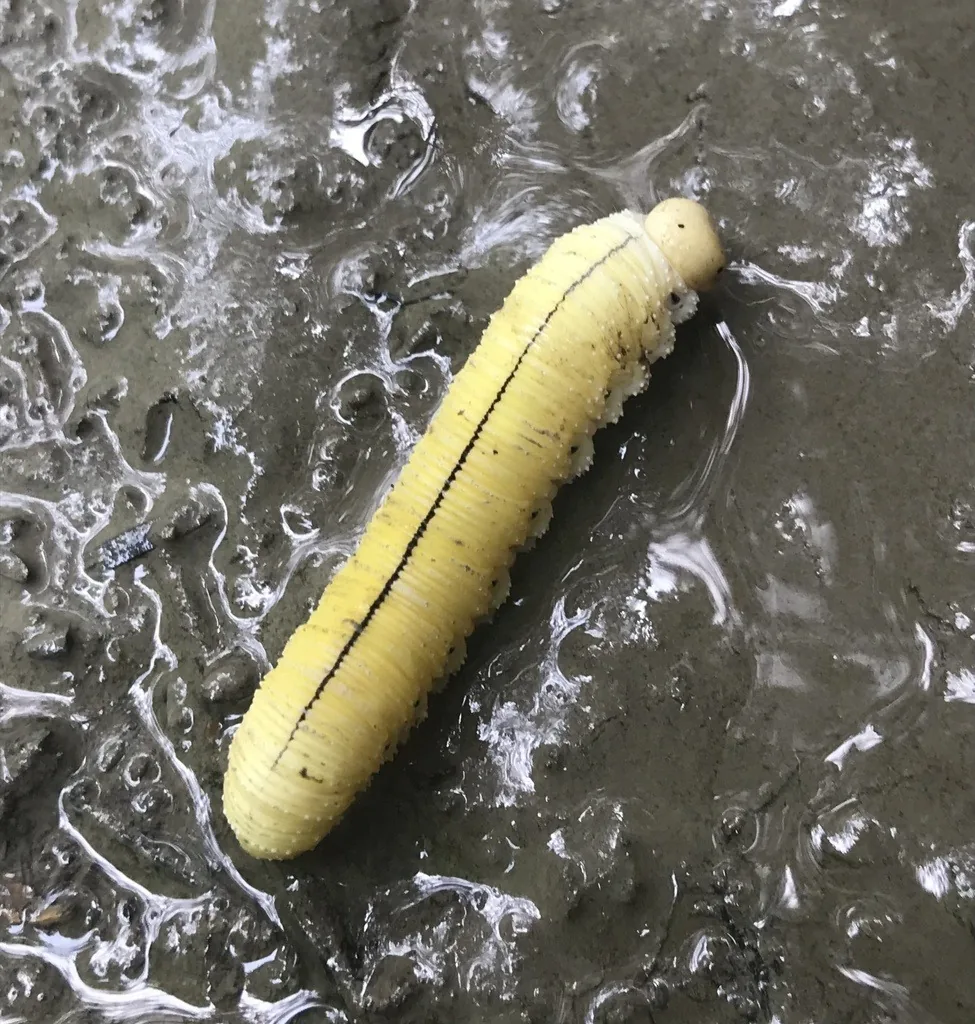
- Larvae grow to about 2 1/4 inches, yellowish white and wrinkled, with a dark stripe down the back.[1][2]
- Like other sawfly larvae, they have more pairs of prolegs than moth caterpillars.[1]
Look-alikes
| Look-alike | How to tell them apart |
|---|---|
| Northern giant hornet | Iowa State lists the elm sawfly among the native insects mistaken for the giant hornet; the sawfly is only about an inch long and can't sting.[2] |
| Cicada killer | Our largest wasp, 1 1/4 to 1 5/8 inches long, black with pale yellow stripes and spots and translucent orange wings.[2] |
Where it lives
It has defoliated willow and elm in the northern Great Plains and the Midwest, while NC State calls it uncommon in North Carolina.[1][2]
Biology and life cycle
Adults emerge from late May through June; females saw pockets in elm leaves and lay up to 12 eggs per leaf, 30 to 150 eggs in all.[1]
Larvae feed for about a month, then spin tough, papery cocoons about 1 inch long in leaf litter or just under the soil.[1]
Some spend two or more winters in the cocoon, so there is one generation a year or every two to three years.[1]
Damage and signs
Health risk
None; sawflies don't sting and are harmless.[2]
Control
Prevention
Monitor susceptible trees for larvae from late June to August.[2]
Biological control
Eggs and larvae are parasitized by wasps and flies, and shrews and deer mice eat the larvae in their cocoons.[1]
Pesticides
Sawflies are sensitive to insecticides; products labeled for leaf-feeding pests of elm should give adequate control.[1]
Common questions
- What is the big blue wasp on my elm?
- Probably an adult elm sawfly, a non-stinging relative of wasps about an inch long.[1][2]
- Is the elm sawfly a giant hornet?
- No. It is much smaller, metallic blue and can't sting.[2]
- What is the big yellow caterpillar curled on elm leaves?
- Likely an elm sawfly larva, up to 2 1/4 inches long with a dark stripe down the back.[1][2]
Sources
- NC State Extension, “Elm Sawfly (PDIC Factsheet).” content.ces.ncsu.edu/elm-sawfly (accessed 2026-10-15)
- Iowa State University Extension and Outreach, “Elm Sawfly and other Asian Giant Hornet Look-Alikes (Yard and Garden, June 2020).” yardandgarden.extension.iastate.edu/article/2020/06/elm-sawfly-and-other-asian-giant-hornet-look-alikes (accessed 2026-10-15)
- iNaturalist, “Cimbex americanus taxon page (order and family).” www.inaturalist.org/taxa/1028452 (accessed 2026-10-06)