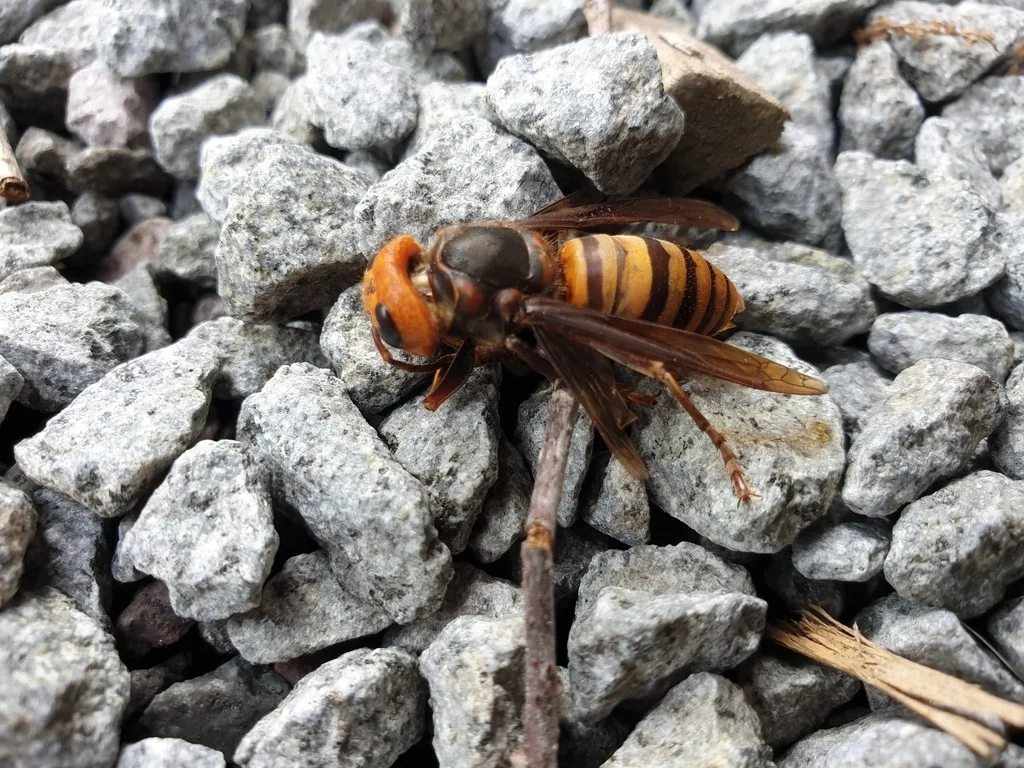
How to identify it
Look-alikes
| Look-alike | How to tell them apart |
|---|---|
| European hornet | Established in the eastern U.S.; its thorax, top of head and cheeks are reddish brown, and its black abdominal bands trail teardrop shapes.[6] |
| Cicada killer | A large, slender solitary wasp with a black abdomen marked with yellow splotches, reddish eyes and amber wings; it nests alone in soil burrows.[6] |
| Yellowjackets | Less than an inch long, with yellow faces and a black area near the top of the head.[2] |
| Bald-faced hornet | About an inch long and mostly black with white stripes and spots.[2] |
Where it lives
In North America it was found only in northwestern Washington and British Columbia. It hasn't been confirmed anywhere else in the United States and was declared eradicated from the U.S. at the end of 2024.[4][1][6]
Biology and life cycle
It forms large colonies, usually nesting in the ground in its native range but also in tree cavities.[2][5]
All four nests found in Washington were in cavities of alder trees in Whatcom County, located and destroyed in 2020 and 2021.[5][4]
Adults hunt other insects, gather tree sap and raid other bee and wasp colonies; homeowners would be most likely to meet foragers from July to October.[5]
Damage and signs
Health risk
Not typically aggressive, but it stings when handled or defending its nest. Its longer stinger can pierce beekeeping suits, and a sting can deliver more venom. Seek medical attention immediately after multiple stings.[3][5]
Control
When to call a professional
Do not try to remove or destroy a suspected nest yourself; this hornet aggressively defends its nest. Report it so state officials can respond.[5]
In Washington, report suspected invasive hornets to WSDA with a photo if possible; elsewhere, contact your state agriculture department or apiary inspector.[1]
Current U.S. status
WSDA verified the first two U.S. reports near Blaine in December 2019, the same fall Canada found the hornet at two sites in British Columbia.[4]
By the end of 2021, WSDA had located and eradicated four nests in Whatcom County. No hornets were detected from 2022 through 2024.[4][1]
After three years without confirmed detections, WSDA and USDA declared the northern giant hornet eradicated from Washington and the United States.[1]
WSDA still asks the public to report suspected invasive hornets, and is now also watching for the yellow-legged hornet, a different invasive species.[1]
Common questions
- Are murder hornets still in the United States?
- According to WSDA and USDA, no. The northern giant hornet was declared eradicated from the United States at the end of 2024.[1][4]
- I saw a giant hornet in the eastern U.S. What is it likely to be?
- Most likely a European hornet or cicada killer, the large wasps most often mistaken for the northern giant hornet.[6]
- What should I include in a hornet report?
- A photo if you can, the location and date, the insect's size and colors, what it was doing, and which direction it flew.[1]
Sources
- Washington State Department of Agriculture, “Invasive Hornets.” agr.wa.gov/departments/insects-pests-and-weeds/insects/hornets (accessed 2026-10-06)
- Washington State Department of Agriculture, “Invasive Hornets: Identification.” agr.wa.gov/departments/insects-pests-and-weeds/insects/hornets/identification (accessed 2026-10-06)
- Washington State Department of Agriculture, “Invasive Hornets: Human Health.” agr.wa.gov/departments/insects-pests-and-weeds/insects/hornets/human-health (accessed 2026-10-06)
- Washington State Department of Agriculture, “Invasive Hornets FAQ: Northern Giant Hornet.” agr.wa.gov/departments/insects-pests-and-weeds/insects/hornets/faq-s/northern-giant-hornet (accessed 2026-10-06)
- Pacific Northwest Insect Management Handbook (Oregon State, Washington State and University of Idaho Extension), “Northern Giant Hornet (2019), Emerging Insect Pests in the Pacific Northwest.” pnwhandbooks.org/insect/emerging-insect-pests/ongoing-eradication-programs/northern-giant-hornet-2019 (accessed 2026-10-06)
- Ohio State University Extension (Ohioline), “European Hornets and Look-Alikes (ENT-0102, February 2025).” ohioline.osu.edu/factsheet/ent-0102 (accessed 2026-10-06)
- iNaturalist, “Vespa mandarinia taxon page (order and family).” www.inaturalist.org/taxa/322284 (accessed 2026-10-06)