On this page
How to identify it
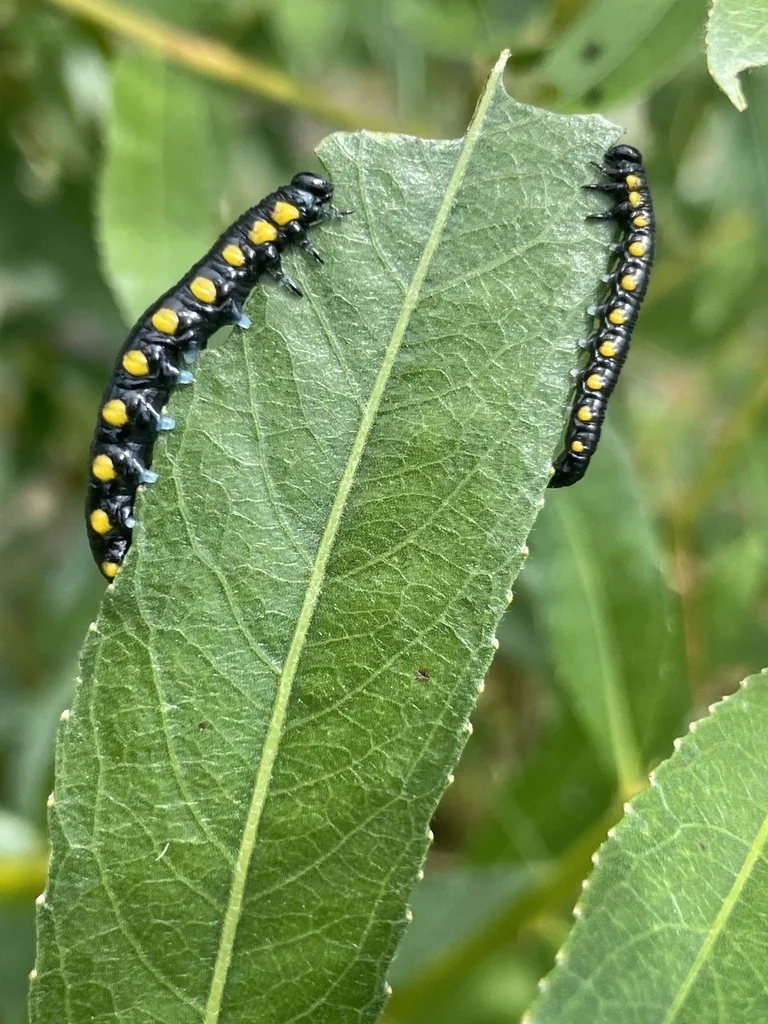
- Larvae are black or greenish-black with a black head and large yellow spots along each side of the body.[1][2]
- Full-grown larvae are about 18 mm (3/4 inch) long.[1][2]
- Like other sawfly larvae they have six or more pairs of prolegs (the fleshy legs on the abdomen) and a smooth body with little or no hair; moth and butterfly caterpillars have two to five pairs.[1]
- The larvae feed side by side in groups. Disturbed sawfly larvae often rear up and arch their bodies together.[1][2]
Look-alikes
| Look-alike | How to tell them apart |
|---|---|
| Moth and butterfly caterpillars | Caterpillars have only two to five pairs of prolegs on the abdomen and can be smooth, hairy or spiny; sawfly larvae have six or more pairs and are smooth. Btk sprays that work on caterpillars do not kill sawflies.[1] |
Where it lives
Southeastern Canada and south and west through the Eastern States to Georgia and Montana, according to the USDA Forest Service. Minnesota Extension lists it among the state's sawflies.[2][1]
Biology and life cycle
Hosts are willows, cottonwood, aspen and other poplars. Willow is the favored host.[1][2]
Winter is spent as a prepupa (the stage between a mature larva and a pupa) in a cocoon in the leaf litter or topsoil beneath the tree. Pupation and adult emergence follow in spring.[1][2]
Females lay eggs in pockets cut into the leaf tissue, and the young larvae feed together in colonies.[2]
In Minnesota, larvae first appear in May and feed through June. They pupate in the soil; some adults come out to lay eggs in July, while others stay in the soil until the following spring. The second generation feeds from July to the end of summer and then goes into the soil for the winter.[1]
Across its range there are usually one to five generations a year depending on location. In the north some individuals stay in diapause for up to 20 months before finishing development.[2]
Damage and signs
- Young larvae chew small holes in the leaves. Older larvae eat nearly the whole leaf, leaving only the midrib.[1][2]
- Defoliation is occasionally severe. Willows in ornamental plantings and along streams are sometimes heavily stripped, and basket willows in the South have been badly damaged.[1][2]
- Minnesota Extension notes that sawfly feeding usually spoils a plant's appearance more than its health. Recently transplanted trees and plants stripped several years in a row are more likely to be hurt.[1]
Health risk
The sources discuss only leaf feeding on willows and poplars and describe no harm to people.[1][2]
Control
Prevention
Check willows and poplars for larvae in spring and again in mid-summer, when the second generation feeds.[1]
Keep trees healthy with good site choice, watering and fertilizing; a healthy plant suffers less from sawfly feeding.[1]
Traps and physical control
Pick off small groups and drop them into a pail of soapy water, crush them on the plant, or knock them off with a strong spray of water.[1]
Pesticides
If a pesticide is needed, treat while larvae are half grown or smaller. Once they are full grown the damage is done. Because the larvae feed in groups, spot-treat the infested branches instead of the whole tree.[1]
Insecticidal soap and horticultural oil work on small numbers of young larvae and spare most natural enemies, but they kill only the larvae they touch. Azadirachtin and spinosad stay active on the foliage for one to two weeks. Minnesota Extension also lists permethrin, bifenthrin, lambda-cyhalothrin and carbaryl as contact options.[1]
Bacillus thuringiensis var. kurstaki (Btk) does not work: it kills moth and butterfly caterpillars, not sawfly larvae.[1]
Common questions
- What are the black caterpillars with yellow spots on my willow?
- Most likely willow sawfly larvae. They are black or greenish-black with large yellow spots along the sides, grow to about 3/4 inch, and feed in groups on willow and poplar leaves.[1][2]
- Will Bt kill willow sawflies?
- No. Btk only affects moth and butterfly caterpillars. Insecticidal soap, horticultural oil, azadirachtin or spinosad on young larvae are the low-impact choices.[1]
- Will willow sawflies kill my tree?
- Usually not. Sawfly feeding mostly affects appearance, and healthy plants tolerate it, though willow sawflies occasionally defoliate willows heavily.[1][2]
Sources
- University of Minnesota Extension, “Sawflies (J. Hahn, J. Lloyd).” extension.umn.edu/yard-and-garden-insects/sawflies (accessed 2026-11-10)
- USDA Forest Service, “Eastern Forest Insects, Miscellaneous Publication 1175 (W. L. Baker, 1972; scanned copy).” archive.org/details/easternforestins1175bake (accessed 2026-11-10)
- iNaturalist, “Euura ventralis taxon page (order and family).” www.inaturalist.org/taxa/1354066 (accessed 2026-11-10)