On this page
How to identify it
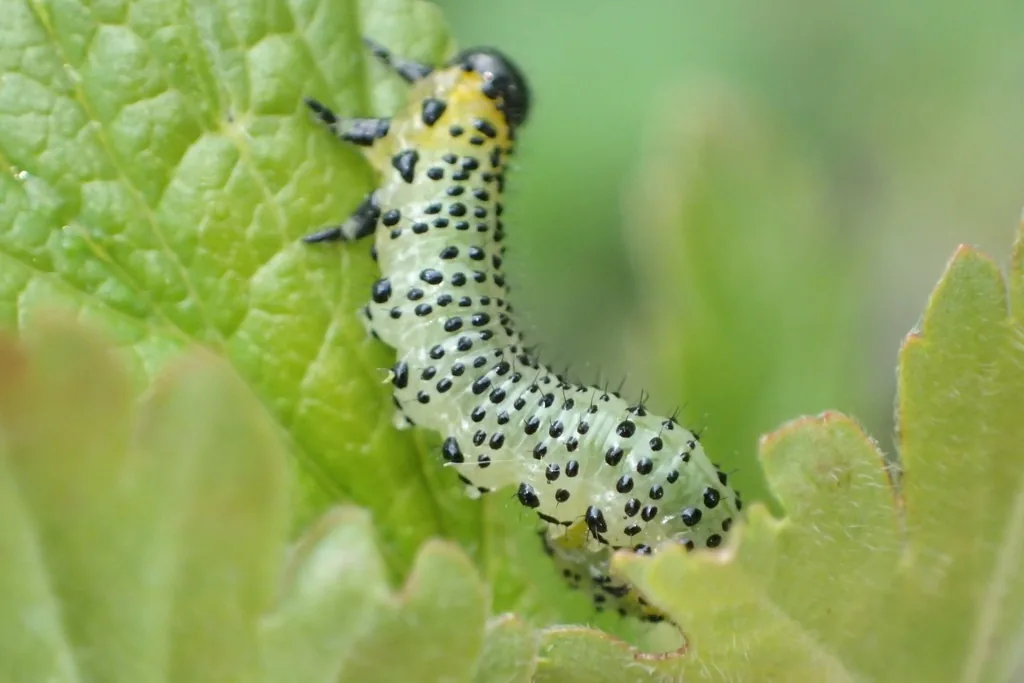
- Young larvae are whitish to pale green; older ones are greenish with black spots, black heads and yellow patches near the head, about 1/2 inch long when full grown.[1][3][2]
- The larvae usually feed along the leaf edge and often curl into a J shape.[3][1]
- Adults are small, thick-bodied sawflies about 1/3 inch long; males are mostly black, and the slightly larger females have a light brown or yellow-marked abdomen.[3][1][2]
Look-alikes
| Look-alike | How to tell them apart |
|---|---|
| Currant spanworm | The larva of a moth, Itame ribearia, also feeds on currant and gooseberry leaves and is spotted too, but it is an inchworm that moves with a looping walk.[3] |
Where it lives
It is an introduced sawfly. Colorado State says it is likely widespread in that state, spreading mostly with infested plants, and it is a pest of currants and gooseberries in the Pacific Northwest as well.[3][1][2]
Biology and life cycle
It spends the winter as a larva in a cocoon in the soil around previously infested bushes, and the adults emerge in spring as the leaves come out.[3][1][2]
Females lay short rows of white eggs along the midrib on the underside of shaded leaves in the interior of the bush, and the eggs hatch in one to two weeks.[3][2]
The larvae feed for two to three weeks, then drop to the ground and dig into the soil to pupate.[2][3]
Colorado State reports one generation a year there; in the Pacific Northwest a second generation of larvae turns up around harvest, in June or July.[3][1][2]
Damage and signs
- Young larvae chew small shotholes in the middle of interior leaves, then move to the leaf edges; in outbreaks whole leaves are eaten except the larger veins.[3][2]
- Heavy early-season defoliation can cut fruit yields this year and next, expose berries to sunscald, and weaken bushes so other pests such as the currant borer do more harm.[3]
Health risk
It feeds only on currant and gooseberry leaves; WSU, the PNW Handbook and Colorado State mention no risk to people.[1][2][3]
Control
Prevention
WSU suggests floating row cover may be useful, and the PNW Handbook advises cutting out and destroying badly infested canes.[1][2]
Traps and physical control
Check bushes daily in April for small holes in the centers of leaves near the middle of the plant; catching the first larvae early is what limits the damage.[2][1][3]
Hand-pick larvae or the leaves they're on, shake the bush over a container, or knock them off with a hard jet of water; many dislodged larvae never make it back onto the plant.[3][2][1]
Pesticides
Chemical options are limited on currants and gooseberries. The PNW Handbook lists no products registered for home-garden use, while Colorado State notes some pyrethrins formulations allow use on these crops; don't spray unless larvae or damage are present.[2][3][1]
Common questions
- Is the green spotted caterpillar on my currants a caterpillar?
- It's a sawfly larva, not a moth caterpillar. Its relatives are wasps, and the adult is a small, thick-bodied sawfly you may see flying around the bush in spring.[3][1]
- When should I look for imported currantworms?
- Start in April, as the leaves come out: look for small holes in the centers of leaves toward the middle of the bush, and check again around harvest for a second generation.[2][1]
Sources
- Washington State University Extension, “Currant, Gooseberry: Imported currantworm (HortSense).” hortsense.cahnrs.wsu.edu/fact-sheet/currant-gooseberry-imported-currantworm/ (accessed 2026-10-19)
- Oregon State University, Washington State University and University of Idaho Extension, “Currant and gooseberry: Imported currant worm (Pacific Northwest Insect Management Handbook).” pnwhandbooks.org/insect/small-fruit/currant-gooseberry/currant-gooseberry-imported-currant-worm (accessed 2026-10-19)
- Colorado State University, Department of Agricultural Biology, “Imported Currantworm (Currant Sawfly), Colorado Insect of Interest (W. Cranshaw).” webdoc.agsci.colostate.edu/bspm/arthropodsofcolorado/Imported-Currantworm.pdf (accessed 2026-10-19)
- iNaturalist, “Euura ribesii taxon page (order and family).” www.inaturalist.org/taxa/1265392 (accessed 2026-10-06)