The short answer
- Confirm it first: in the evening or at night, use a flashlight and feel through the soil surface within about a foot of a cut plant. Cutworms are smooth, 1 to 2 inches long when grown, and curl into a C when disturbed.[3][4][1]
- Pick them off and crush them or drop them into soapy water. UC IPM calls handpicking at night with a flashlight very effective.[1][3][4]
- Put a collar around each transplant, pushed into the soil and standing a couple of inches above it. Cardboard, plastic, foil, cut drink bottles or cans with both ends removed all work.[3][4][5][6]
- Clean up: remove plant residue and weeds, keep the garden weed-free over winter, and till before planting to expose larvae and pupae.[1][3][2]
- Plant a few extra seedlings or sturdy transplants to allow for some losses.[1]
- Sprays are rarely needed in a home garden. If you use one, Bt or spinosad on larger plants works only when the caterpillars eat it, so apply in the evening and target young larvae.[3][1][5][7]
Cutworm species
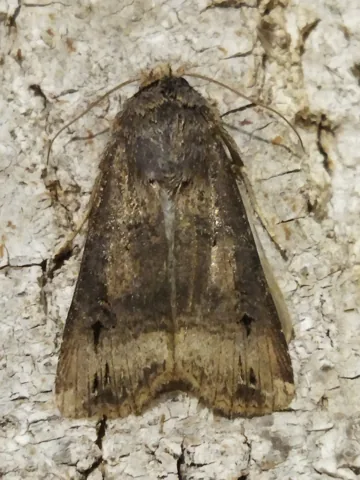 Cutworms
Several moth species, e.g., black cutworm (Agrotis ipsilon)
Cutworm is a general name for the caterpillars of dozens of moth species. They earned the name by cutting off young plants at or just below the soil line, and seedlings and fresh transplants suffer most.
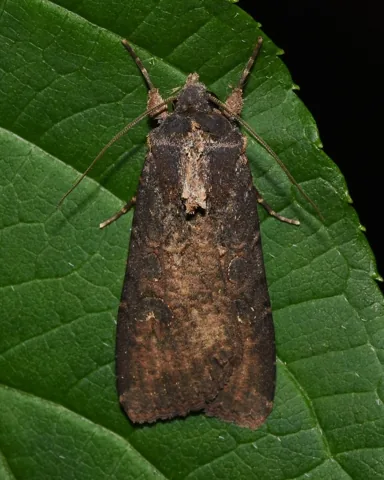 Variegated Cutworm
Peridroma saucia
The variegated cutworm, nicknamed the climbing cutworm, is a plump moth caterpillar that climbs plants at night to eat leaves, flowers, buds and fruit, and it also cuts off seedlings near the soil line.
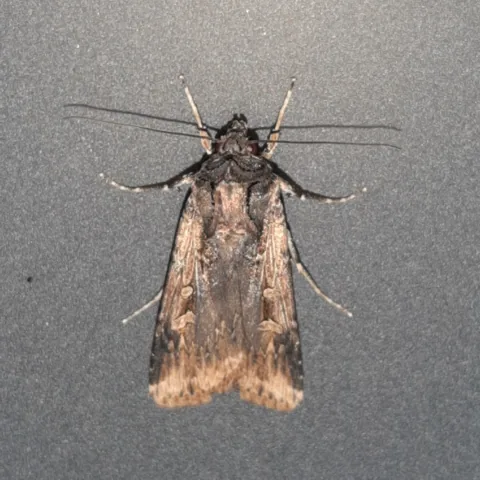 Granulate Cutworm
Feltia subterranea
The granulate cutworm is a night-feeding caterpillar that cuts off young vegetable plants near the ground. It ranges across the Americas, and NC State Extension finds it more abundant in the southern part of its range, while the black cutworm is more abundant in the north.
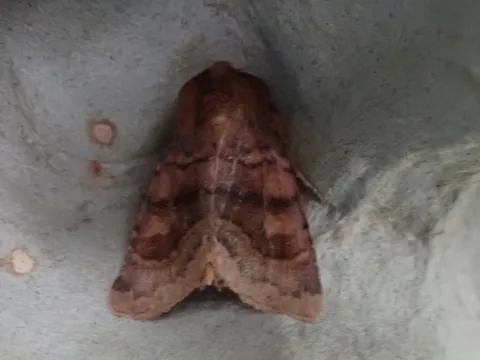 Bronzed Cutworm
Nephelodes minians
The bronzed cutworm (Nephelodes minians) is a large, dark brown cutworm with a bronze sheen and three narrow yellow stripes down its body. It is one of the cutworms most often found in turf, where it clips grass blades at or near the soil surface and leaves small brown circular patches, and in spring gardens it can cut off newly planted seedlings. Unlike several other cutworms it has a single generation a year.
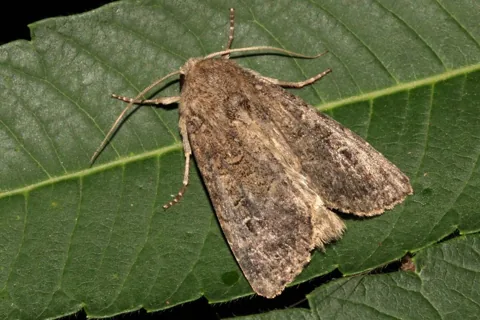 Glassy Cutworm
Apamea devastator
The glassy cutworm (Apamea devastator; older sources call it Crymodes devastator) is a true subterranean cutworm. Its glossy, semi-translucent greenish-white to dirty gray larva has a prominent red-brown head and spends nearly its whole life inside grass crowns or among the roots, so the damage shows up as browning, loosened or dead patches of established grass in fall and spring that are often blamed on winterkill.
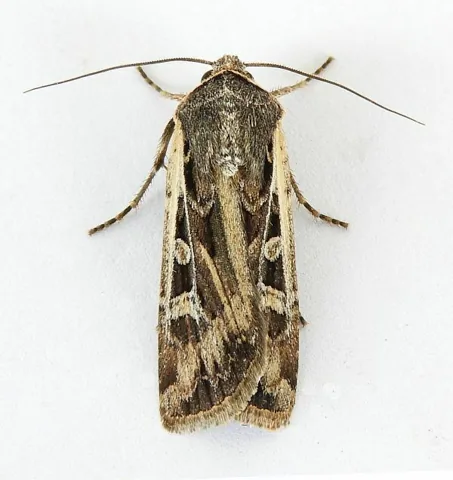 Miller Moth (Army Cutworm Moth)
Euxoa auxiliaris
Miller is a name for any moth that turns up in large numbers around homes. In Colorado and much of the Rocky Mountain West it is mainly the adult army cutworm, which passes through on a yearly migration from the plains to the mountains.
Is it cutworms?
Cutworms curl their bodies around a stem and chew through it just above the soil, so the plant falls over. A plant that was chewed but not cut through wilts.[3]
Look in the morning, when damage is fresh. Clipped or wilting plants and droppings on the ground near them are signs of cutworm feeding. Because the caterpillars hide by day, it's common to find damaged plants and no larvae.[3]
The larvae are plump, smooth, nearly hairless caterpillars, 1 to 2 inches long when full-grown. Color ranges from dingy white to tan, brown, gray, green, pink or black, plain or spotted or striped, depending on the species. A disturbed cutworm curls into a tight C.[4][3][1]
Cutworms don't only cut stems. Some species chew holes in leaves or bore into heads of lettuce and cabbage-family crops, eat into young fruit, or feed on the blossoms and leaves of ornamentals.[1]
The moths themselves do no damage. They are drab, night-flying, gray-brown moths; adults feed on flower nectar and only the larvae harm plants.[3][4]
Four ways cutworms feed
New Hampshire Extension sorts cutworms by how they feed, which also tells you which defense fits.[4]
- Surface cutworms chew plants just above or just below the soil, usually only enough of the stem to topple the plant, and sometimes drag plant parts into their burrows. New Hampshire Extension says they cause the most damage in gardens and landscapes there, in spring. The black cutworm, greasy gray with black bumps on each segment, is one; it tunnels in the soil and may leave a noticeable hole near the cut plant.[4][1][3]
- Climbing cutworms go up the stems of garden plants, shrubs, vines and trees and eat buds, leaves and fruit. The variegated cutworm is the best-known climber; UC IPM gives mature larvae as 1.5 to 2.0 inches long, pale gray to dark mottled brown with red and yellow dots along the back. UC IPM recommends sticky collars to keep climbing cutworms off berries.[4][3][1]
- Army cutworms gather in great numbers, strip one area and move on by the thousands, eating plants mostly from the top down.[4]
- Subterranean cutworms stay in the soil and feed on roots and underground stems. Minnesota Extension says the glassy cutworm, for one, stays in the soil and feeds on roots.[4][3]
Which cutworm is it?
Most cutworm species look very similar. Which ones you meet depends on region: in Minnesota, black and variegated cutworms migrate in from the south each year, while dingy, bronzed and glassy cutworms are native and overwinter there as eggs or larvae in weedy or grassy areas.[3]
Minnesota Extension lists the bronzed, variegated, black, dingy, glassy and army cutworms as the most common species there. In Utah, the black and variegated cutworms are the two most common in turf. In Texas, Travis County Extension warns gardeners about the granulate cutworm, grayish-red with a brown head, which feeds on beans, cabbage-family crops, melons, potatoes, lettuce, onions, tomatoes, peppers and many other vegetables.[3][7][5]
When cutworms strike
Cutworms are mainly a spring problem. Damage is worst early in the season when plants are small; the caterpillars stay active through summer but are rarely a problem after spring.[1][3]
The exception is climbing feeding later in the season. Minnesota Extension says you may find cutworms climbing tomatoes, peppers and celery to eat leaves and fruit, and UC IPM says tomatoes touching the ground suffer the most fruit injury.[3][2]
- Overwintering: New Hampshire Extension says most species spend winter in the soil or under plant debris as partly or fully grown larvae, start feeding in early spring and pupate in early summer. Utah State says the turf species there overwinter as pupae. Species differ.[4][7]
- Eggs: most species lay on the stems of grasses and weeds, and some on bare ground. Minnesota Extension says moths lay on any green plants early in spring, weeds and cover crops included, and a female can lay hundreds of eggs. Utah State gives more than 1,200 eggs in less than 10 days for the turf species.[4][3][7]
- Egg-laying season: Minnesota Extension says it runs from early spring (black cutworm) to late summer or fall (dingy, glassy and bronzed cutworms). New Hampshire Extension says adult females lay in fall, so it advises removing weeds and mowing grass close then.[3][4]
- Hatch: from a few days to two weeks, depending on the species.[4]
- Young larvae feed on leaves or small roots until about 1/2 inch long, then start cutting or burrowing through seedling stems. Control works better while the larvae are small.[3]
- Generations: up to three a year (Minnesota Extension) or up to four depending on temperature (Utah State, turf species). Utah State says the whole life cycle takes about 60 days.[3][7]
How to find them
Cutworms feed in the evening or at night and hide in plant debris or soil during the day, so a daytime look often finds damage but no caterpillar.[3][6]
- Search in the late afternoon and evening, when cutworms are active, or go out after dark with a flashlight and check the base of freshly cut plants and the top layer of soil.[3][4][6]
- By day, scratch the soil at the base of damaged plants. Minnesota Extension says to run your hand over the soil within one foot of the damage, rolling over clumps and other hiding spots.[6][3]
- Check the edges first. On farms, cutworms often move in from grassy or weedy edges, and digging at the base of plants with small areas of leaf feeding can turn up a young cutworm before it starts cutting.[3]
- Look at wilted plants closely to see whether the stem was partly cut at the soil line.[3]
Clean up and prepare the bed
Much of cutworm prevention happens before planting, by taking away the weeds and residue where moths lay eggs and young larvae feed.[3][1]
- Remove plant residue and weeds, and keep the garden weed-free through winter.[1][3]
- Till before planting to expose and kill larvae that survived the winter. UC IPM's tomato guidelines say tilling at least 2 weeks before planting helps destroy residue that could hold larvae and pupae, especially after alfalfa, beans or a legume cover crop.[3][2]
- Till in fall as well to destroy larvae or pupae in the soil, especially if you are turning sod, hay or a grassy fallow area into garden.[3]
- End cover crops early so they aren't green and inviting when moths are laying eggs.[3]
- Use compost rather than green manure, which Minnesota Extension says may encourage egg-laying. In a field study, black cutworm damage in nematode-treated plots was greater where fresh cow manure had been added than in plots with no fertilizer; composted manure didn't have that effect.[3][11]
- Keep a 3 to 4 foot strip of bare, dry soil around the garden or a valuable planting, which cutworms find unattractive to cross.[3]
- Weeds hold cutworms whether they are living or dead, so kill and remove them or till them under well before planting. If pupae are already in the soil, removing host plants alone may not stop damage.[2][6]
Collars: the main defense for transplants
A collar physically blocks larvae from reaching the stem. The key is that it sits partly in the soil and partly above it.[5][3]
Sources give different sizes, so err on the generous side. Minnesota Extension says push one end a few inches into the soil and leave several inches above ground, which it says stops most cutworm species. New Hampshire Extension says at least an inch down and two inches up. Washington State's Hortsense says 2 inches into the soil and 2 inches above it.[3][4][6]
Minnesota Extension notes that research on collars in farm plantings is limited, although its home garden advice recommends them.[3]
- Materials named by extension services: aluminum foil, cardboard or sturdy cardboard, plastic, cut-up drink bottles, milk cartons, toilet paper rolls, sections of PVC pipe, and food cans with both ends cut out. Foil can also be wrapped directly around the stem.[3][4][5][6]
- A collar can circle one plant or a group of plants.[6]
- UC IPM also suggests screen or protective cloth over seedlings.[1]
- For climbing cutworms in perennial crops such as berries, UC IPM recommends sticky collars on the stems instead.[1]
Row covers
Row cover can keep moths from laying eggs on the leaves of host plants, but Texas A&M AgriLife says to use it only if you're confident no pupae are already in the soil. Our row cover guide covers fabrics and installation.[5]
Handpicking and natural enemies
Removing cutworms by hand is the first-choice control in the extension sources here; Washington State says to pick non-chemical options first.[1][3][6]
- Pick cutworms off at night and crush them or drop them into a bucket of soapy water. UC IPM rates night handpicking with a flashlight as very effective.[1][3][4]
- If you find eggs or egg clusters on leaves, squash them or remove them.[5]
- Clip and dispose of leaves and blossoms with cutworms on them.[1]
- Birds and spiders eat cutworms; Washington State lists encouraging them among its non-chemical options.[6]
- Plant more than you need, or use hardy transplants, to absorb some losses. Cutworm damage is often patchy, so UC IPM's tomato guidelines suggest replanting the hit spots rather than treating the whole planting.[1][2]
Bt, spinosad and other sprays
Minnesota Extension says pesticides are usually not necessary in the home garden, and UC IPM says they are not very effective and not recommended on ornamentals. UC IPM says larger garden plants may be protected with Bt or spinosad sprays.[3][1]
Timing is the hard part. Cutworms spend the day buried in soil, so a spray on the leaves only works if they come up and eat or touch it. Minnesota Extension's farm advice says midnight to dawn is often the most effective time, and that a treatment must land before the caterpillars are big enough to cut plants, since they can still cut plants before they die.[3]
- Bacillus thuringiensis (Bt) var. kurstaki: a bacterial insecticide that affects only caterpillars and helps conserve predatory insects. It works only after it is eaten; death takes 1 to 5 days, and young larvae are most affected. Washington State says it gives some control if caterpillars eat enough, and suggests a spreader-sticker with liquid Bt. Spray in the evening, with good coverage.[5][8][6]
- Spinosad: a nerve poison that kills insects that eat or touch it, typically within 1 to 2 days. Sunlight breaks it down; half-lives on leaves are 2 to 16 days. UC IPM's tomato guidelines call it a stomach poison, say to apply when eggs first hatch to target young larvae, and say heavy infestations need a second application in 4 or 5 days. Some formulations are approved for organic growing.[9][2]
- Both Bt and spinosad work best against small larvae, according to Utah State, and both need good coverage because they must be eaten.[7][5]
- Insecticidal soap can be used on smaller larvae.[5]
- Cutworm baits: New Hampshire Extension says to sprinkle a cutworm bait around the base of plants while they are young and tender. UC IPM's tomato guidelines list a carbaryl bait as a ground application, and say not to let it drift onto blooming crops or weeds where bees forage.[4][2]
- Bt sweet corn: if you grow a Bt variety, check whether cutworms are on its list. You may still see some feeding, because Bt works only after it is eaten.[3]
- Bees: spinosad is very highly toxic to bees, though NPIC reports little or no effect on honey bees and other beneficial insects once sprays have dried. Bt toxins are specific to the target insect family.[9][8]
- Whatever you use, make sure the label lists both the crop and the pest, and follow the days-to-harvest interval. Spot-treat damaged areas instead of the whole garden.[3][4][2]
Beneficial nematodes
Utah State lists the nematode Steinernema carpocapsae as an alternative to chemical control for cutworms and armyworms in turf: apply in early morning or evening, irrigate before and after, use 25 million per 1,000 square feet, and expect to need several applications.[7]
Research backs the idea with limits. In Rutgers laboratory and pot tests, S. carpocapsae tended to be the most virulent of seven nematode species against black cutworms in pots with grass; fourth and fifth instars were usually the most susceptible stages and pupae the least. The authors call for more field testing.[10]
In small field plots of seedling corn, S. carpocapsae reduced black cutworm damage in every fertilizer treatment except the higher rate of fresh manure.[11]
Note the contrast with sprays: Bt and spinosad work best on small larvae, while in the Rutgers study fourth and fifth instars were the most susceptible to nematodes. Our beneficial nematode guide covers buying, storing and applying them.[7][10]
Cutworms in lawns
A few cutworm species feed on turfgrass. They clip blades close to the crown at night and hide in the thatch by day. Utah State says the damage is more scattered than armyworm damage, often small pockets that look like ball marks on a putting green, and that golf courses are especially favored. Birds working the lawn often signal a heavy infestation.[3][7]
To check, pour 2 tablespoons of lemon-scented dishwashing liquid in 2 gallons of water over 1 square foot and watch for 5 to 8 minutes for caterpillars to surface. Utah State's treatment threshold is 10 to 15 larvae per square yard with obvious damage.[7]
Cutworms don't damage roots or crowns, so a properly watered and fertilized lawn can usually recover without insecticide. Damage is erratic, which Utah State says makes preventive treatment unnecessary; avoid overdoing fertilizer and irrigation, which can attract egg-laying females, and spot-treat if needed. Our armyworm and sod webworm guide has the full lawn plan.[7]
Common questions
- What is cutting my seedlings off at the ground overnight?
- Most likely cutworms. Check the soil within a foot of the damaged plants in the evening or with a flashlight after dark for C-shaped caterpillars; black cutworms may leave a hole in the soil nearby.[3][4]
- How deep should a cutworm collar go?
- Sources differ: at least 1 inch into the soil and 2 inches above (New Hampshire), 2 inches into the soil and 2 above (Washington State), or a few inches down and several inches up (Minnesota).[4][6][3]
- Does Bt kill cutworms?
- It can, if the caterpillars eat enough of it. Bt kurstaki targets caterpillars, works best on young larvae and takes 1 to 5 days. Spray in the evening, since cutworms feed at night.[6][8][5]
- Is spinosad safe to use for cutworms in a vegetable garden?
- Spinosad is low in toxicity to people and other mammals, but it is very highly toxic to bees until sprays dry. Follow the label for the crop and the days to harvest.[9][3]
- When are cutworms worst?
- In spring, on seedlings and new transplants. They stay active through summer but are rarely a problem after spring, except for climbing cutworms on crops like tomatoes, peppers and celery.[1][3]
- Do I need to spray for cutworms?
- Usually not in a home garden. Cleanup, collars, handpicking and extra transplants handle most problems.[3][1]
Photo credits
- Cutworms: (c) SteveM4560, some rights reserved (CC BY) — via iNaturalist, CC BY 4.0
- Variegated Cutworm: Chrissy McClarren and Andy Reago, public domain (CC0), via iNaturalist
- Granulate Cutworm: (c) Arthur de Jesús Chavarría Pérez, some rights reserved (CC BY) — via iNaturalist, CC BY 4.0
- Bronzed Cutworm: Lynn Harper, public domain (CC0), via iNaturalist
- Glassy Cutworm: (c) Dan Riley, some rights reserved (CC BY) — via iNaturalist, CC BY 4.0
- Miller Moth (Army Cutworm Moth): (c) jimeckert49, some rights reserved (CC BY) — via iNaturalist, CC BY 4.0
Sources
- University of California Statewide IPM Program, “Cutworms (Home and Landscape).” ipm.ucanr.edu/home-and-landscape/cutworms/ (accessed 2026-11-10)
- University of California Statewide IPM Program, “Cutworms, Tomato: Pest Management Guidelines.” ipm.ucanr.edu/agriculture/tomato/cutworms/ (accessed 2026-11-10)
- University of Minnesota Extension, “Cutworms (Schuh, Hahn and Wold-Burkness; reviewed 2023).” extension.umn.edu/yard-and-garden-insects/cutworms (accessed 2026-11-10)
- University of New Hampshire Cooperative Extension, “Cutworms [fact sheet] (Eaton and Maccini, updated August 2016).” extension.unh.edu/resource/cutworms-fact-sheet (accessed 2026-11-10)
- Texas A&M AgriLife Extension, Travis County, “Cutworms (Wizzie Brown, March 2023).” travis-tx.tamu.edu/2023/03/09/cutworms-by-wizzie-brown (accessed 2026-11-10)
- Washington State University Extension, “Corn: Cutworms and armyworms (Hortsense).” hortsense.cahnrs.wsu.edu/fact-sheet/corn-cutworms-and-armyworms/ (accessed 2026-11-10)
- Utah State University Extension, “Armyworms and Cutworms in Turfgrass (Hodgson, June 2007).” extension.usu.edu/planthealth/research/armyworms-and-cutworms-in-turfgrass (accessed 2026-11-10)
- National Pesticide Information Center, “Bacillus thuringiensis (Bt) General Fact Sheet.” npic.orst.edu/factsheets/btgen.html (accessed 2026-11-10)
- National Pesticide Information Center, “Spinosad Fact Sheet.” npic.orst.edu/factsheets/spinosadgen.html (accessed 2026-11-10)
- Pest Management Science (PubMed 22344709), “Ebssa L, Koppenhofer AM. Entomopathogenic nematodes for the management of Agrotis ipsilon: effect of instar, nematode species and nematode production method. Pest Manag Sci 2012;68(6):947-57.” pubmed.ncbi.nlm.nih.gov/22344709/ (accessed 2026-11-10)
- Journal of Nematology (PubMed 19270937), “Shapiro DI, Lewis LC, Obrycki JJ, Abbas M. Effects of fertilizers on suppression of black cutworm (Agrotis ipsilon) damage with Steinernema carpocapsae. J Nematol 1999;31(4S):690-3.” pubmed.ncbi.nlm.nih.gov/19270937/ (accessed 2026-11-10)