On this page
How to identify it
- Larvae are pale and plain, without conspicuous markings. Young larvae are about 1/2 inch long, smooth and gray-white; full-grown larvae reach about 1 1/2 inches and turn gray-green.[1][2]
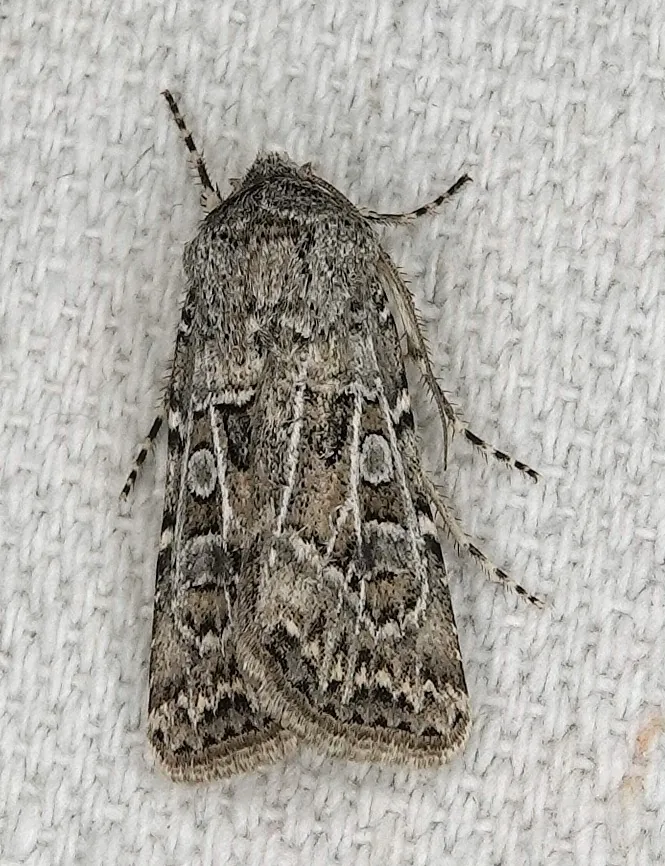
- The moths are light gray with indistinct markings and a wingspan of about 1 1/4 to 1 1/2 inches. Colorado State notes a white underside to the forewings and several distinct cross lines near the wing tips.[1][2]
- The larvae stay below ground, feeding on the stems of the crown just under the soil surface. They are easiest to find in the driest parts of a field, such as hilltops.[1][2]
Look-alikes
| Look-alike | How to tell them apart |
|---|---|
| True armyworm | Armyworm caterpillars are generally larger and have distinct stripes, while pale western cutworm larvae lack distinct markings.[2] |
Where it lives
Kansas State gives its range as the western High Plains to the Pacific and Canada to New Mexico. It is a sporadic problem in the westernmost counties of Kansas, a more consistent one in the northern plains states and southern Canada, and Colorado State calls it a potentially devastating pest of Colorado wheat.[1][2]
Biology and life cycle
Moths emerge from the soil in late summer and fall and are most active at night. Their flights peak about when winter wheat is being tilled and planted, and egg laying typically peaks in September.[1][2]
Females lay eggs in clusters of 30 to 40 in the top 1/2 inch of loose, dry, sandy or dusty soil, and one female can lay 250 to 300. The eggs usually hatch in late winter or very early spring, sooner in warm spells; Colorado State notes hatching in February and March in Montana when the soil surface tops 70°F.[2][1]
Larvae feed through spring, passing through six or eight stages by May and early June, then move to chambers several inches below the soil surface to pupate. Adults can begin emerging in late July.[2][1]
Spring rain keeps it in check. When the previous May and June had fewer than 10 days with a wet soil surface, populations can be expected to rise; with more than 15 such days, they nearly disappear. Rain of more than about 1/4 inch drives the larvae to the surface, where they are exposed to predators, parasites, pathogens and birds. It may take several dry springs in a row to build a serious outbreak.[1][2]
Damage and signs
- Damage often becomes noticeable when wheat begins to joint in March or April. The larvae cut the stems at the crown, mostly at night; look for leaf feeding, wilted leaves and dead tillers. The larvae are easiest to find in the driest spots, such as hilltops.[1][2]
- Besides winter wheat and other small grains, it can feed on corn, sugar beets and alfalfa, and occasionally on weeds.[2]
- Corn is hit occasionally, usually where a wheat field is replanted to corn in early spring. The larvae may cut off small seedlings below ground, and on larger plants they may bore in and kill the growing point.[1]
Health risk
Kansas State and Colorado State describe it only as a crop pest and mention no risk to people or animals.[1][2]
Control
Prevention
Watch the weather and the field. Dry springs set up outbreaks, so after a May and June with few wet days, check wheat in the driest parts of fields, such as hilltops, as the crop begins to joint in March or April. The larvae are in the soil at the base of the plants.[1][2]
Biological control
Rains of more than about 1/4 inch drive larvae to the soil surface, where they are exposed to predators, parasites, pathogens and birds.[1][2]
Pesticides
Because outbreaks are sporadic, insecticides are the main management tool. Kansas State suggests considering treatment when larvae average two or more per foot of row. Control can be difficult because the larvae feed below the soil surface, especially when the soil is dry.[1][2]
Common questions
- Why are patches of my wheat dying on the hilltops in spring?
- Pale western cutworm is one cause in the western Plains. Moths lay eggs in loose, dry soil, so the larvae are easiest to find in the driest parts of a field, such as hilltops, where they cut the stems just below the soil. Look in the soil around the crowns of dying plants.[1][2]
- How can I tell if a pale western cutworm outbreak is coming?
- Look back at the previous May and June. Fewer than 10 days with a wet soil surface means numbers can be expected to rise; more than 15 such days and the cutworms nearly disappear. Several dry springs in a row may be needed for a serious outbreak.[1][2]
- Can pale western cutworm damage corn?
- Occasionally, usually where a wheat field is replanted to corn in early spring. The larvae may cut off small seedlings below ground and kill the growing point of larger plants.[1]
Sources
- Kansas State University Department of Entomology, “Pale Western Cutworm (Wheat Pests).” entomology.k-state.edu/extension/crop-protection/wheat/palewestern.html (accessed 2026-11-08)
- Colorado State University Agricultural Biology, “Pale western cutworm.” agsci.colostate.edu/agbio/ipm-pests/pale-western-cutworm/ (accessed 2026-11-08)
- iNaturalist, “Agrotis orthogonia taxon page (order and family).” www.inaturalist.org/taxa/212873 (accessed 2026-11-08)