On this page
How to identify it
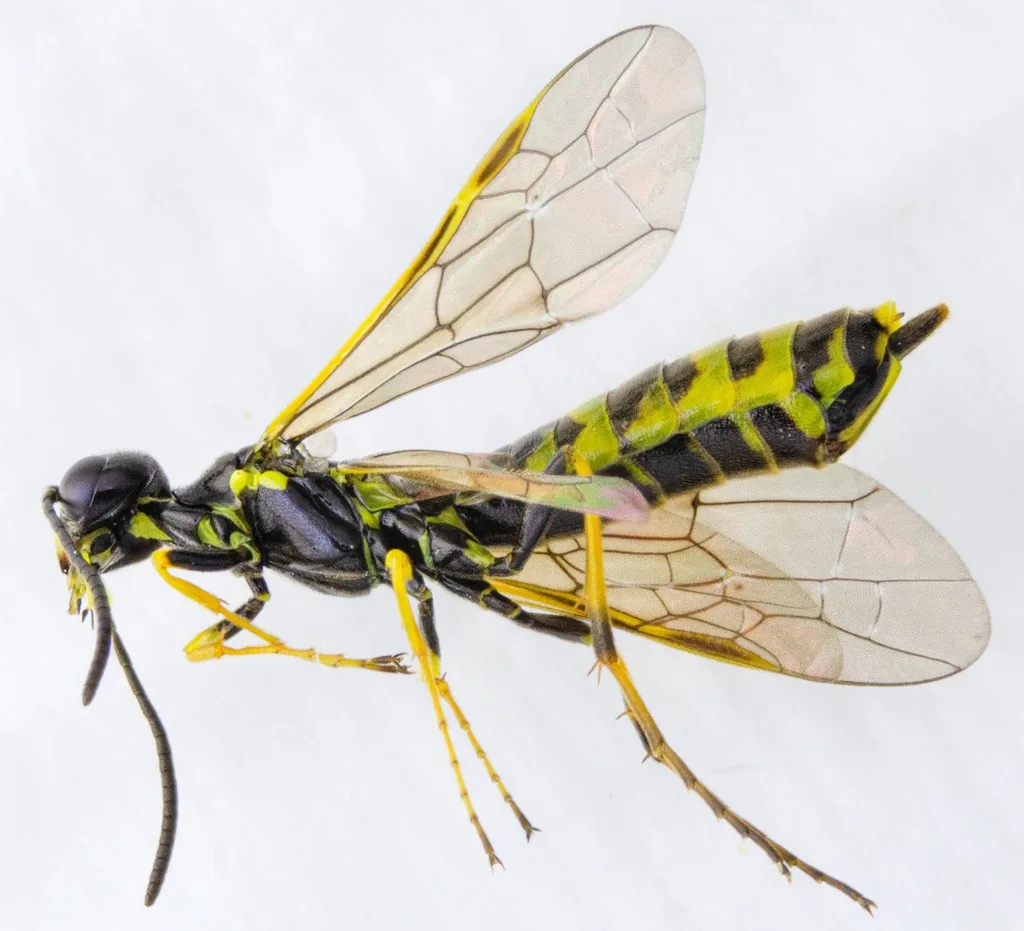
- Adults are dark, slender and less than 1 inch long, with yellow markings on the abdomen. Females are generally larger, with short ovipositor sheaths that stick out just past the tip of the abdomen.[1]
- The larva lives inside the stem. It is colorless at hatching, greenish yellow while feeding and yellow-white when mature, about 1/2 inch long, with a dark, hard head capsule; a larva in diapause curls into an S shape when pulled from the stem.[1]
- Infested stems often have a darkened area just below the nodes and sawdust-like frass inside. After the larva cuts the stem, a stub plugged with frass stays anchored in the ground.[1]
- Eggs are pale white, oval and less than 1/16 inch long, laid singly inside the stem.[1]
Look-alikes
| Look-alike | How to tell them apart |
|---|---|
| Other larvae in grain and grass stems | The wheat stem sawfly larva's dark, heavily hardened head capsule and fairly large body set it apart from other larvae found in cereal or grass stems.[1] |
Where it lives
It occurs across North America from California to the Mississippi River and from British Columbia to Manitoba, and has been reported as far south as Kansas and New Mexico. Kansas State reports it in southwestern Nebraska and northeastern Colorado and probably in northwestern Kansas, though that has not been confirmed.[1][2]
Biology and life cycle
Many authorities consider it native to North America, an insect that adapted to wheat as European settlers began growing cereal crops on a large scale; some researchers suggest it came from northeastern Asia. Kansas State calls it native to the High Plains and notes that it is spreading south.[1][2]
There is one generation a year. Adults live only 7 to 10 days, but emergence stretches over about three weeks and sometimes a month, starting in mid- to late June in North Dakota. Adults are weak fliers that move to nearby fields, and wind can carry them farther.[1]
Females lay eggs in the elongating stems in early summer. Several eggs may go into one stem, more than 10 at high densities, but only one larva survives, feeding on the pith and moving up and down the stem.[1]
As the plant matures, usually before harvest, the larva moves to the base of the stem, chews a notch around the inside and plugs the stem below with frass. It overwinters there in the stub as a mature larva in diapause, then spends about 20 to 30 days as a prepupa and pupa in spring before the adult chews its way out.[1]
Spring, winter and durum wheat are the main hosts, and barley, triticale and spelt are also attacked; barley suffers very little damage, and oats don't support the sawfly even though females lay eggs in them. It also lives in native and cultivated grasses in the genera Agropyron, Bromus, Elymus and Elytrigia.[1]
It once attacked mainly spring wheat, but it has adapted to winter wheat, which now takes extensive damage in the northern Great Plains.[1][2]
Damage and signs
- Larval feeding lowers the stem's vascular efficiency, giving fewer and lighter kernels; yield on infested stems can drop by up to 20 percent, and grain protein can fall too.[1]
- The bigger loss comes from lodging after the stems are girdled. Stem infestations above 70 percent and losses of up to 80 percent from lodging have been recorded in Montana and North Dakota, and harvesting lodged wheat with the header near the ground still leaves losses of 10 to 25 percent.[1]
- Infested plants also have lower test weight and shriveled grain, and not every mature larva girdles its stem.[2]
- Infestations are often heaviest along field edges.[1]
Health risk
It is a plant-feeding wasp. NDSU and Kansas State describe it only as a crop pest and mention no risk to people or animals.[1][2]
Control
Prevention
Check fields several weeks before harvest by pulling plants from across the field, edges included, and splitting the stems; the infestation level is the percentage of stems with larvae. Sweep nets show whether adults are present but don't give a reliable count.[1]
If 10 to 15 percent of the crop was cut by sawflies, plant a solid-stemmed wheat variety the next season. Sawfly larvae die more often and do less damage in solid stems, and the newest solid-stemmed hard red spring wheats yield on par with hollow-stemmed ones, though stem solidness can vary with light, temperature, moisture, nutrients and plant spacing.[1]
Rotating to corn, legumes or other broadleaf crops, which the sawfly won't lay eggs in, can lower numbers in a field, though sawflies can fly in again from nearby fields, grass borders or Conservation Reserve Program land. Planting after May 20 has been suggested, since a late crop won't be at the stem stage when females lay eggs, but it usually lowers yield. Tillage to expose overwintering larvae doesn't kill enough of them and harms the parasitic wasps.[1]
Traps and physical control
Swathing, or straight-cutting with a stripper header, is the only option in the year of an infestation. NDSU recommends it when more than 15 percent of stems are infested, as soon as kernel moisture drops below 40 percent, with a high swathing height that leaves at least the lower third of the plant to spare the parasitic wasps in the stems.[1]
Biological control
Parasitic wasps, mainly Bracon cephi in North Dakota wheat and Bracon lissogaster in native grasses, lay eggs near sawfly larvae inside the stems, and their larvae kill the sawfly larvae. In a 2000 to 2003 survey in western North Dakota, parasitism ranged from 7 to 88 percent and averaged 35 percent. They survive in solid-stemmed varieties, and high swathing and no-till help conserve them.[1]
Pesticides
Insecticides don't work. Eggs, larvae and pupae are protected inside the stem, adults move in and out of fields over a month-long emergence and don't feed or drink, and broad-spectrum sprays kill the beneficial parasitic wasps. Kansas State says there is no chemical control for this pest.[1][2]
Common questions
- Is the wheat stem sawfly a fly?
- No. It is a plant-eating wasp; its larvae feed inside wheat stems.[2][1]
- Why is my wheat falling over before harvest?
- If stems break near the base and the stubs are plugged with sawdust-like frass, wheat stem sawfly larvae may have girdled them. Split some stems and look for the S-shaped larvae.[1]
- Can I spray for wheat stem sawfly?
- No. Sprays haven't worked, because the immature stages are sealed inside the stem and the adults are exposed only briefly. Solid-stemmed varieties, swathing or a stripper header, and parasitic wasps are what manage it.[1][2]
Sources
- North Dakota State University Extension, “Integrated Pest Management of Wheat Stem Sawfly in North Dakota, E1479 (J. Knodel, T. Shanower and P. Beauzay, revised February 2025).” www.ndsu.edu/agriculture/extension/publications/integrated-pest-management-wheat-stem-sawfly-north-dakota (accessed 2026-11-08)
- Kansas State University Department of Entomology, “Wheat Stem Sawfly, Facts and Information on Crop Pests (J. P. Michaud, updated October 2025).” entomology.k-state.edu/extension/crop-protection/wheat/wheat-stem-sawfly.html (accessed 2026-11-08)
- iNaturalist, “Cephus cinctus taxon page (order and family).” www.inaturalist.org/taxa/143245 (accessed 2026-11-08)