On this page
How to identify it
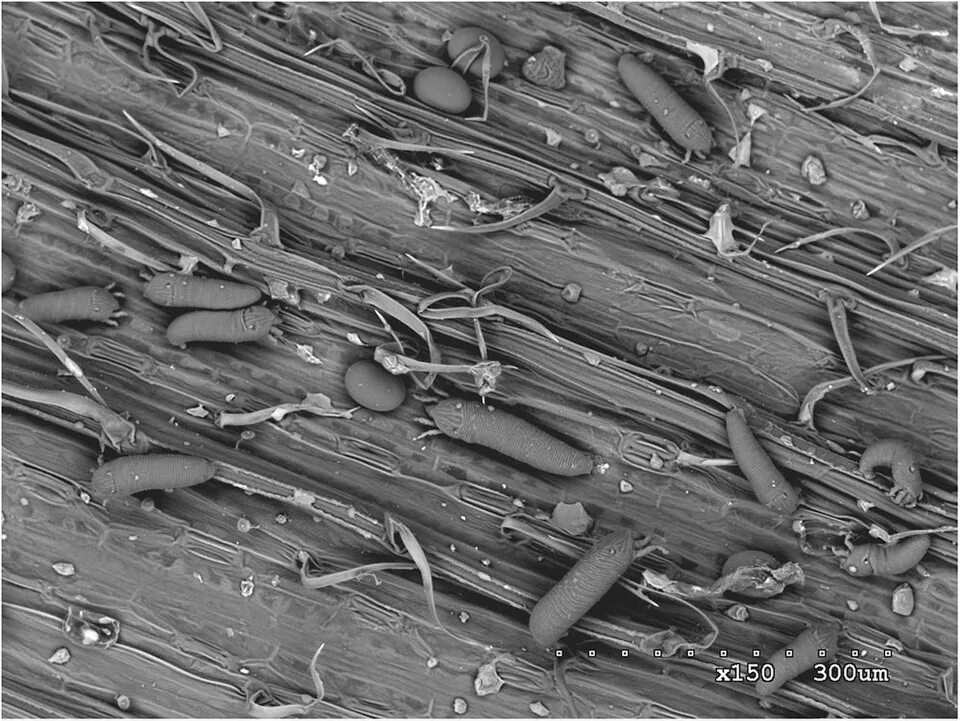
- Adults and young are white and cigar-shaped, tapering at both ends, with only four legs, set near the head. They are nearly invisible to the naked eye; you need a hand lens of 10x or stronger.[1][2]
- They are small enough to fit between the veins of a wheat leaf, and they lay their eggs in rows along the leaf veins.[1][2]
- Heavy populations make the leaf margins roll inward into a tight curl. Most mites are on the newest leaves, and they move to each new leaf as it emerges.[1][2]
Look-alikes
| Look-alike | How to tell them apart |
|---|---|
| Russian wheat aphid | Russian wheat aphids also roll up the newest wheat leaves, which they use as shelter, and the leaves show purple, yellow or white streaks. Look inside rolled leaves for small, lime-green, football-shaped aphids; wheat curl mites are white, cigar-shaped and need a 10x lens.[3][1][2] |
| Brown wheat mite | Brown wheat mites are metallic brown to black, about the size of a printed period. Their feeding stipples the leaves and dries the tips, and heavily infested fields look scorched.[4] |
Where it lives
Kansas State describes it as widely distributed in North America and around the world, wherever wheat is grown. Wheat streak mosaic is one of the most destructive wheat diseases in western Kansas, the High Plains virus affects wheat and corn in the Great Plains, and Colorado State calls the mite a pest of great economic significance in Colorado.[1][2]
Biology and life cycle
Adults, young and eggs overwinter on wheat and nearby perennial grasses. The mites stop reproducing near freezing but can survive several months at near-freezing temperatures and several days at 0°F.[2][1]
They multiply fastest at about 75 to 85°F. In good conditions a generation takes only about 8 to 10 days, and populations seem to be favored by hot, dry weather.[1][2]
When wheat dries down, the mites gather on the flag leaves and heads and are carried by the wind to summer hosts. Volunteer wheat is the most important; corn, barnyard grass, stinkgrass, witchgrass and green foxtail also serve as hosts. In fall the trip reverses, onto newly emerged winter wheat.[1][2]
A mite survives only a few hours off a plant in warm weather, but the wind can carry it up to 10 miles, which is why controlling volunteer wheat is an area-wide job for wheat farmers.[1]
A mite that feeds on an infected plant picks up the virus and carries it through the rest of its development, but does not pass it to its offspring.[2]
Damage and signs
- Heavy feeding makes the leaf margins roll inward. Feeding also triggers chemical changes in the plant that hold back photosynthesis and root growth.[1][2]
- The viruses are the main concern. Chlorotic speckles or streaks on the leaves and stunted plants suggest wheat streak mosaic. Wheat streak mosaic alone averages a 2 to 3% yield loss, but with severe mite infestations and infection in the fall it can cause total loss.[2]
- Infections with wheat streak mosaic and Triticum mosaic together can be especially damaging. Discoloration and stunting in varieties resistant to wheat streak mosaic point to Triticum mosaic, and Colorado State reports no varieties resistant to it.[1][2]
- Hail during heading can knock kernels and mites to the ground. The volunteer wheat that sprouts early is infested right away, building large summer populations and raising the risk for the next fall's seedlings.[1]
Health risk
Kansas State and Colorado State describe it only as a pest of wheat and its grass hosts and mention no risk to people or animals.[1][2]
Control
Prevention
Avoid planting early, which gives the mites more time to build up and spread virus. Don't plant wheat next to late-maturing corn, which can hold mites and wheat streak mosaic virus.[1][2]
Where wheat streak mosaic is common, choose resistant varieties and avoid highly susceptible ones. Some resistance breaks down in hot weather, and some newer varieties resist the mite itself; Kansas State's publication MF-991 rates wheat varieties for their response to the mite and the virus.[1][2]
Sanitation
Destroy volunteer wheat and grassy weeds, with tillage or herbicides, at least two weeks before planting winter wheat. Kansas State calls this the most effective practice against the mite and the diseases it carries.[1][2]
Pesticides
Foliar miticides have never proven effective against wheat curl mites, and Colorado State says there are no viable chemical options and notes that the leaf curling makes the mites very difficult to suppress with insecticides. Prevention is the most effective option.[1][2]
Common questions
- Can I spray for wheat curl mites?
- No spray has proven effective. Kansas State says foliar miticides have never worked against them, and Colorado State lists no viable chemical options. Control rests on killing volunteer wheat and grassy weeds and on planting date and variety choice.[1][2]
- How long before planting should volunteer wheat be destroyed?
- At least two weeks before planting winter wheat in the fall. This is the most effective step against the mite and wheat streak mosaic.[1][2]
- Why did a hailstorm lead to wheat streak mosaic the next fall?
- Hail at heading knocks kernels and mites to the ground. The volunteer wheat that sprouts early is infested at once, mites build up over the summer, and the large population moves to the newly planted wheat in fall.[1]
Sources
- Kansas State University Department of Entomology, “Wheat Curl Mite (Wheat Pests).” entomology.k-state.edu/extension/crop-protection/wheat/curlmite.html (accessed 2026-11-08)
- Colorado State University Agricultural Biology, “Wheat curl mite, Aceria tosichella.” agsci.colostate.edu/agbio/ipm-pests/wheat-curl-mite/ (accessed 2026-11-08)
- Kansas State University Department of Entomology, “Russian Wheat Aphid, Facts and Information on Crop Pests (J. P. Michaud, updated June 2024).” entomology.k-state.edu/extension/crop-protection/wheat/russian.html (accessed 2026-11-08)
- Kansas State University Department of Entomology, “Brown Wheat Mite (Wheat Pests).” entomology.k-state.edu/extension/crop-protection/wheat/brown-wheat-mite.html (accessed 2026-11-08)
- iNaturalist, “Aceria tosichella taxon page (order and family).” www.inaturalist.org/taxa/1663799 (accessed 2026-11-08)