On this page
How to identify it
- The larva has two broad, dull-red stripes running the length of its back and a yellowish-brown head. Full-grown larvae are about 38 millimeters (1 1/2 inches) long.[2]
- Like other cutworms, the larva has three pairs of legs behind the head and usually five pairs of fleshy prolegs on the abdomen, and it curls up when disturbed.[2]
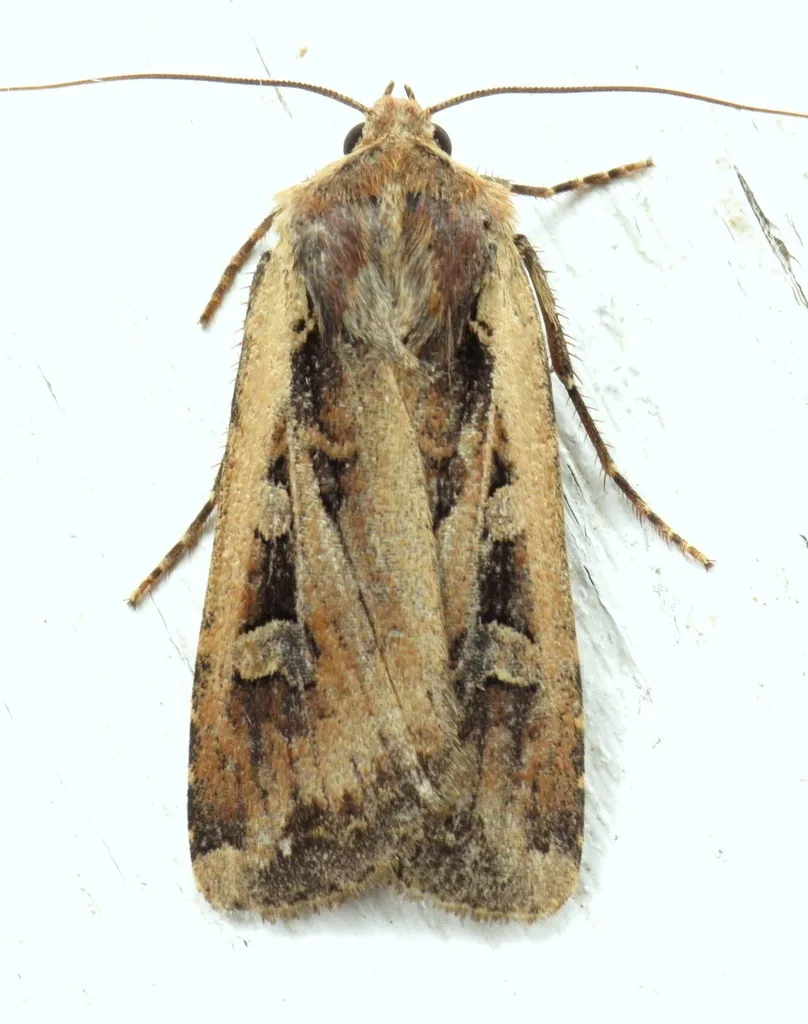
- The adult moths come in four color forms, so the moth is harder to recognize than the larva.[2]
Look-alikes
| Look-alike | How to tell them apart |
|---|---|
| Darksided cutworm | Darksided cutworm larvae are often mixed in with redbacked cutworms in the same fields, and the two can be easy to confuse.[2] |
| Dingy cutworm | Dingy cutworm larvae have a thin light line down the middle of the back, flanked by broader diagonal markings that look like tire tracks, instead of two broad red stripes.[2] |
| Other cutworms | Several cutworm species can be present in the same damaged patch, and some finish feeding earlier in the year than others, so knowing the species can matter.[2] |
Where it lives
It is a frequent and serious pest on the Canadian Prairies, and one of the most damaging cutworms in Manitoba. In the Pacific Northwest it is a key pest of mint east of the Cascades, with severe damage recorded in central Oregon.[1][2][3]
Biology and life cycle
There is one generation a year. Moths fly from midsummer into fall, with a peak in August in Manitoba, and lay their eggs on or just below the soil surface, often in weedy fallow fields, weedy patches in crops or under plants and debris.[2][1][3]
The eggs spend the winter in the soil and hatch in April as the soil warms. The larvae feed for about six to eight weeks, doing most of their damage in June, then pupate; the moths emerge in late June and July.[1][3]
By day the larvae usually stay in the top few centimeters of soil; at night they come to the surface or move underground in search of food. In mint fields they also clip shoots underground during the day.[1][3]
Temperature sets the pace of growth: larvae kept at a constant temperature took an average of 65 days to finish their six larval stages at 15 C (59 F) but only 29 days at 25 C (77 F).[2]
Hot, dry Augusts favor the moths, which need nectar from flowers to produce eggs, and loose, dry soil makes egg laying easier.[1]
Damage and signs
- Young larvae chew small holes and notches in leaves. Older larvae eat into the stems and cut them off at or just below the soil surface, leaving wilted or severed plants.[1][2][5]
- In grain fields, patches of bare soil appear and slowly spread, from an acre or two up to whole fields. The patches often form on knolls and light soils and are easy to mistake for poor germination or drought stress.[1]
- In mint, larvae clip new spring shoots at or below ground, and in some years in central Oregon damage in May and early June has been bad enough to cause extensive stand loss. Damage is worse in sandy, loose soils.[3]
- Its hosts include cereals, canola, mustard, flax, sugar beet, sunflower, peas, alfalfa, most vegetables, tree seedlings and garden flowers. In feeding experiments larvae grew better on canola and peas than on wheat.[1][2][5]
Health risk
These agricultural sources treat it only as a crop and garden pest and do not mention any harm to people.[1][2][3]
Control
Prevention
Keep fallow fields and crops free of weeds in August, when the moths look for weedy ground to lay eggs, and leave fallow soil crusted from late July to late September to discourage egg laying.[1]
Traps and physical control
To starve young larvae before spring seeding, let volunteer growth reach 3 to 5 centimeters (about 1 1/4 to 2 inches), cultivate, and then seed 10 to 14 days later. In mint, fall plowing destroys the eggs and almost always brings infestations down to noneconomic levels.[1][2][3]
Biological control
Parasitic flies and wasps, ground beetles, rove beetles, wolf spiders, birds and diseases all attack cutworms. Disease and parasites are the most important reasons redbacked cutworm numbers fall quickly after an outbreak peaks, and after about two years parasites are usually numerous enough to bring an outbreak down.[2][1]
Pesticides
Foliar insecticides and seed treatments are available for cutworms in field crops; foliar sprays work best when applied in the evening, and sometimes it is most economical to treat only the infested patches. Larvae that have reached 30 to 35 millimeters have already done most of their feeding and may not be worth treating.[2]
Scouting and thresholds
Check seedlings at least weekly from mid-May to mid-June. Because cutworms feed at night, look for notched, wilted or cut plants and dig around them; a garden trowel and a soil sifter help. In Alberta, count larvae in the top 5 to 7 centimeters of soil in 50-by-50-centimeter squares at several spots.[2][1]
Economic thresholds are not firmly established. About 5 to 6 redbacked cutworms per square meter may justify control in cereals, while well-established crops with good moisture can tolerate more.[1][2]
Pheromone traps catch the male moths and have been used to track populations in Alberta since 1978, but they have not proven reliable for predicting the next season's larval numbers.[1][4][2]
Common questions
- What is cutting off my seedlings at the soil line overnight?
- Cutworms such as the redbacked cutworm hide in the soil by day and cut plants at or just below the surface at night. Dig around freshly cut plants to find the curled larvae; redbacked cutworms have two broad dull-red stripes down the back.[1][2]
- When do redbacked cutworms do the most damage?
- Most damage happens in late May and June, while the larvae that hatched in April are feeding on young crops.[1][2]
Sources
- Government of Alberta, “Redbacked cutworm.” www.alberta.ca/redbacked-cutworm (accessed 2026-11-09)
- Manitoba Agriculture, Government of Manitoba, “Cutworms in Field Crops (fact sheet, May 2024).” www.gov.mb.ca/agriculture/crops/insects/pubs/cutworms-in-field-crops.pdf (accessed 2026-11-09)
- Pacific Northwest Pest Management Handbooks (Oregon State, Washington State and University of Idaho Extension), “Mint: Redbacked cutworm (Pacific Northwest Insect Management Handbook).” pnwhandbooks.org/insect/agronomic/mint/mint-redbacked-cutworm (accessed 2026-11-09)
- Journal of Chemical Ecology (via NCBI PubMed), “A four-component pheromone blend for optimum attraction of redbacked cutworm males, Euxoa ochrogaster (D. L. Struble; Journal of Chemical Ecology 7(3): 615-625, 1981; abstract).” pubmed.ncbi.nlm.nih.gov/24420600/ (accessed 2026-11-09)
- Journal of Economic Entomology (via NCBI PubMed), “Influence of host plant species and fertilization regime on larval performance and feeding preference of the redbacked cutworm and the pale western cutworm (R. E. Batallas and M. L. Evenden; Journal of Economic Entomology 113(2): 731-741, 2020; abstract).” pubmed.ncbi.nlm.nih.gov/31814017/ (accessed 2026-11-09)
- iNaturalist, “Euxoa ochrogaster taxon page (order and family).” www.inaturalist.org/taxa/219979 (accessed 2026-11-09)