On this page
How to identify it
- The larva is glossy and semi-translucent, greenish-white or gray, with no body markings but a prominent reddish-brown head and neck shield; the Pacific Northwest handbook notes dots along the sides and a brown line over the eyes. Mature larvae are 35 to 40 mm (about 1.5 inches) long.[1][3][2]
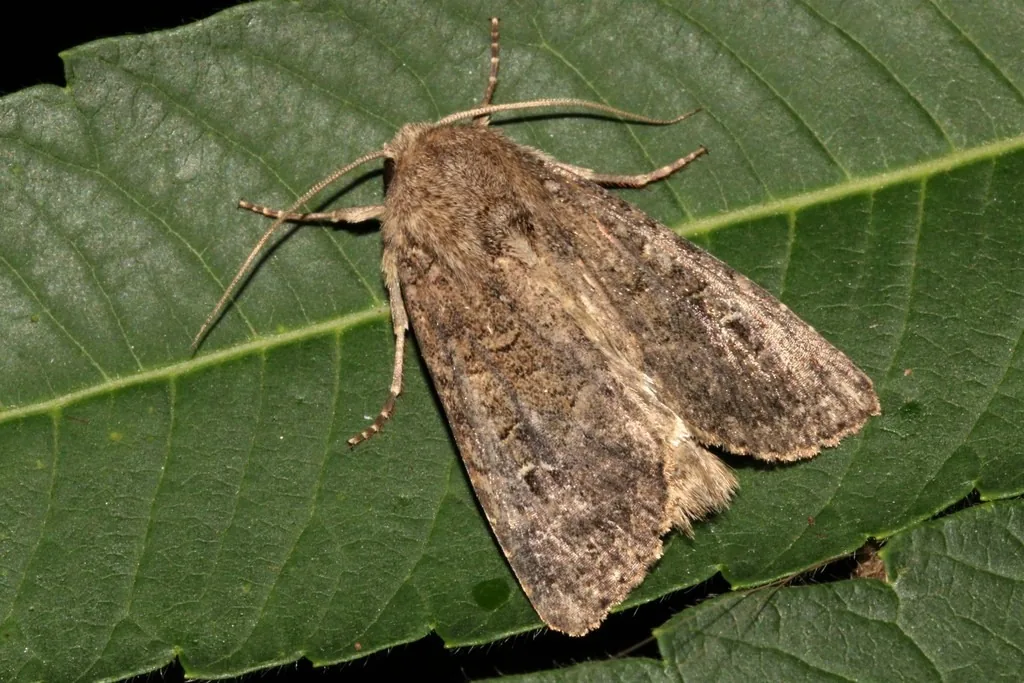
- The adult is a nondescript, medium-sized grayish moth with a scattering of dark markings on the forewings and a wingspan of 35 to 40 mm (about 1.25 to 1.5 inches). The reddish-brown pupa, about 20 mm long, is formed in the soil near the host plant.[1][2]
- Unlike surface-feeding cutworms, glassy cutworms are found by digging: they bore into the crown and through the roots and seldom feed above ground or on leaves.[2][1]
Look-alikes
| Look-alike | How to tell them apart |
|---|---|
| Sod webworms, including cranberry girdler | Sod webworm larvae also feed in grass crowns, but in western Oregon they finish feeding and prepare to overwinter by late October and do not resume in spring, whereas glassy cutworm damage runs from September through April. Sod webworms are smaller and individually do much less damage.[2][1] |
| Protagrotis obscura | East of the Cascades this unnamed noctuid, not the glassy cutworm, is the primary grass pest; its larvae look identical, have the same life history and cause the same damage.[2] |
| Other Apamea cutworms | Apamea inficita, the yellow-headed cutworm (A. amputatrix) and A. cogitata were mixed with true glassy cutworms in Alberta fescue fields; all four look alike as larvae and have similar life histories and damage.[1] |
| Black and winter cutworms | In Pacific Northwest turf these two are more common than glassy cutworm and feed above ground on foliage; the black cutworm is gray to almost black with a row of black dots, the winter cutworm green with black and tan dashes.[3] |
Where it lives
A sporadic pest of grass crops and turf throughout much of North America that has caused serious damage to grass seed fields in the Pacific Northwest and the Canadian Prairie Provinces; west of the Cascades it is one of the most common cutworms infesting grasses, and Manitoba notes it can sometimes be abundant in grassy crops.[1][2][4]
Biology and life cycle
Moths fly from July to early September (late June through August in the Pacific Northwest), and most eggs are laid during August on the upper surface of a grass leaf near its base or on the soil near grass crowns. Eggs hatch in about 10 days and the young larvae begin feeding at once.[1][2]
Larvae are about half grown by freeze-up and overwinter as partly grown larvae. West of the Cascades they keep feeding through the winter; in eastern Oregon, Washington, Idaho and the Prairies they go dormant in the coldest months and resume feeding as soon as green growth returns in early spring. They pupate in the soil by the end of June. There is one generation a year.[1][2][4]
The moths prefer established grass for egg laying, so the pest is mainly a problem in older stands. Commonly infested grasses are tall and creeping red fescue, timothy, bluegrass and brome; cereals, corn and vegetables can be attacked when planted into newly broken sod or fields that carried grassy weeds the previous fall.[2][1]
Drought appears to favor population increases: Alberta's severe Peace River outbreak in 2000 followed two years of drought. Ground beetles and parasitic wasps and flies were numerous in those outbreak fields, and in some fields half the cutworms were parasitized.[1]
Damage and signs
- Larvae feed on stems and crowns at or below the soil surface and bore through roots. Damage appears in fall and again the following spring; heavy infestations seriously weaken and even kill mature plants, and cold winters make the injury worse.[1][2]
- Because the feeding is hidden, infestations are usually noticed in spring as browning or poor growth that gets labeled winterkill. In badly damaged Alberta fields the tops of grass tufts could be kicked free because fall feeding had removed most of the crown tissue.[2][1]
- Low and even moderate infestations may cause no noticeable damage when growing conditions are good; healthy, vigorous stands tolerate more cutworms than stressed ones.[1]
Health risk
The sources treat the glassy cutworm only as a pest of grasses and field crops and mention no effect on people.[1][2]
Control
Prevention
Scout in October (and again in early spring) by digging plant crowns and roots to at least 3 inches and inspecting them for larvae; dig up sickly or browning plants and search the roots and surrounding soil. No economic threshold has been established for this pest.[2][1]
Cultivate newly broken land and summerfallow with grassy weeds well during August so there is no fresh growth to attract egg-laying moths; spring-seeded tall fescue in western Oregon should be scouted carefully from early October.[1][2]
Pheromone trap monitoring is not possible because no glassy cutworm lure is commercially available; rely on larval sampling once larvae are at least 10 mm long.[1]
Biological control
Predatory ground beetles and parasitic wasps and flies attacked outbreak populations in Alberta, with up to 50 percent of cutworms parasitized in some fields.[1]
Pesticides
Chemical control is seldom successful because most larvae are too far below the soil surface to be reached, even with irrigation; Manitoba likewise notes that foliar insecticides are less effective against subterranean species such as the glassy cutworm. Where insecticides are used, apply them with as much water as feasible, and light to moderate rain or irrigation within a week improves results. The Pacific Northwest handbook lists bifenthrin, cyfluthrin, lambda-cyhalothrin and zeta-cypermethrin for grass seed fields.[2][4][1]
Common questions
- Why does my grass look winterkilled in patches?
- Glassy cutworm larvae feed in the crowns and roots from fall into spring, and the damage is often first detected in spring and mislabeled as winterkill. Dig the crowns and roots of browning plants to 3 inches and look for translucent gray larvae with red-brown heads.[2][1]
- Will a lawn insecticide control glassy cutworms?
- Usually not well. The larvae live too far below the surface for most sprays to reach them, so cultural measures, scouting and natural enemies matter more; if you do spray, use high water volume and water it in.[2][1][4]
- How is glassy cutworm different from a sod webworm?
- Both feed in grass crowns, but sod webworm larvae stop feeding by late October and pupate in spring, while glassy cutworms damage grass from September through April and are larger, so each one does far more damage.[2][1]
Sources
- Alberta Agriculture and Forestry, Government of Alberta, “Glassy Cutworm (Agri-News pest page).” www1.agric.gov.ab.ca/$department/deptdocs.nsf/all/prm2497 (accessed 2026-11-10)
- Pacific Northwest Pest Management Handbooks (Oregon State University, Washington State University and University of Idaho), “Grass seed-Glassy cutworm, Pacific Northwest Insect Management Handbook.” pnwhandbooks.org/insect/legume-grass-field-seed/grass-seed/grass-seed-glassy-cutworm (accessed 2026-11-10)
- Pacific Northwest Pest Management Handbooks (Oregon State University, Washington State University and University of Idaho), “Turfgrass-Cutworm, Pacific Northwest Insect Management Handbook.” pnwhandbooks.org/insect/hort/turfgrass/turfgrass-cutworm (accessed 2026-11-10)
- Manitoba Agriculture, Government of Manitoba, “Cutworms in Field Crops (fact sheet, May 2024).” www.gov.mb.ca/agriculture/crops/insects/pubs/cutworms-in-field-crops.pdf (accessed 2026-11-10)
- iNaturalist, “Apamea devastator taxon page (order and family).” www.inaturalist.org/taxa/213838 (accessed 2026-11-10)