How to identify it
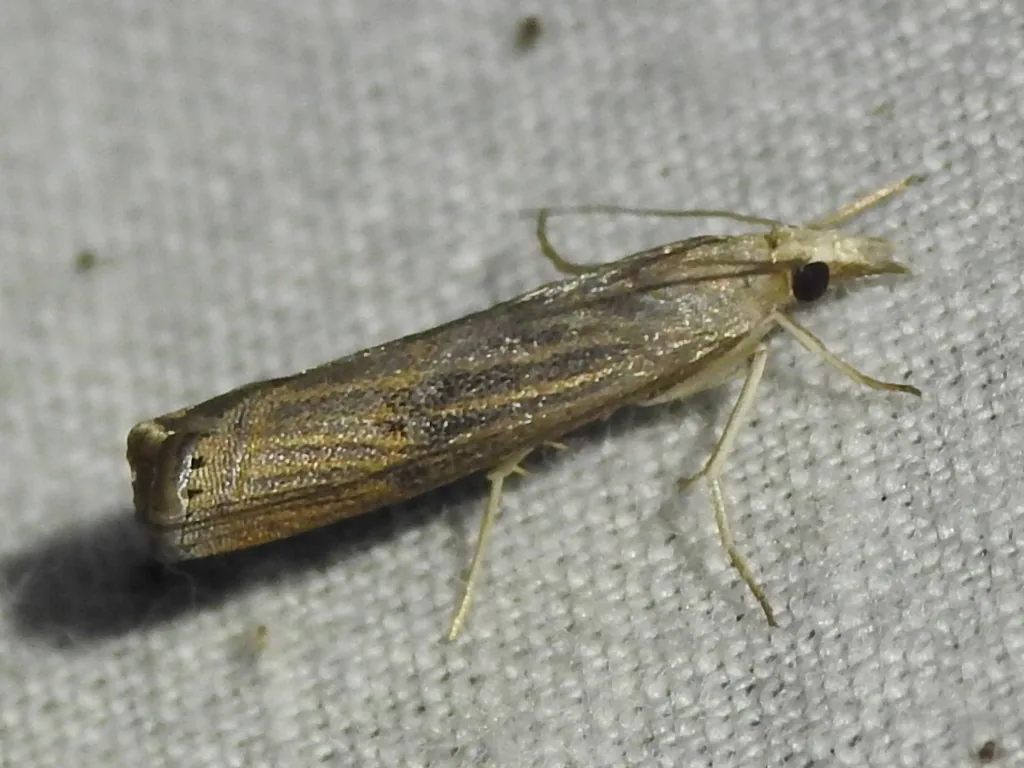
- Adults are dull whitish, gray or tan moths with a wingspan of about 3/4 to 1 inch and a pair of projections sticking forward from the head like a snout.[1]
- At rest the moth wraps its wings close around its body, so it looks narrow and tube-shaped, often facing down on a grass stem.[1][2]
- Disturbed moths make short, jerky, zigzag flights just above the grass, especially at dusk, and they come to lights at night.[1][2][3]
- Full-grown larvae are about 3/4 inch long, brownish to greenish or grayish, with rows of dark spots that each carry a long bristle.[1][2][3]
Look-alikes
| Look-alike | How to tell them apart |
|---|---|
| Tropical sod webworm | A southern lawn moth that holds its wings flat in a triangle over its back instead of rolling them around its body; its translucent green larvae attack warm-season grasses.[4] |
| Cutworms | Sod webworm larvae are smaller, carry rows of bristly dark spots and live in silk-lined tunnels in the thatch, where you'll often find green droppings.[1][3] |
| Dog urine spots | Urine spots turn yellow first and keep a ring of dark green grass around them; webworm spots have clipped blades, no green border and don't yellow first.[1] |
Where it lives
Several sod webworm (lawn moth) species infest lawns in places such as Pennsylvania, Minnesota and California; in mild-winter areas like the Texas Gulf Coast, the tropical sod webworm also attacks lawns.[1][2][3][4]
Biology and life cycle
Larvae overwinter in their silk tunnels, finish feeding in spring and pupate from late May into June in Pennsylvania.[1]
Females drop eggs onto the turf while flying at night; each can lay up to 200 eggs, and the eggs hatch in 7 to 10 days.[1][3]
Two generations a year are common in the North, with larvae feeding in early summer and again from late July into September.[1][2]
Larvae stay in silk-lined burrows at the soil surface during the day and come out at night to feed.[2][3]
Damage and signs
- Young larvae skeletonize grass blades; older ones notch or clip them off just above the crown and pull them into the burrow.[3][1]
- Early damage shows as ragged brown spots about the size of a quarter or a baseball that grow and join into large dead areas.[2][1]
- The worst damage usually comes in July and August, on drought-stressed slopes and other spots that are hard to water.[1]
- Birds probing for the larvae can leave pencil-sized holes in the brown patches.[1]
Health risk
Sod webworms are medically harmless; the only harm is to the grass the caterpillars eat.[4]
Control
Prevention
Plant endophyte-enhanced perennial ryegrass, tall fescue or fine fescue where they suit your site; the fungi inside these grasses repel sod webworms.[1][3]
Mowing above 2.5 inches makes damage hard to notice, and removing heavy thatch takes away some of the larvae's shelter.[3]
Traps and physical control
Check before treating: soak a square yard of turf with 2 tablespoons of dish detergent in 2 gallons of water and count the larvae that crawl up.[1][2]
Biological control
Insect-parasitic nematodes such as Steinernema carpocapsae and products containing Bacillus thuringiensis kurstaki can suppress young larvae; Bt breaks down quickly in sunlight.[3][1]
Pesticides
Treat only if counts pass about 10 to 15 larvae per square yard, using a product labeled for sod webworms applied in late afternoon or evening, when larvae feed.[1][3]
When to scout
In Minnesota, scout in June and again in early August to catch both generations of larvae.[2]
Look for dew sparkling on small webs in early morning, and for fresh green droppings and silk tunnels in the thatch of brown spots.[2][1]
Watering and fertilizing can help mask webworm damage, and even heavily fed-on southern turf usually recovers.[1][4]
Common questions
- What are the little tan moths flying over my lawn at dusk?
- Most likely lawn moths, the adults of sod webworms. The moths only sip liquids; the caterpillars do the damage, so check for larvae with a soapy-water drench first.[1][2][4]
- Do lawn moths always mean lawn damage?
- No. In Minnesota the moths are common but larval damage is uncommon, so count larvae first; healthy, well-watered turf often hides light feeding.[2][1]
Sources
- Penn State Extension, “Sod Webworms in Home Lawns.” extension.psu.edu/sod-webworms-in-home-lawns (accessed 2026-10-06)
- University of Minnesota Extension, “Sod webworms (reviewed 2018).” extension.umn.edu/yard-and-garden-insects/sod-webworms (accessed 2026-10-06)
- University of California Statewide IPM Program, “Sod Webworms (UC IPM Pest Management Guidelines: Turfgrass, UC ANR Publication 3365-T).” ipm.ucanr.edu/agriculture/turfgrass/sod-webworms/ (accessed 2026-10-06)
- Texas A&M AgriLife Extension, “Tropical Sod Webworm (Field Guide to Common Texas Insects).” texasinsects.tamu.edu/sod-webworm/ (accessed 2026-10-06)
- iNaturalist, “Parapediasia teterrellus taxon page (order and family).” www.inaturalist.org/taxa/553984 (accessed 2026-10-06)