On this page
How to identify it
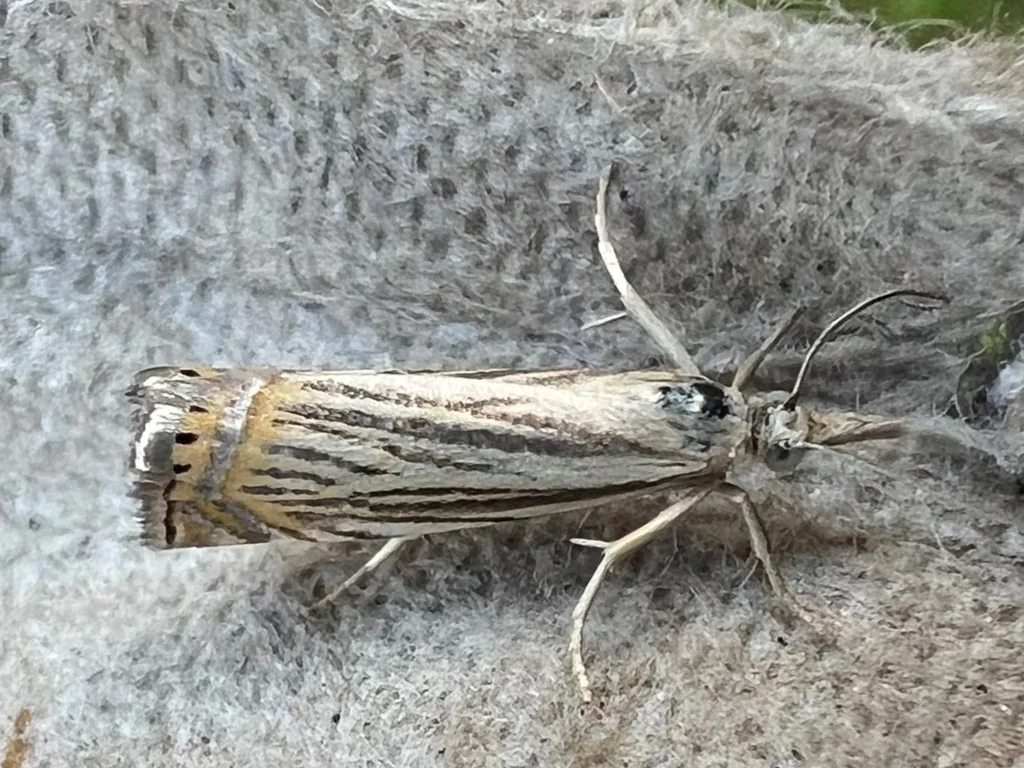
- Adults are snout moths about 1/2 inch long (the Pacific Northwest handbook says about 0.33 inch) with a 3/4-inch wingspan; the buff or pale straw forewings carry brown and cream stripes or silver bands and three black spots near each wing tip, with silver scales near the fringe. They fly at night, low to the ground.[1][2][4]
- Larvae are dirty white, creamy or pinkish with an orange-brown to light brown head and no obvious markings, reaching 1/2 to 3/4 inch (about 15 mm) in the thatch, soil or cranberry duff. The small hooks on the abdominal prolegs are arranged in circles or ovals, unlike the straight rows of armyworms and cutworms.[1][2][3][4]
- Eggs are dropped loose on grass blades, plant crowns or the bed floor; they are white at first and turn orange-red close to hatching. The pupa is pale yellow, about 10 mm, inside a cocoon camouflaged with bits of twig and leaf.[1][2][4]
Look-alikes
| Look-alike | How to tell them apart |
|---|---|
| Other sod webworms | Eggs and pupae are easily confused with other turf sod webworms, but cranberry girdler larvae lack their obvious markings and feed at or below the thatch rather than near the surface, which also makes them harder to detect and control.[1] |
| White grubs | Cranberry girdler damage looks like heavy white grub feeding, with the sod loosely attached to the soil; taking soil samples is the way to tell which insect is responsible.[1] |
| Glassy cutworm | In grass seed fields the glassy cutworm also feeds in crowns, but its damage runs September through April, whereas cranberry girdler larvae finish feeding and enter cocoons by late October and do not resume in spring.[2] |
| Cranberry flea beetle | Girdled cranberry runners can also be the work of flea beetle larvae, so check the underground stems for the insect as well as the chewing.[4] |
Where it lives
Found throughout the United States and particularly damaging in Pacific Northwest turf seed production areas; first detected in northern and northeastern Utah in the early 1980s, and a pest of cranberry beds in Oregon, Washington and Wisconsin.[1][3][4]
Biology and life cycle
There is one generation a year. Adults emerge in mid-June (May to July in Pacific Northwest cranberry beds) and fly for six to eight weeks; some years bring a smaller fall flight. After mating, females drop several hundred eggs a week on grass blades, crowns and soil, and a female can lay up to 700 eggs in all. Eggs hatch in 9 to 12 days.[1][2][3][4]
Young larvae burrow into the thatch or upper soil and feed on crowns and roots for about two months, from late June into late October or early November. Newly hatched larvae in cranberry beds prefer to burrow into the crowns of grass weeds before moving to the vines, so weedy, grassy beds suffer first.[1][2][3]
Cooler October temperatures trigger the prepupae to spin a tough silken tunnel or a camouflaged cocoon of twigs and leaf scraps in the soil or duff, where they overwinter as dormant larvae. They pupate the following spring and the moths emerge shortly afterward.[1][2][4]
Larvae prefer cool-season grasses such as Kentucky bluegrass, bentgrass and fine-leaf fescues, and are also recorded on other grasses, cranberry, sheep sorrel, Douglas-fir and true firs; they can move from infested grassland into nursery conifer seedlings and strip tissue from the taproot surface.[1][4]
Damage and signs
- In turf, heavy infestations prune the roots and destroy the crowns so the lawn becomes loosely attached to the soil. The first sign is small brown patches in late summer when larvae are near maturity; widespread infestations create large dead areas by early fall, and drought-stressed turf browns earlier. Utah State's treatment threshold is 10 to 15 larvae per square yard, though untreated Utah turf has reached 20 to 30 per square foot.[1]
- In grass seed fields larvae feed on and in the crowns and roots of most grasses and can seriously injure established stands; two to six larvae per crown can cause damage.[2]
- In cranberry beds the larvae eat through the bark of runners at or below the soil surface, girdling or severing them. The vines beyond the girdle die, foliage turns red or brown in September and leaves drop during the winter flood, leaving dead spots that grasses and sedges invade and that can take years for new runners to recover. Partly girdled vines are weakened and bear poor fruit.[3][4]
Health risk
The sources treat the cranberry girdler only as a pest of turf, grass seed and cranberry and mention no effect on people.[1][3]
Control
Prevention
Keep turf properly irrigated and fertilized without exceeding recommended schedules, since overly maintained turf attracts egg-laying females and healthy turf tolerates low to moderate infestations and recovers. Endophyte-infected perennial ryegrass and fescue varieties reduce larval damage.[1][2]
Scout for adults at sunset in summer and for larvae with soil samples from early summer. In seed fields, pheromone traps set at canopy height from mid-June signal risk when catches exceed 50 to 75 moths per trap in a 5-day period, and larvae are sampled in early September; cranberry growers check thin or off-color areas of beds in late summer and after the winter flood, and look for frass in the duff next to stems.[1][2][3][4]
Sanitation
In cranberry beds, control grassy weeds that let girdlers establish, and re-sand the bed with 0.5 to 0.75 inch of sand in fall or winter, which reduces moth emergence and improves other controls because the larvae prefer the duff layer.[3][4]
Traps and physical control
Short floods of one or two days in August after egg hatch have controlled small larvae (longer than two days can damage vines), a long dormant-season flood may help, and Wisconsin growers have used summer floods; the larvae are easily drowned in August and September.[3][4]
Biological control
Parasitic wasps and flies, birds, spiders, ground beetles, rove beetles and ants kill eggs, larvae and pupae, and diseases and bird predation reduce larvae from October through March. Beds and lawns that receive few broad-spectrum insecticides keep more of these predators. Insect-parasitic nematodes such as Steinernema carpocapsae are effective when applied in the morning or evening two to four weeks after peak moth flight (after egg hatch), with irrigation before and after; several applications may be needed.[1][2][3][4]
Pesticides
Utah State lists spinosad and Bacillus thuringiensis as reduced-risk products that work best on small larvae, with beta-cyfluthrin, carbaryl, chlorpyrifos and trichlorfon also registered for Utah turf; aerate thatch deeper than 1/2 inch, water 48 hours before, water in with 1/2 to 3/4 inch afterward and mow to about 1.5 inches. Seed-field insecticides (beta-cyfluthrin, bifenthrin, gamma- and lambda-cyhalothrin) go on in September with irrigation, because late-October applications miss larvae already in cocoons. For cranberries the Pacific Northwest handbook says there are currently no efficacious products.[1][2][3]
Common questions
- Why does my lawn pull up like a carpet in late summer?
- Cranberry girdler larvae prune roots and destroy crowns at or below the thatch, so the sod comes loose the way it does with white grubs; confirm with soil samples, since the larvae are dirty white with an orange-brown head and no markings.[1]
- When should I treat for cranberry girdler?
- While the larvae are small, in late summer: seed fields are treated in September with irrigation, and applications in late October or later fail because the larvae have stopped feeding and spun cocoons. Nematodes go on two to four weeks after peak moth flight.[2][3][1]
- Can flooding a cranberry bed control it?
- Yes. One- or two-day floods in August after egg hatch have controlled small larvae, which drown easily in August and September, but floods longer than two days can damage the vines.[3][4]
Sources
- Utah State University Extension, “Cranberry Girdler, Utah Pests fact sheet (E. W. Hodgson and A. H. Roe, June 2007).” extension.usu.edu/planthealth/research/cranberry-girdler (accessed 2026-11-10)
- Pacific Northwest Pest Management Handbooks (Oregon State University, Washington State University and University of Idaho), “Grass seed-Sod webworm (cranberry girdler), Pacific Northwest Insect Management Handbook.” pnwhandbooks.org/insect/legume-grass-field-seed/grass-seed/grass-seed-sod-webworm-cranberry-girdler (accessed 2026-11-10)
- Pacific Northwest Pest Management Handbooks (Oregon State University, Washington State University and University of Idaho), “Cranberry-Cranberry girdler, Pacific Northwest Insect Management Handbook.” pnwhandbooks.org/insect/small-fruit/cranberry/cranberry-cranberry-girdler (accessed 2026-11-10)
- Washington State University College of Agricultural, Human, and Natural Resource Sciences (hosted file), “Cranberry Girdler (cranberry insect profile, PDF).” wpcdn.web.wsu.edu/wp-wsucahnrs/uploads/sites/2166/2025/05/Cranberry-Girdler.pdf (accessed 2026-11-10). Undated profile that refers readers to UW Extension for diazinon registration changes expected in 2007 or 2008; used for biology and cultural control only.
- iNaturalist, “Chrysoteuchia topiarius taxon page (order and family).” www.inaturalist.org/taxa/321779 (accessed 2026-11-10)