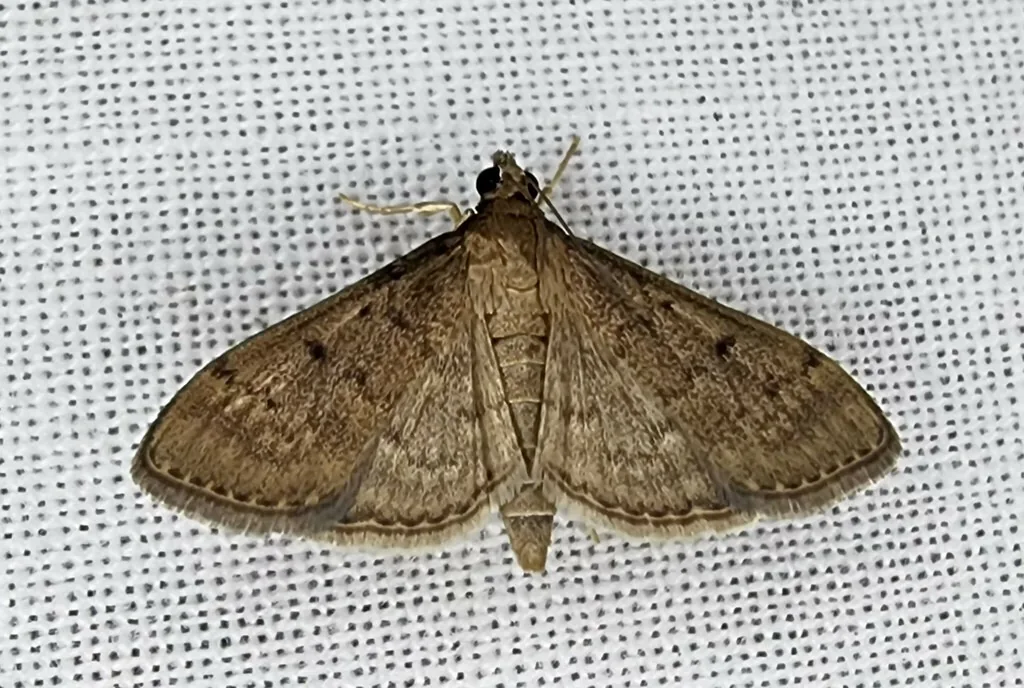
How to identify it
Look-alikes
| Look-alike | How to tell them apart |
|---|---|
| Other sod webworms | A tropical species of warm-season turf.[1] |
Where it lives
In North America it has been recorded from Florida, Georgia, Louisiana, Texas and Hawaii.[1]
Biology and life cycle
In south Florida adults are present year round, peaking September through November.[1]
Larvae feed at night and hide in thatch by day.[1]
Damage and signs
- Damage starts ragged and grows into bare areas; caterpillars prefer hot, dry turf.[1]
Health risk
It feeds on grass; UF/IFAS mentions no risk to people.[1]
Control
Pesticides
Several insecticides can control it, with attention to timing, resistance and effects on other organisms.[1]
Common questions
Sources
- University of Florida IFAS Extension (Featured Creatures), “Tropical Sod Webworm, Herpetogramma phaeopteralis (EENY-541).” edis.ifas.ufl.edu/publication/IN968 (accessed 2026-10-06)
- iNaturalist, “Herpetogramma phaeopteralis taxon page (order and family).” www.inaturalist.org/taxa/330489 (accessed 2026-10-06)