On this page
How to identify it
- Grown caterpillars are 1 to 1 1/4 inches (25 to 32 mm) long, with a dull, dingy brown to cream body in a mottled pattern.[2][1]
- A broad gray stripe runs down the back, with a light gray V on each abdominal segment, and the head is light brown with dark brown markings.[2][1]
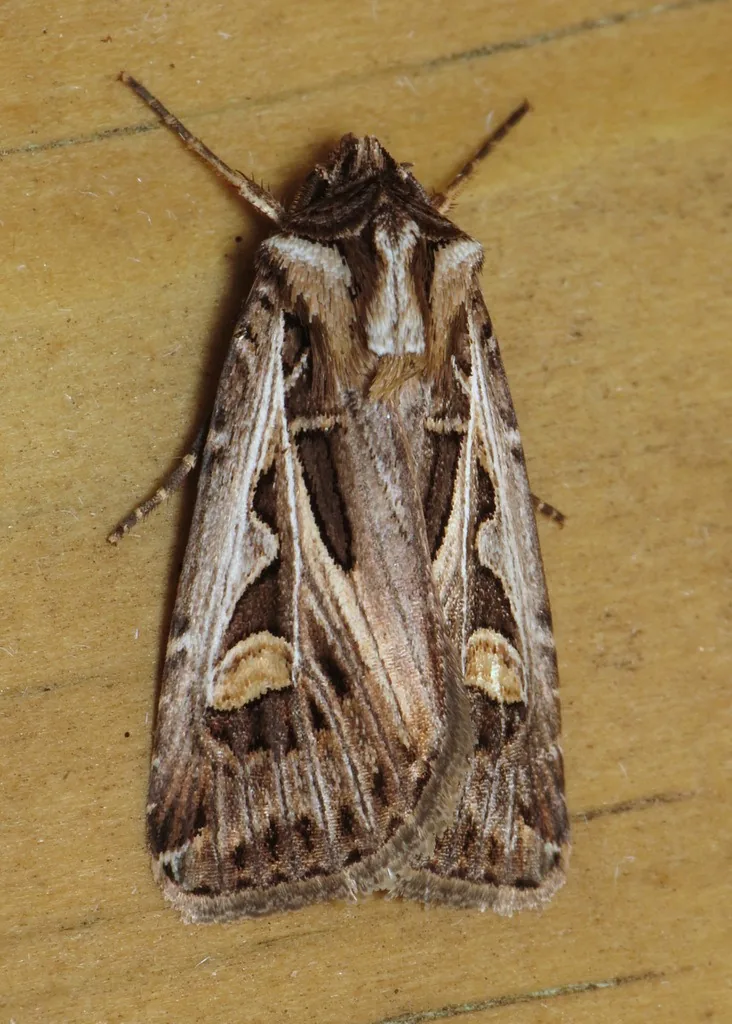
- The moth's forewings are dark brown with lighter brown, bean-shaped markings beside a light triangular mark.[1][2]
- What looks like one species is a complex of sibling species that look identical but use different sex pheromones: two types occur across the prairies of western Canada and at least two more in eastern Canada.[3][4]
Look-alikes
| Look-alike | How to tell them apart |
|---|---|
| Pale western cutworm | Its caterpillar is pale yellow to gray with a distinct white line down the middle of the back, and it feeds below the soil surface; cutworm moths in general are told apart by their forewing markings.[1] |
| Darksided and redbacked cutworms | These late-season cutworms spend the winter as eggs rather than as partly grown caterpillars, and their older caterpillars cut plants from 1 inch below to 2 inches above the soil surface.[1] |
Where it lives
It is one of the more common and widely distributed noctuids in North America, found across the prairies of western Canada and in eastern Canada, and it is one of four cutworms that can damage sunflower stands in South Dakota.[3][1]
Biology and life cycle
It is an early-season cutworm with a single generation a year. The caterpillars spend the winter in the soil in their second or third stage, start feeding again on whatever plants are available, including crop seedlings, when spring warms up, and pupate around mid-June.[1]
Moths emerge in August and fly until mid-October, with activity peaking in September. Females lay eggs on plants in the aster family, such as sunflower, safflower, goldenrod and ragweed, and the young caterpillars feed on the flower heads before dropping to the soil in their second or third stage.[1]
Cutworm caterpillars feed at night and hide under plant residue or just under the soil surface by day.[1]
The two prairie types fly at partly overlapping times. They hybridize easily in the laboratory, but there is no evidence that they do so in the field.[3]
Damage and signs
- The caterpillars feed mostly above ground on leaves and only rarely on stems, but they can cut plants off at or just below the soil surface.[2][1]
- Young caterpillars leave small notches or holes in leaves, or eat away only some layers of the leaf and leave clear windows.[1]
- In sunflower, leaf feeding normally doesn't cause economic injury, but cutting off young seedlings can thin a stand significantly, and earlier-planted fields are at greater risk.[1]
- In corn, cutworms are most common in fields following sod, alfalfa or small-grain stubble and in continuous corn with heavy crop or weed residue.[2]
Health risk
None of these sources mentions any risk to people; they treat it only as a crop pest.[1][2]
Control
Prevention
Scout sunflower from emergence through the V4 to V6 stages. Because the caterpillars feed at night, look by day for wilted, broken or cut plants, then dig 1 to 6 inches deep around them to find the caterpillars.[1]
Early detection is essential in corn; consider treatment there if one plant in 20 is injured and cutworms are present.[2]
Pesticides
In sunflower, SDSU Extension recommends a foliar insecticide at 1 caterpillar per square foot or when 25 to 30% of scouted plants are cut, applied late in the day or early evening since the caterpillars feed at night. Insecticide seed treatments may reduce feeding when populations are small, but stand losses can still occur when they are large.[1]
In corn, pyrethroids have performed better without incorporation in most studies. Crusted or dry surface soil can reduce control with some materials, which rotary hoeing just before or after application can counteract, and how well current Bt corn hybrids control it is unknown.[2]
Common questions
- When are dingy cutworms active?
- The caterpillars feed in spring until about mid-June after overwintering partly grown, and the moths fly from August to mid-October, peaking in September.[1]
- Why can't I find the cutworms that are cutting my seedlings?
- Cutworm caterpillars feed at night and hide under plant residue or the soil surface by day, so SDSU Extension advises digging 1 to 6 inches around cut plants to find them.[1]
- Is the dingy cutworm really more than one species?
- Apparently. Researchers found pheromone types within the dingy cutworm that look identical but seem to be reproductively isolated sibling species: two across the western Canadian prairies and at least two in eastern Canada.[3][4]
Sources
- South Dakota State University Extension, “Chapter 11: Sunflower Insect Pests, P-00205-11 (A. Varenhorst, P. Rozeboom and P. Wagner, July 2021).” extension.sdstate.edu/sites/default/files/2021-08/P-00205-11.pdf (accessed 2026-11-09)
- High Plains Integrated Pest Management (Extension Services of Nebraska, Colorado, Wyoming and Montana), Bugwood Wiki, “Dingy Cutworm, High Plains IPM Guide (author F. B. Peairs).” wiki.bugwood.org/HPIPM:Dingy_Cutworm_FC (accessed 2026-11-09)
- Journal of Chemical Ecology (via NCBI PubMed), “Electroantennographic responses differentiate sibling species of dingy cutworm complex, Feltia jaculifera (J. R. Byers et al.; Journal of Chemical Ecology 16(10): 2969-2980, 1990; abstract).” pubmed.ncbi.nlm.nih.gov/24263269/ (accessed 2026-11-09)
- Journal of Chemical Ecology (via NCBI PubMed), “Identification of sex pheromones of two sibling species in dingy cutworm complex, Feltia jaculifera (J. R. Byers and D. L. Struble; Journal of Chemical Ecology 16(10): 2981-2992, 1990; abstract).” pubmed.ncbi.nlm.nih.gov/24263270/ (accessed 2026-11-09)
- iNaturalist, “Feltia jaculifera taxon page (order and family).” www.inaturalist.org/taxa/119550 (accessed 2026-11-09)