The short answer
- Confirm the pest first: pour soapy water over about a square yard of turf at the edge of the brown area and watch for caterpillars to come up within about 10 minutes.[1][11][8]
- Sod webworms usually aren't worth treating unless the flush turns up more than about 10 to 15 larvae per square yard. For fall armyworms there is no set number: judge by how fast the lawn is browning and how big the caterpillars are.[8][13][10][5][6]
- If you treat, do it while the caterpillars are small, late in the day when they feed, with a product labeled for lawn caterpillars, and don't water it in unless the label says to.[3][6][8][10][1]
- Spraying the fuzzy fall armyworm egg masses on siding or posts does nothing; scrape or scrub them off instead.[5][6]
- Established lawns usually recover because the crowns and roots survive. Water, and reseed thin cool-season lawns such as tall fescue in fall.[2][6][7][13]
Lawn caterpillar profiles
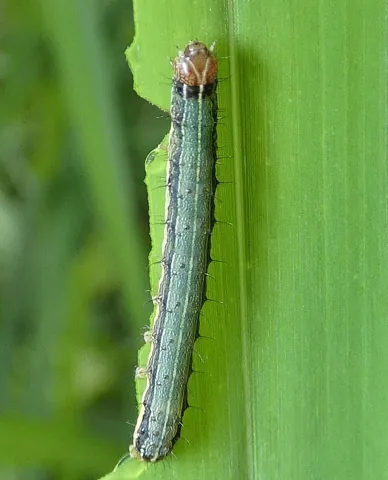 Fall Armyworm
Spodoptera frugiperda
Fall armyworms are moth caterpillars that prefer grasses. Often noticed in late summer, large numbers can turn a green lawn brown in a few hours or practically overnight, and they feed and move in groups, which is how they earned the armyworm name.
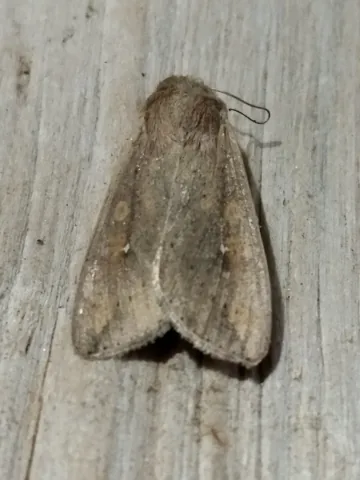 True Armyworm
Mythimna unipuncta (formerly Pseudaletia unipuncta)
The true armyworm, often just called the armyworm, is a moth caterpillar that prefers grasses, including lawns, grain crops and hay. Larvae feed mostly at night, and when the grass is gone they move in a mass to new food, which gave the insect its name.
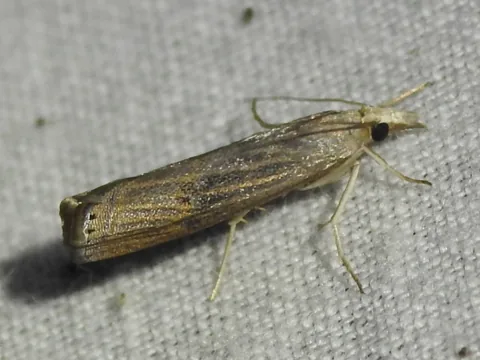 Sod Webworms
Crambinae lawn moths, e.g., Parapediasia teterrella (bluegrass sod webworm), Pediasia trisecta and Crambus species
Sod webworms are caterpillars of small, pale lawn moths with snout-like mouthparts. The larvae hide in silk-lined tunnels in the thatch by day and chew grass blades at night, leaving small brown patches that can merge during dry summers.
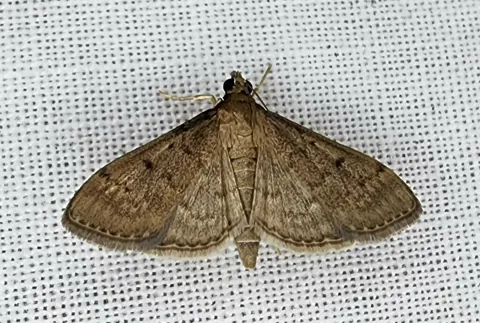 Tropical Sod Webworm
Herpetogramma phaeopteralis
Tropical sod webworm caterpillars feed at night on warm-season lawn grasses, and in Georgia their activity peaks in fall, September through November, when patches can turn brown and dry.
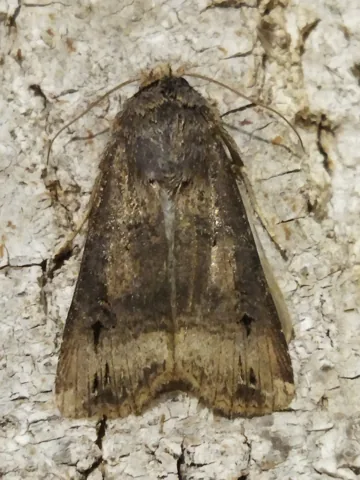 Cutworms
Several moth species, e.g., black cutworm (Agrotis ipsilon)
Cutworm is a general name for the caterpillars of dozens of moth species. They earned the name by cutting off young plants at or just below the soil line, and seedlings and fresh transplants suffer most.
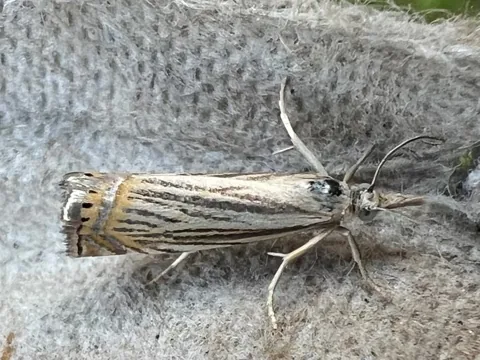 Cranberry Girdler (Subterranean Webworm)
Chrysoteuchia topiarius
The cranberry girdler (Chrysoteuchia topiarius, written C. topiaria in extension sources) is a sod webworm that works below the surface: its dirty-white, brown-headed larvae prune the roots and crowns of cool-season grasses so the sod lifts like grub damage, and in cranberry beds they chew the bark off runners beneath the leaf litter until whole patches of vine die in late August and September. It is one generation a year and is hardest to find and control of the sod webworms because it feeds at or below the thatch.
Armyworm or sod webworm?
Clemson calls the fall armyworm the caterpillar most commonly linked to leaf damage on turfgrass in South Carolina, and Utah State calls sod webworms the most widely recognized turf insect pests in Utah. Several other caterpillars cause similar damage and are handled the same way.[1][13][12]
- Fall armyworm caterpillar: green, brown or nearly black with stripes along the body, a wide dark stripe down each side, and a light upside-down "Y" on the head. Clemson and NC State give a top length of about 1 to 1.5 inches; Iowa State says full-grown caterpillars reach 1.5 to 2 inches.[1][3][6]
- Fall armyworm moth: mostly gray with white markings, about 1 inch long with a wingspan up to 1½ inches, and a pale spot near the center of the front wing. Moths are drawn to bright lights.[1][3]
- Fall armyworm eggs: furry or moldy-looking masses, white to tan, laid on grass blades and on flat upright surfaces such as house siding, fence posts, signs, play equipment and bird feeders. Iowa State counts 100 to 500 eggs per mass; one female can lay as many as 1,000 eggs.[1][3][6]
- Sod webworm caterpillar: slimmer and smaller, about 3/4 inch when grown (NC State and Utah State give 5/8 to 1 inch), beige, gray, brown or green, with rows of dark spots each bearing coarse hairs. It lives in a silk-lined tunnel in the thatch by day and often curls into a ball or C-shape when disturbed.[8][4][13][10]
- Sod webworm moth ("lawn moth"): a dull, pale moth with a wingspan of about 3/4 to 1 inch and a snout-like projection on the front of the head. At rest it wraps its wings tightly around its body, and at dusk it flies in short, jerky zigzags just above the grass.[8][13][9][10]
- True armyworms and cutworms also feed on turf. Utah State lists the true armyworm as the most common armyworm in Utah lawns, and the same checks and treatments apply.[12]
What the damage looks like
Both caterpillars clip grass blades rather than roots, so the first job is ruling out drought, dog spots and grubs.[8][13][12]
- Fall armyworm: lawns go brown almost overnight, often starting near a wall, post or sign where eggs were laid and spreading outward with a sharp line between eaten and green grass. Early feeding can look like drought; later the turf looks scorched or scalped, with only stems left.[1][3][7]
- That speed comes from the last caterpillar stages: Clemson notes that over 93% of the leaf area a fall armyworm eats is eaten after its 4th larval stage, so a lawn can look fine until the caterpillars are nearly grown.[1]
- Sod webworm: small brown spots, about quarter- to baseball-sized, of closely clipped grass that grow and merge into large irregular patches. Look for green droppings in the thatch, silk tunnels, and dew sparkling on webs early in the morning.[8][9][4]
- Pencil-sized holes in the brown patches usually mean birds have been probing for webworms; birds feeding on a lawn can also point to heavy armyworm numbers.[8][12]
- Not caterpillars? Dog urine spots turn yellow before going brown and keep a ring of dark green grass around the edge; sod webworm spots don't. Grub-damaged turf peels back like a rug because the roots are gone, which caterpillar damage doesn't cause.[8][13][11]
When and where they show up
Fall armyworms arrive with migrating moths and come and go with the weather; sod webworms live in the lawn year-round.[2][3][13]
- Fall armyworms overwinter only in the far south (Clemson names South Florida and the southernmost parts of Texas) and moths migrate north every year. Numbers vary with the weather, and Clemson notes damage seems worse after droughts.[2][3]
- In the Carolinas fall armyworms show up from late May or June, with the worst damage in August; they can complete a generation in about a month and keep going into November in a mild fall. A frost ends them for the year.[2][1][5][7]
- Big outbreaks happen. In 2021 heavy fall armyworm populations damaged turf from Oklahoma to Georgia and Indiana to Maryland between June and August, Kentucky called it one of the worst years on record in home lawns, and storm-blown moths laid eggs as far north as Iowa in late August.[5][7]
- New seedings, newly laid sod and lawns less than a year old take the worst fall armyworm damage, and Iowa State found tall fescue hit harder than Kentucky bluegrass.[3][6]
- Sod webworms overwinter as larvae in the thatch and usually have two generations a year, sometimes one to four. The worst damage tends to come in July and August; Utah State puts peak injury in late summer and early fall, and Minnesota warns that heavy second-generation infestations can damage large areas.[8][4][13][9]
- Sod webworm damage is worst on drought-stressed lawns and on slopes and banks that are hard to water. Bluegrass and bentgrass suffer most in California; endophyte-infected ryegrass and tall fescue and warm-season grasses hold up better.[8][10]
Step 1: Do a soap flush
Soapy water irritates the caterpillars and drives them up out of the thatch where you can count them. Extension recipes differ a little, but all use ordinary liquid dish soap.[8][11][9]
- Mix the solution: 1 to 2 tablespoons of dish soap in 1 to 2 gallons of water (Clemson HGIC 2159), 2 tablespoons in 2 gallons (Penn State, Utah State), or 1 to 2 fluid ounces in 1 gallon (UC IPM).[1][8][13][11]
- Pour it slowly over 1 square yard of green turf right next to the damage, where caterpillars are still feeding. Utah State uses a 1-square-foot area instead, and Minnesota suggests pouring into a coffee can with both ends cut out, pushed into the turf.[1][11][13][9][4]
- Watch for up to 10 minutes. Clemson reports armyworms surfacing within 5 to 10 minutes.[1][2][11]
- Check several spots in a large lawn. Fall armyworms feed on the surface, so you won't need to dig; Iowa State suggests looking under the posts and siding where egg masses were laid.[11][5][6]
- If nothing comes up, dig instead: white grubs and billbug larvae don't respond to the drench test and are found by cutting under the thatch and checking the roots.[11]
- For sod webworms, Minnesota suggests scouting in June and again in early August; Clemson suggests checking for fall armyworms every 7 to 10 days through the season.[8][9][2]
Step 2: Decide whether to treat
Healthy, well-watered lawns tolerate light to moderate caterpillar feeding and regrow from the crowns, so a few caterpillars don't call for a spray.[13][12][6]
Sod webworm thresholds vary by source, so use them as a guide:[8][13][10][9][4]
- Penn State and Utah State: treatment may be warranted at 10 to 15 larvae per square yard. Penn State adds that 4 to 6 per square foot has also been suggested and the number varies.[8][13]
- UC IPM: more than 15 per square yard, or more than 5 on stressed golf greens.[10]
- Minnesota: tolerate up to 12 larvae per square foot. NC State: control is recommended at three or four per square foot.[9][4]
- Armyworms: Utah State uses 10 to 15 per square yard with obvious damage for armyworms and cutworms. Iowa State says there is no threshold for fall armyworms and weighs the lawn's health, the caterpillars' size, how much has been eaten and how soon frost is due.[12][5][6]
- Caterpillar size matters most for fall armyworm. NC State warns insecticides are generally ineffective on large larvae, which are about to stop feeding and burrow into the soil anyway, so treat only if most are still small.[3][6]
Step 3: Treat the right way
Lawn caterpillars have to eat or touch the insecticide on the grass blades, so the goal is to leave it on the leaves where they feed. A grub product watered into the soil earlier in the season is unlikely to control armyworms.[5][1]
- Mow tall grass first (collect the clippings) and water lightly beforehand: Iowa State says several hours before, Minnesota a day before, and Utah State 1/2 inch of water 48 hours before.[6][3][10][9][13]
- Spray late in the afternoon or evening, or early in the morning, when the caterpillars are active.[8][4][6]
- Cover the turf well. Iowa State recommends at least 1 gallon of spray per 1,000 square feet; NC State's sod webworm guide uses 6 gallons per 1,000 square feet.[6][4]
- Spot-treat the infested area when the caterpillars are confined to part of the lawn instead of blanketing the whole yard.[6][12]
- After a spray, most sources say to hold off watering and mowing so the product stays on the blades: UC IPM, Clemson and Iowa State say 24 hours (UC IPM says 2 days after Bt), and Minnesota says at least three days. Utah State's turf sheets take the opposite approach and water in 1/2 to 3/4 inch right after. NC State also says not to water sod webworm sprays in. Follow the product label.[10][1][2][5][9][4][13]
- Granules need watering to activate and may act more slowly than sprays.[6]
- Don't spray preventively. Clemson found some common lawn insecticides lasted only one week against fall armyworms, and Utah State calls preventive caterpillar treatments unnecessary because outbreaks are erratic.[2][12]
What works on lawn caterpillars
Most options below work best on small caterpillars. Use a product labeled for lawns and for the pest, and follow the label.[10][13][6][9]
- Bacillus thuringiensis kurstaki (Bt): works on young larvae but breaks down quickly in sunlight, washes off leaves and doesn't work on late-stage larvae. Apply when most larvae are young.[10][8][13][12]
- Spinosad: a reduced-risk option that also works best on small larvae.[13][12][1]
- Insect-parasitic nematodes (Steinernema carpocapsae): suit sod webworms because the larvae live in the thatch. Utah State's rate is 25 million per 1000 square feet, applied early or late in the day with watering before and after; several applications may be needed. Check the expiration date, since they don't keep long.[10][8][13][12]
- Azadirachtin (neem) products can control small fall armyworms.[6][5][9]
- Pyrethroids such as bifenthrin, cyfluthrin, lambda-cyhalothrin and permethrin, and carbaryl, are labeled for lawn caterpillars. Iowa State reports pyrethroids give about 7 days of control and that pyrethroid resistance in fall armyworm has been reported in other regions.[1][3][6][5]
- Chlorantraniliprole and tetraniliprole: Iowa State says these may give up to 30 days of control and suggests switching to them, often through a lawn care company, if a pyrethroid doesn't knock fall armyworms down quickly. NC State notes chlorantraniliprole must go on very early.[5][6][3]
- Many of these products are toxic to bees. UC IPM warns not to spray directly on, or let drift onto, blooming weeds where bees are foraging, which in a lawn often means flowering clover.[10]
Fall armyworm egg masses on the house
After storms carry moths north, fuzzy gray or tan patches can appear on siding, posts, bird feeders and play equipment. These are egg masses.[5][6]
- Insecticides don't control fall armyworm eggs, and Iowa State sees no advantage in spraying egg masses on structures.[5][6]
- Scrape, brush or scrub the masses off with soapy water, including hatching caterpillars.[5][6]
- Then watch the grass under and around the spots where the masses were for the next few weeks. The eggs hatch in 2 to 10 days, and newly hatched caterpillars spin silk threads to disperse.[3][1][5]
Make the lawn less attractive
Clemson calls reducing the lawn's attractiveness the best defense against fall armyworms; for sod webworms, grass choice and mowing height help most.[2][10][8]
- Use slow-release nitrogen. Clemson says the lush growth from quick-release fertilizer attracts egg-laying fall armyworm moths, and Utah State warns that overly fertilized and watered turf draws egg-laying moths of both pests.[2][12][13]
- Water deeply and infrequently, and keep thatch under control. UC IPM says dethatching can remove some sod webworm habitat, though larvae can be numerous without a thatch layer.[2][10]
- Mow on the high side for cool-season lawns: UC IPM notes sod webworm damage is usually not noticeable in turf mowed above 2.5 inches.[10]
- Where the grass suits your area, choose endophyte-enhanced perennial ryegrass, tall fescue or fine fescue, which resist sod webworms. Keep endophyte seed out of livestock pasture.[8][10][13]
- Don't overseed warm-season lawns with winter rye; Clemson notes rye is highly attractive to fall armyworms.[2]
- Spare natural enemies. Parasitic wasps and flies, birds, earwigs, rove beetles and other predators attack lawn caterpillars, and Utah State warns that broad-spectrum sprays on light infestations reduce this natural control. NC State notes natural enemies often keep fall armyworms in check but can't handle large outbreaks.[13][10][3][2]
Bringing the lawn back
Because both caterpillars eat blades and leave roots in place, most lawns come back. Kentucky Extension says lawns will recover from armyworm damage, though some may need reseeding.[7][13]
- Warm-season grasses (bermudagrass and similar): Clemson says fall armyworms don't kill established warm-season lawns because the stolons and rhizomes survive. Be patient and wait to fertilize until the lawn fully greens up next spring.[2]
- Tall fescue: it may need reseeding because the caterpillars can damage its growing points. Clemson suggests seeding in mid-September at 5 to 6 pounds of seed per 1,000 square feet.[2]
- Cool-season lawns in general: keep the crowns watered, overseed thin areas in fall, and keep new seed moist. Iowa State suggests 0.75 to 1 pound of slow-release nitrogen per 1,000 square feet to speed recovery.[5][6]
- Water and fertilize properly and lawns usually outgrow sod webworm feeding.[13][8]
Common questions
- Why did my lawn turn brown overnight in late summer?
- A fall armyworm outbreak is one likely cause: the caterpillars eat most of their food in their last stages and move across the lawn in groups. A soap flush at the edge of the brown area will bring them up within about 10 minutes.[1][7][3]
- Will my lawn grow back after armyworms?
- Usually. Established warm-season grass regrows from runners, and other lawns recover with water and fertilizer, though tall fescue and thin cool-season lawns may need reseeding in fall.[2][7][6]
- What are the little moths flying over my lawn at dusk?
- Most likely sod webworm moths, called lawn moths: pale, snouted moths that fly in short zigzags low over the grass. Seeing them is a reason to do a soap flush, not to spray.[8][9][13]
- Does dish soap kill armyworms?
- The soap flush is a monitoring test: it drives caterpillars to the surface so you can count them. The extension guides use it to decide whether to treat, not as the treatment.[1][8][11]
- Should I spray the fuzzy egg masses on my siding?
- No. Insecticides don't control the eggs; scrape or scrub them off with soapy water and watch the nearby grass.[5][6]
Photo credits
- Fall Armyworm: (c) Helio Lourencini, some rights reserved (CC BY) — via iNaturalist, CC BY 4.0
- True Armyworm: (c) SteveM4560, some rights reserved (CC BY) — via iNaturalist, CC BY 4.0
- Sod Webworms: (c) Sam Kieschnick, some rights reserved (CC BY) — via iNaturalist, CC BY 4.0
- Tropical Sod Webworm: (c) Alexis Smith, some rights reserved (CC BY) — via iNaturalist, CC BY 4.0
- Cutworms: (c) SteveM4560, some rights reserved (CC BY) — via iNaturalist, CC BY 4.0
- Cranberry Girdler (Subterranean Webworm): Jack Gelinas, public domain (CC0), via iNaturalist
Sources
- Clemson Cooperative Extension, Home & Garden Information Center, “Armyworms: Identification, Damage, & Control in Turfgrass (HGIC 2159).” hgic.clemson.edu/factsheet/armyworms-identification-damage-control-in-turfgrass/ (accessed 2026-11-10)
- Clemson Cooperative Extension, Home & Garden Information Center, “Have Armyworms Decimated Your Lawn?.” hgic.clemson.edu/have-armyworms-decimated-your-lawn/ (accessed 2026-11-10)
- NC State Extension, “Fall Armyworms in Turf.” content.ces.ncsu.edu/fall-armyworm-in-turf (accessed 2026-11-10)
- NC State Extension, “Sod Webworms in Turf.” content.ces.ncsu.edu/sod-webworm-in-turf (accessed 2026-11-10)
- Iowa State University Extension and Outreach, Yard and Garden, “Fall Armyworms - The Surprise of 2021.” yardandgarden.extension.iastate.edu/article/2021/09/fall-armyworms-surprise-2021 (accessed 2026-11-10)
- Iowa State University Extension and Outreach, Yard and Garden, “Fall Armyworm Control in Home Lawns.” yardandgarden.extension.iastate.edu/encyclopedia/fall-armyworm-control-home-lawns (accessed 2026-11-10)
- University of Kentucky College of Agriculture, Food and Environment, “Brown lawns could mean fall armyworm damage (2021).” exclusives.mgcafe.uky.edu/2021/hort/brown-lawns-could-mean-fall-armyworm-damage (accessed 2026-11-10)
- Penn State Extension, “Sod Webworms in Home Lawns.” extension.psu.edu/sod-webworms-in-home-lawns (accessed 2026-11-10)
- University of Minnesota Extension, “Sod webworms.” extension.umn.edu/yard-and-garden-insects/sod-webworms (accessed 2026-11-10)
- University of California Statewide IPM Program, “Sod Webworms (Turfgrass Pest Management Guidelines).” ipm.ucanr.edu/agriculture/turfgrass/sod-webworms/ (accessed 2026-11-10)
- University of California Statewide IPM Program, “Monitoring and Treating Insects and Mites (Turfgrass Pest Management Guidelines).” ipm.ucanr.edu/agriculture/turfgrass/monitoring-and-treating-insects-and-mites/ (accessed 2026-11-10)
- Utah State University Extension, “Armyworms and Cutworms in Turfgrass.” extension.usu.edu/planthealth/research/armyworms-and-cutworms-in-turfgrass (accessed 2026-11-10)
- Utah State University Extension, “Sod Webworms.” extension.usu.edu/planthealth/research/sod-webworm (accessed 2026-11-10)