On this page
How to identify it
- Larvae from the fourth stage on, about 1/2 to 1 1/2 inches long, have two black rectangles just behind an orange head and smooth skin without warts or bumps. Older larvae are light tan or pinkish with faint lengthwise stripes.[1]
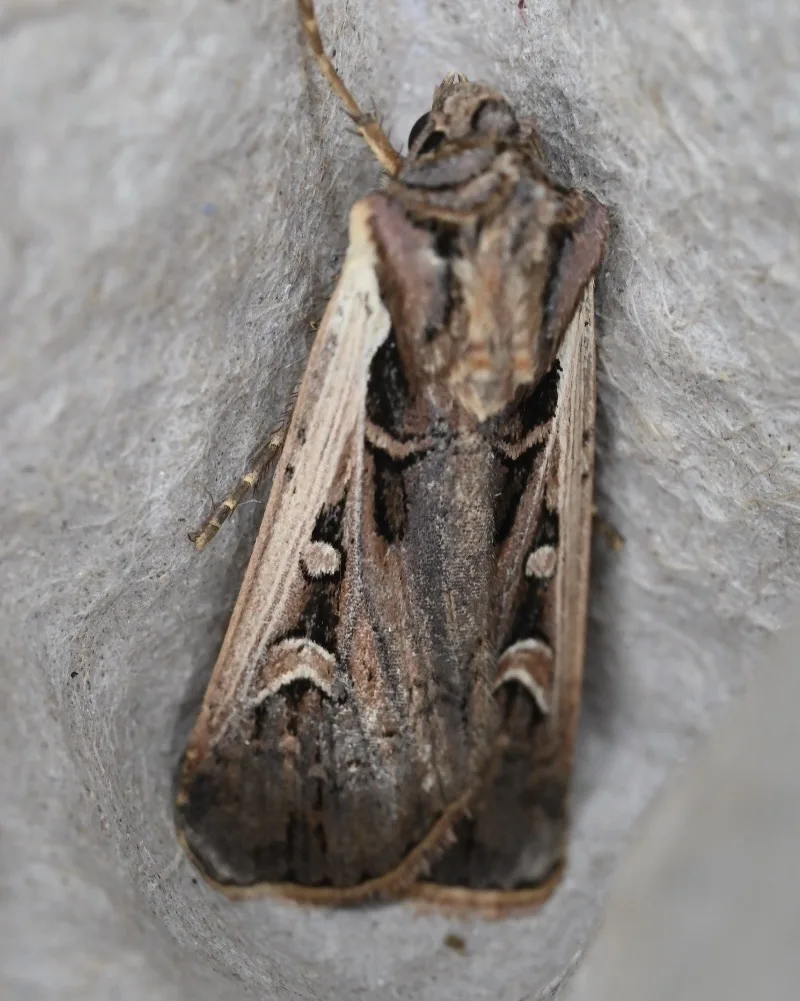
- The moth is grayish brown with a wingspan of about 1 1/2 inches. Each forewing has a whitish stripe along the front edge with two cream-colored outlined shapes just behind it, plus a round spot about halfway along and a kidney-shaped mark about two-thirds of the way to the tip.[1]
- Eggs are laid in masses on the upper surface of upper leaves, often on leaves near the whorl that have not fully unfolded. They are white at first, turn tan, and darken to purple shortly before they hatch.[1][2]
- At harvest, emergence holes in dry husks and damaged ear tips are often the first sign in fields that were not checked.[1]
Where it lives
It is native to North America and has spread eastward from the Great Plains; Purdue Extension now covers it as a corn pest in Indiana. In Kansas it is an occasional problem in the western part of the state, and moths have been trapped farther east without larvae being found in corn there.[1][2]
Biology and life cycle
Moths begin emerging in early July and peak around mid-month in Indiana. Females lay eggs through July and August on many cultivated and wild plants, most often on field corn and dry beans, and they favor corn in the late whorl stage, close to but not past pollination.[1]
Egg masses hold from 5 to 200 eggs (Purdue puts the usual range at 20 to 200, averaging about 50) and hatch in 5 to 7 days. Newly hatched larvae eat their egg shells, then move to sheltered spots such as tassels, leaf axils and silks before working into the ear.[1][2]
There are six larval stages. In late summer and early fall, full-grown larvae drop to the ground, burrow into the soil and build an earthen cell, where they spend the winter as pre-pupae before pupating in spring and early summer. In sandy soils they can go deeper, which helps them survive winter and escape tillage.[1]
Damage and signs
- Most feeding is in the ear, usually at the tip and sometimes on the sides, and several larvae may share one ear. Infestations are often patchy, and young larvae move between neighboring plants.[1]
- Studies in Iowa and Nebraska found that an average of one larva per plant across a field may cut yield by about 4 bushels per acre. Damaged kernels are prone to molds, lowering the quality of food-grade corn.[1]
- The name comes from the larvae's habit of feeding on dry beans as well as corn; they do not feed on soybeans.[1]
Health risk
It feeds only on plants. Purdue and Kansas State describe it as a crop pest and mention no risk to people or animals.[1][2]
Control
Prevention
Set pheromone traps by mid-June and check them weekly. Start scouting when several moths are being caught, focusing first on fields that are about to shed pollen; in Kansas, scouting usually runs July 18 to 30 in the southwest and about a week later in the northwest.[1][2]
Check at least 5 areas of a field, 20 plants in a row at each. Look on the upper surfaces of new and still-unfolded leaves for egg masses, and in the upper leaf axils, tassels and silks for young larvae. Plan on several visits over a few weeks.[1]
Not all Bt corn hybrids control western bean cutworm; Purdue notes that only certain hybrids give effective, reliable control.[1]
Biological control
Ground beetle larvae, birds that peck open ear tips, and digging animals (Purdue suspects skunks or raccoons) feed on the larvae and pre-pupae. They are unlikely to keep it below damaging levels in every field, but they have the potential to sharply reduce larval numbers without insecticides.[1]
Pesticides
Purdue's threshold is 5 percent of plants with egg masses or young larvae, with sprays timed for 90 to 95 percent tassel emergence, or for 70 to 90 percent egg hatch if tassels are already out. Kansas State's threshold is eggs or small larvae on 8 percent of plants at 95 percent tassel. Control drops off if spraying waits until all silks are out or larvae have reached the ear tips.[1][2]
Common questions
- Why is western bean cutworm hard to control once ear damage shows?
- By then the larvae are inside the ear, where insecticides are much less likely to reach them. Sprays have to be timed around tasseling and egg hatch, before larvae enter the ear.[1][2]
- Does western bean cutworm attack soybeans?
- No. Its name comes from feeding on dry beans as well as corn, but it does not feed on soybeans.[1]
- What do western bean cutworm eggs look like?
- They are laid in groups of 5 to 200 on the upper surface of upper leaves. Fresh eggs are white, turn tan as they develop, and become purple shortly before hatching.[1][2]
Sources
- Purdue University Extension Entomology, Field Crops IPM, “Western Bean Cutworm, Striacosta albicosta (Smith): corn fact sheet.” ag.purdue.edu/department/entm/extension/field-crops-ipm/_docs/western-bean-cutworm_corn.pdf (accessed 2026-11-08)
- Kansas State University Department of Entomology, “Western Bean Cutworm (J. P. Michaud, Facts and Information on Corn Pests, updated April 2024).” entomology.k-state.edu/extension/crop-protection/corn/western-bean-cutworm.html (accessed 2026-11-08)
- iNaturalist, “Striacosta albicosta taxon page (order and family).” www.inaturalist.org/taxa/143651 (accessed 2026-11-08)