On this page
How to identify it
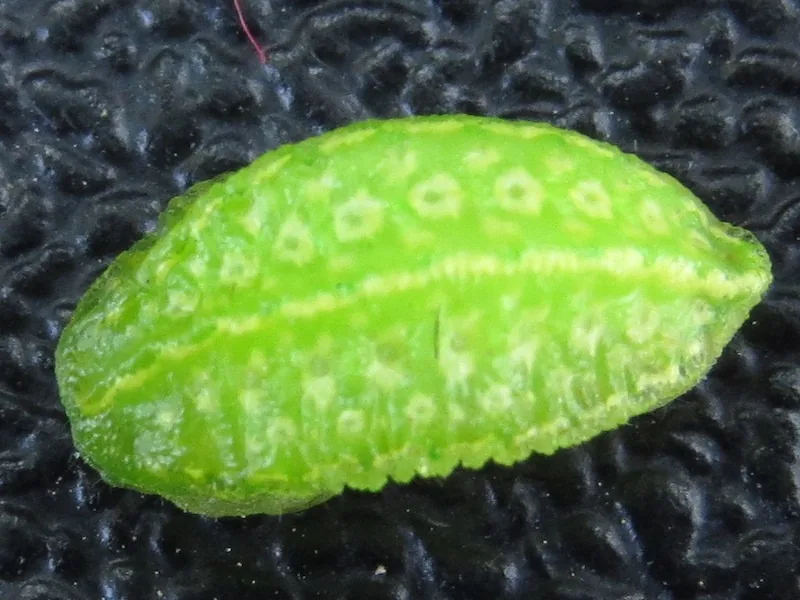
- A green slug caterpillar with yellow markings. Its skin is corrugated, with short, nonstinging hairs recessed into small depressions.[1]
- The back is flattened and then angles down to the sides. A faint yellow stripe runs along each side of the back, strongest over the thorax and toward the rear, and yellow spots run down the back, around the breathing pores and in two lines below them.[1]
- Like other slug caterpillars, it has no paired fleshy legs on the abdomen. Instead there are suckers down the middle of the underside of the first seven abdominal segments, and the head is often tucked out of sight under the thorax.[1]
Look-alikes
| Look-alike | How to tell them apart |
|---|---|
| Apoda slug caterpillars | Similar, but with a dark shade above the yellow stripe along each side of the back.[1] |
| Saddleback and other stinging slug caterpillars | Many slug caterpillars carry urticating spines, and a few can give a very painful sting; Clemson calls the saddleback the most common. The yellow-shouldered slug's short hairs are nonstinging and sit in small pits.[1][4] |
Where it lives
A caterpillar of eastern forests, with one generation a year in the North. GBIF US records since 1990 come from 35 states, most from Alabama, North Carolina, Pennsylvania and Texas.[1][5]
Biology and life cycle
The caterpillars feed on many kinds of forest trees and shrubs, favoring smooth-leaved ones. They are found from July to September, and there is one generation a year in the North.[1][2]
Larval development is very drawn out, commonly 60 to 80 days or more from egg hatch to cocoon.[2]
Parasitic wasps and flies are major enemies of slug caterpillars; researchers commonly find 30 to 50% (up to 80%) of field-collected slug caterpillars parasitized.[2]
Researchers studying insect immunity collected wild yellow-shouldered slugs, along with spiny oak slugs, in Maryland and Washington, D.C., and showed that enough blood (hemolymph) can be drawn from a single caterpillar to count its blood cells.[3][2]
When injected with harmless bacteria, late-instar yellow-shouldered slugs produced more than twice the density of blood cells (hemocytes) of early-instar ones, although unchallenged small and large caterpillars had similar counts. The authors suggest this may help explain why parasitism and infection vary with a caterpillar's stage.[2]
Damage and signs
Health risk
The USDA Forest Service guide describes its short hairs as nonstinging, unlike the urticating spines of many other slug caterpillars. Neither study mentions any risk to people. Clemson lists slug caterpillars among the three main groups of stinging caterpillars, so the nonstinging hairs are a feature of this species, not of the family.[1][2][3][4]
Control
Prevention
Neither the USDA Forest Service guide nor the studies recommend any control; natural enemies, especially parasitoids, attack slug caterpillars heavily.[1][2]
Where it lives
The USDA Forest Service includes it among the caterpillars of eastern forests.[1]
GBIF US records since 1990 come from 35 states, most from Alabama, North Carolina, Pennsylvania and Texas.[5]
Common questions
- Does the yellow-shouldered slug caterpillar sting?
- The USDA Forest Service guide describes its hairs as nonstinging and recessed in small pits in its skin. Many other slug caterpillars do have urticating spines, and a few can sting painfully.[1][4]
- Why does it look like a slug instead of a caterpillar?
- Slug caterpillars lack the paired fleshy legs on the abdomen that other caterpillars have. Instead they have suckers along the middle of the underside, and their heads are often hidden under the thorax.[1]
- When will I see yellow-shouldered slugs?
- From July to September, on the leaves of many kinds of forest trees and shrubs.[1]
Sources
- USDA Forest Service, Forest Health Technology Enterprise Team, “Caterpillars of Eastern Forests, FHTET-96-34 (D. L. Wagner, V. Giles, R. C. Reardon and M. L. McManus, November 1997; scanned copy).” archive.org/details/caterpillarsofea001997 (accessed 2026-11-11)
- PLoS ONE (via NCBI PubMed), “Hemocyte density increases with developmental stage in an immune-challenged forest caterpillar (T. M. Stoepler, J. C. Castillo, J. T. Lill and I. Eleftherianos; PLoS ONE 8(8): e70978, 2013; abstract).” pubmed.ncbi.nlm.nih.gov/23940679/ (accessed 2026-11-11)
- Journal of Visualized Experiments (via NCBI PubMed), “A simple protocol for extracting hemocytes from wild caterpillars (T. M. Stoepler, J. C. Castillo, J. T. Lill and I. Eleftherianos; Journal of Visualized Experiments (69): e4173, 2012; abstract).” pubmed.ncbi.nlm.nih.gov/23183567/ (accessed 2026-11-11)
- Clemson Cooperative Extension, Home & Garden Information Center, “Stinging Caterpillars (HGIC factsheet).” hgic.clemson.edu/factsheet/stinging-caterpillars/ (accessed 2026-11-11)
- Global Biodiversity Information Facility (GBIF), “Lithacodes fasciola: US occurrence records since 1990 by state (GBIF occurrence search API).” api.gbif.org/v1/occurrence/search?taxonKey=5105603&country=US&hasGeospatialIssue=false&year=1990%2C2026&facet=stateProvince&facetLimit=400&limit=0 (accessed 2026-11-11)
- iNaturalist, “Lithacodes fasciola taxon page (order and family).” www.inaturalist.org/taxa/201343 (accessed 2026-11-11)