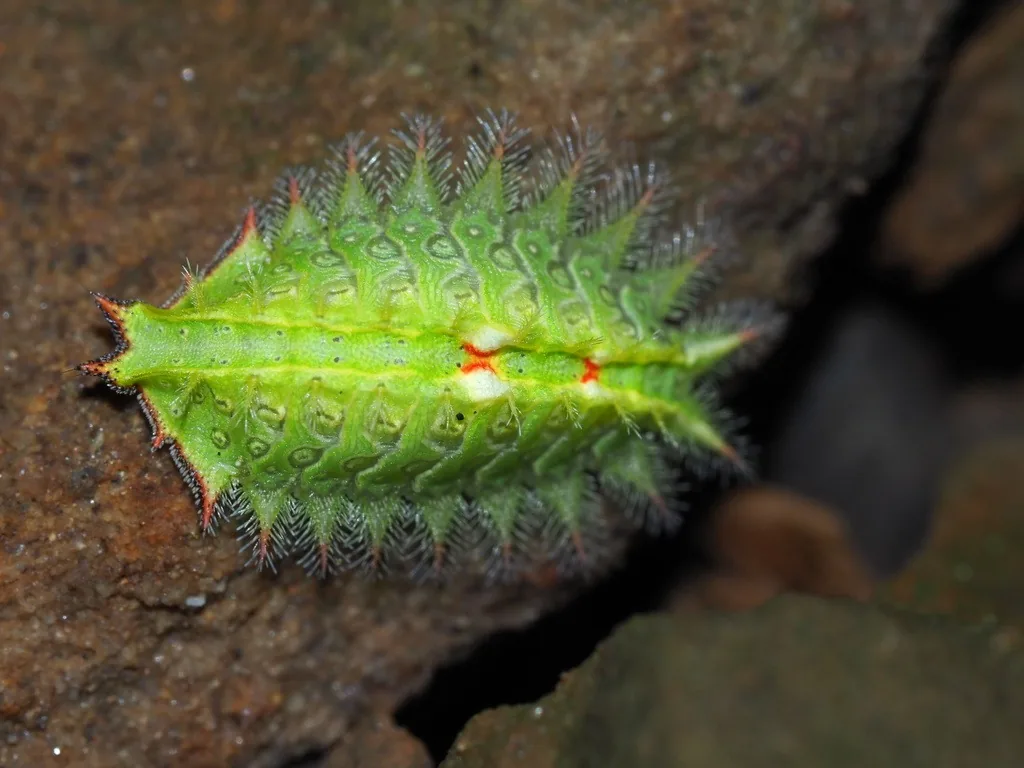
How to identify it
- Caterpillars are flattened, oval and pastel green, with plumes of stinging hairs around the edge and shorter stinging hairs on top.[1]
- Two pale lines run down the back, ending in a pair of “horns” at the front and a pair of stinging plumes at the rear; some have small red dots.[1]
- Adults are small brown moths about 3/4 inch long with a one-inch wingspan.[1]
Look-alikes
| Look-alike | How to tell them apart |
|---|---|
| Saddleback caterpillar | The most common slug caterpillar: charcoal gray with a lime-green saddle across the middle.[2] |
Where it lives
NC State reports it on hardwoods in North Carolina; slug caterpillars as a group are among the stinging caterpillars of the Southeast.[1][2]
Biology and life cycle
Caterpillars feed in summer and fall, even as leaves begin to change color, then spin dense, slightly oval cocoons, usually on the host plant.[1]
Moths fly from May to August, and there is probably one generation a year.[1]
Hosts include cherry, elm, hickory, linden, maple, oak, Norway maple and other trees and shrubs.[1]
Damage and signs
Health risk
The hollow stinging hairs release venom that causes burning pain and inflammation; NC State notes the symptoms can last several days.[1][2]
Control
Prevention
Most stings come from brushing against trees and shrubs during yard work; admire them without touching.[2]
Traps and physical control
Be careful if removing one by hand, since the stings are uncomfortable for days.[1]
Pesticides
No preventive treatment is needed, because the caterpillar is so rarely encountered.[1][2]
Common questions
- What should I do if a crowned slug stings me?
- Use tape to pull out broken spines, wash the area with warm soapy water and apply an ice pack to reduce swelling and pain.[2]
- Is the crowned slug dangerous?
- It stings painfully and the symptoms may last several days, but it is rarely encountered.[1]
- Do I need to spray my tree?
- No. It is so rarely encountered that preventive treatment isn't necessary.[1][2]
Sources
- NC State Extension, “Crowned Slug Caterpillar (PDIC Factsheet).” content.ces.ncsu.edu/crowned-slug-caterpillar (accessed 2026-10-15)
- Clemson Cooperative Extension, Home & Garden Information Center, “Stinging Caterpillars (HGIC 2482).” hgic.clemson.edu/factsheet/stinging-caterpillars/ (accessed 2026-10-15)
- iNaturalist, “Isa textula taxon page (order and family).” www.inaturalist.org/taxa/154469 (accessed 2026-10-06)