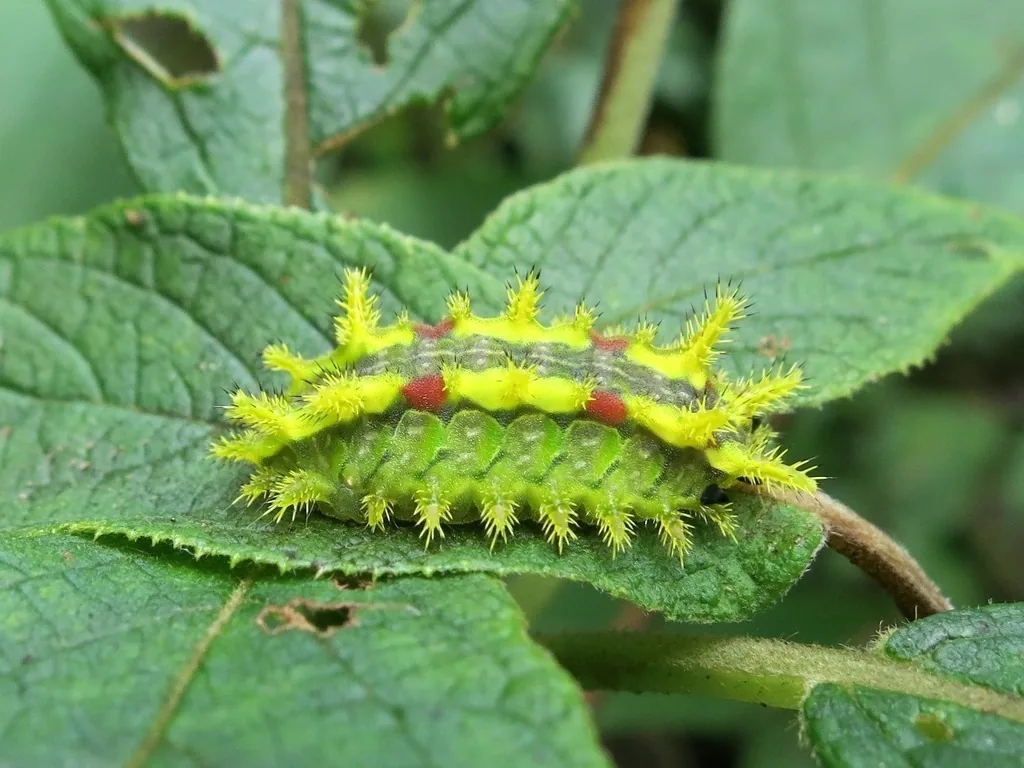
How to identify it
Look-alikes
| Look-alike | How to tell them apart |
|---|---|
| Saddleback caterpillar | The spiny oak-slug is less venomous than the saddleback.[1] |
Where it lives
UK Extension describes it among Kentucky's commonly encountered stinging caterpillars.[1]
Biology and life cycle
Young slug caterpillars may feed in groups, but older larvae feed alone.[1]
Grown larvae are usually found in late summer, with one generation a year.[1]
Damage and signs
- It feeds on oak, beech, chestnut, willow, pear, bayberry, sourwood, wild cherry and other trees.[1]
Health risk
Touching the spines can cause itching, pain, swelling or blistering; very young, older or unwell people tend to react more severely.[1]
Control
Prevention
Most stings come from brushing against leaves where caterpillars feed; their bright warning colors help you spot them.[1]
Pesticides
Where many are near homes, schools or play areas, Bacillus thuringiensis or carbaryl products can reduce them; follow the label.[1]
Common questions
Sources
- University of Kentucky Entomology (ENTFACT), “Stinging Caterpillars (ENTFACT-003).” entomology.mgcafe.uky.edu/ef003 (accessed 2026-10-06)
- iNaturalist, “Euclea delphinii taxon page (order and family).” www.inaturalist.org/taxa/136548 (accessed 2026-10-06)