On this page
How to identify it
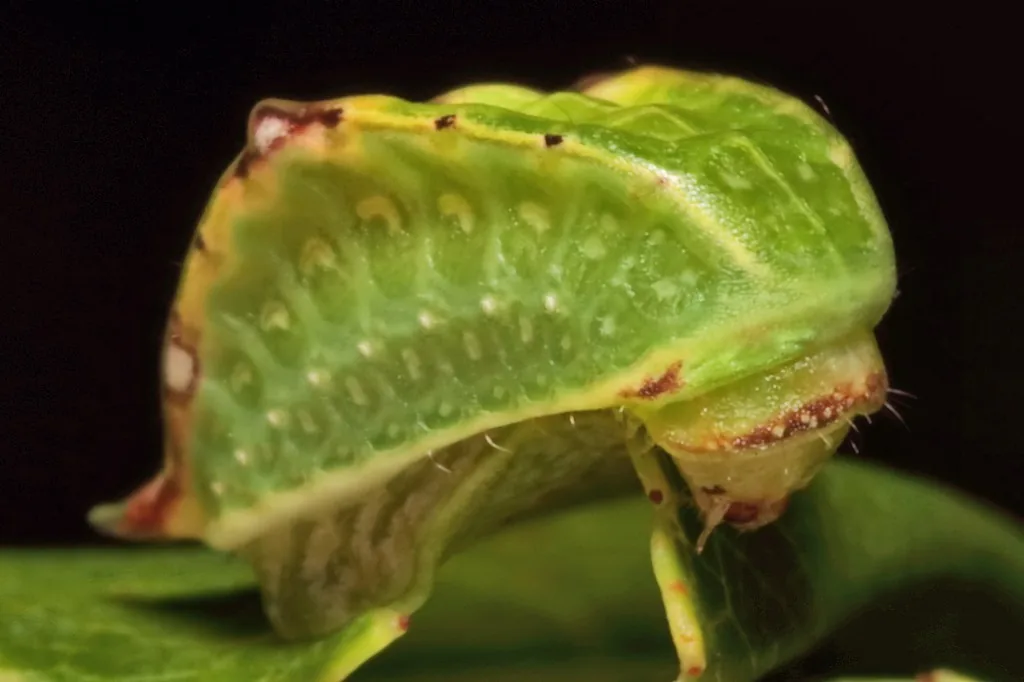
- The caterpillar is humped, highest at the fourth abdominal segment, with two ridges running front to back that end in a short, pointed tail; each ridge carries a small pointed bump at the crest. The head is retracted into the thorax and the legs are hidden, giving it the look of a small overturned skiff.[1][2]
- Color varies: the sides are green, sometimes with white spots that mimic damaged or dying leaf tissue, while the back ranges from brown to green; some individuals are gray, and others green with small to large brown blotches. The body is smooth, with no stinging spines.[2][1]
- The adult is a gray to beige moth about an inch or a little more long with its wings folded, with dark brown markings along the outer edge of the wings and a noticeable tuft of hair-like scales on the thorax.[1]
Look-alikes
| Look-alike | How to tell them apart |
|---|---|
| Saddleback caterpillar | Charcoal black or brown with an unmistakable lime green saddle and fingerlike lobes studded with stinging spines that deliver an intense sting; the skiff caterpillar has no spines at all.[2][1] |
| Yellow-shouldered slug | Green with yellow markings and a flattened back that angles downward, with a corrugated surface of non-stinging setae; the skiff caterpillar instead has a strongly humped back with two crested ridges and a pointed tail.[2][1] |
| Crowned slug caterpillar | Green, usually marked with red, strongly flattened and encircled with lobes bearing numerous stinging spines; the skiff caterpillar is smooth and spineless.[2][1] |
Where it lives
Eastern North America: the Forest Service's eastern caterpillar guide covers it, and NC State's fact sheet lists its hosts as American hophornbeam, beech, black cherry, bog-myrtle, maple, oak, sycamore and other trees and shrubs.[2][1]
Biology and life cycle
Caterpillars feed on cherries, oaks and many other woody plants from July to October, with one generation a year in the North.[2][1]
Each caterpillar spins a tough, brown, oval silk cocoon in which it spends the winter. The moth emerges the following growing season, mates and lays flat eggs singly or in small groups.[1]
Tiny braconid wasps often parasitize the caterpillars, and together with bacterial and viral diseases they usually keep populations sparse.[1]
Damage and signs
- The caterpillars chew leaves of their host trees and shrubs, but the skiff caterpillar is hardly ever abundant, and NC State considers it more of a curiosity than a true plant pest.[1]
Health risk
Other slug caterpillars carry clusters of spine-like, urticating hairs that cause a painful sting, but the skiff caterpillar has none and therefore probably cannot sting. Both sources describe it as smooth and spineless.[1][2]
Control
Prevention
No control recommendation seems necessary: the insect is hardly ever abundant and natural enemies keep it in check. Leave it alone and enjoy an unusual caterpillar.[1]
Biological control
Braconid wasp parasitoids and bacterial and viral diseases usually hold the population down without any help.[1]
Pesticides
Only in the rare event of an outbreak, NC State says carbaryl or another insecticide labeled for landscape use should give more than adequate control.[1]
Common questions
- Does the skiff caterpillar sting?
- Probably not. Unlike the saddleback and other slug caterpillars, it has no urticating spines, so NC State says it probably cannot sting.[1][2]
- Why does it look like a boat?
- The body is strongly humped with two crested ridges running front to back and a short pointed tail, and the head and legs are tucked out of sight, so the caterpillar resembles a small overturned skiff.[1][2]
- Should I treat my tree for skiff caterpillars?
- No. They are hardly ever abundant and are kept sparse by parasitic wasps and disease; NC State considers them a curiosity rather than a pest.[1]
Sources
- NC State Extension, North Carolina State University, “Skiff Caterpillar, PDIC Factsheet (James Baker; published April 12, 2016, reviewed Nov. 9, 2026).” content.ces.ncsu.edu/skiff-caterpillar (accessed 2026-11-10)
- USDA Forest Service, Forest Health Technology Enterprise Team, “Caterpillars of Eastern Forests, FHTET-96-34 (D. L. Wagner, V. Giles, R. C. Reardon and M. L. McManus, November 1997; scanned copy).” archive.org/details/caterpillarsofea001997 (accessed 2026-11-10)
- iNaturalist, “Prolimacodes badia taxon page (order and family).” www.inaturalist.org/taxa/207603 (accessed 2026-11-10)