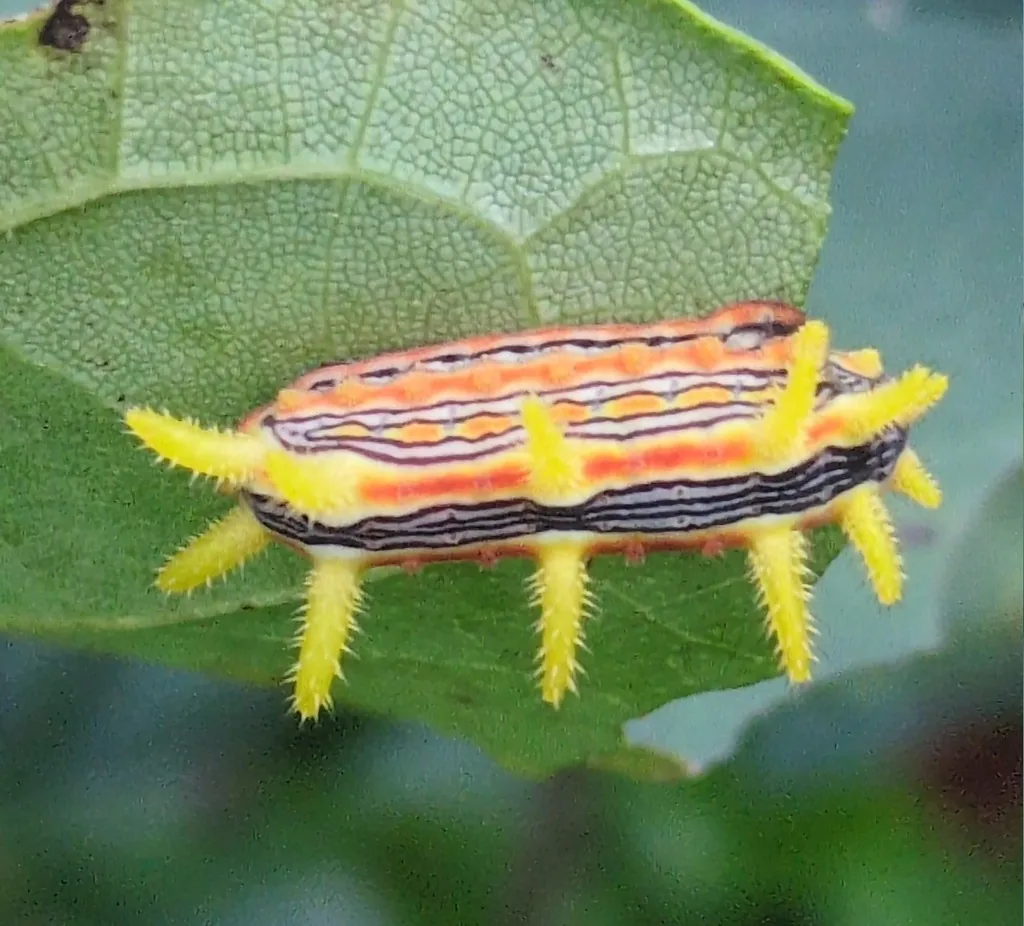
How to identify it
Look-alikes
| Look-alike | How to tell them apart |
|---|---|
| Saddleback caterpillar | A related slug caterpillar with a purple-centered green saddle.[1] |
Where it lives
UK Extension lists it among the commonly encountered stinging caterpillars in Kentucky.[1]
Biology and life cycle
It feeds on bushes and low tree branches.[1]
Like other slug caterpillars, it typically has one generation a year.[1]
Damage and signs
- Hosts include redbud, oak, hickory, bayberry, wild cherry and sycamore.[1]
Health risk
Its spines release venom that can cause pain, swelling, blistering and skin irritation.[1]
Control
Prevention
Remove a caterpillar from clothing or skin with a stick, never a bare hand; broken spines can lodge in clothes and gloves.[1]
Traps and physical control
Clip and relocate the leaf or stem holding a lone caterpillar.[1]
Common questions
- What should I do if a caterpillar stings me?
- Pull broken spines out with tape, wash with soap and water, use an ice pack, and see a doctor if the reaction is severe.[1]
- Should I spray for stinging caterpillars?
- Usually not; preventive sprays aren't recommended unless they're numerous where people gather.[1]
Sources
- University of Kentucky Entomology (ENTFACT), “Stinging Caterpillars (ENTFACT-003).” entomology.mgcafe.uky.edu/ef003 (accessed 2026-10-06)
- iNaturalist, “Parasa indetermina taxon page (order and family).” www.inaturalist.org/taxa/153078 (accessed 2026-10-06)