On this page
How to identify it
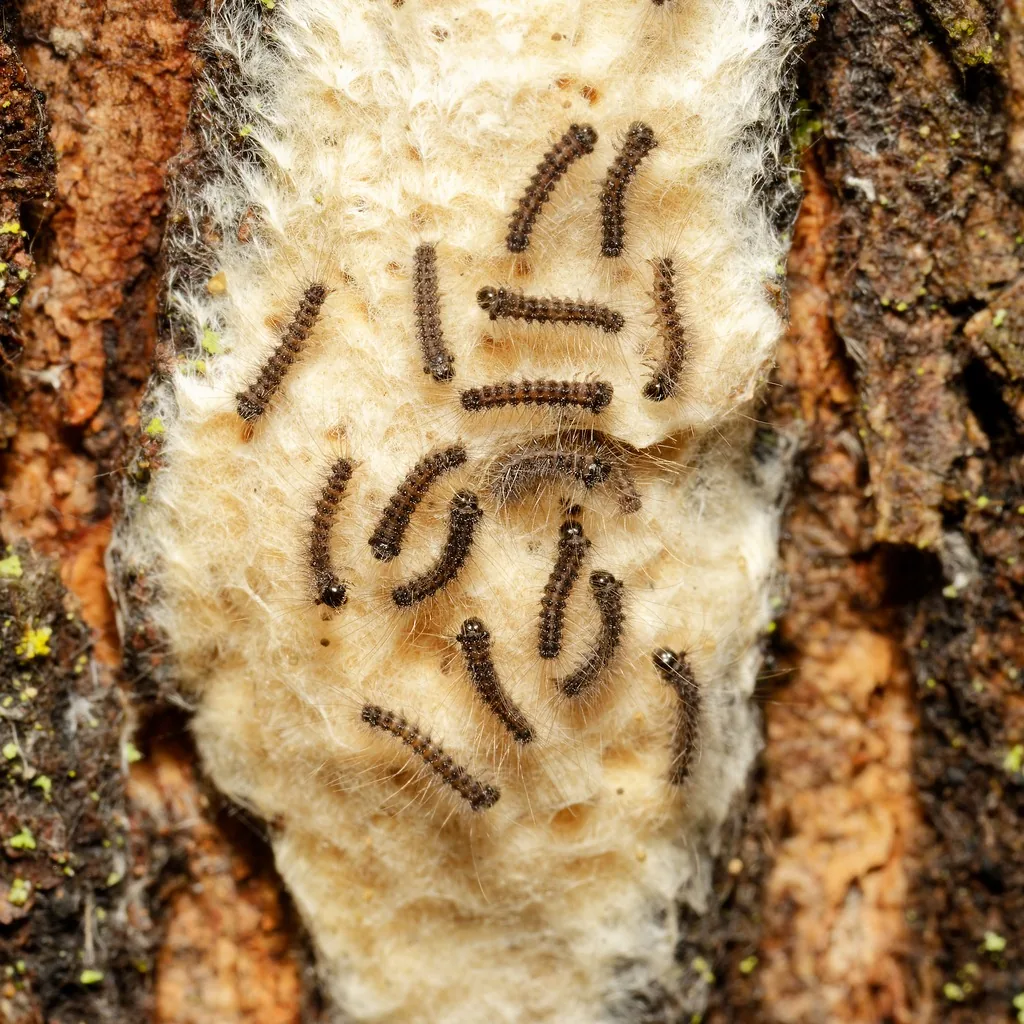
- Egg masses are tan to brown, fuzzy patches covered with buff or yellowish hairs from the female's body, laid on trees, stones, walls, logs and outdoor household items such as patio furniture, toys and lawn equipment.[4][5]
- Older caterpillars are mottled yellow to gray and hairy, with five pairs of blue dots followed by six pairs of red dots along the back. They hatch about 1/16 inch long and may top 3 inches before they pupate.[4][5]
- Young caterpillars have an all-black head; older ones show yellow markings on the head, a quick way to tell whether Bt is still worth using.[5]
- Males are brown with darker markings, about a 1-1/2-inch wingspan and feathery antennae. Females are nearly white with dark saw-toothed markings, about a 2-inch wingspan, and do not fly.[4][5]
- Adult moths don't feed, so only the caterpillar stage strips leaves; by July most defoliation for the year is done.[5]
Look-alikes
| Look-alike | How to tell them apart |
|---|---|
| Eastern tent caterpillar | Tent caterpillars have a white stripe down the back and spin silk tents in branch crotches. Spongy moth caterpillars make no webs or tents, though the two are often active at the same time.[3][5] |
Where it lives
Native to Europe; it escaped in Medford, Massachusetts, in the late 1860s and is now found in Connecticut, Delaware, the District of Columbia, Illinois, Indiana, Maine, Maryland, Massachusetts, Michigan, Minnesota, New Hampshire, New Jersey, New York, North Carolina, Ohio, Pennsylvania, Rhode Island, Vermont, Virginia, West Virginia and Wisconsin. USDA has designated quarantine areas, and APHIS says all states are at high risk because host trees grow everywhere.[4][5][2]
Biology and life cycle
Eggs overwinter. In Massachusetts they usually hatch in the first week of May, or mid-to-late April in a warm spring.[5][4]
Newly hatched caterpillars climb, hang on silk threads and are carried by the wind to new trees, a dispersal called ballooning; in outbreak years they turn up in swimming pools and on fences.[5]
Small and moderate populations often feed at night and come down off the trees by day; in outbreaks they stay in the canopy around the clock. The caterpillar stage lasts about six weeks, ending around the third week of June in Massachusetts.[5]
Adults appear by late June or early July, and each female can lay upward of 1,000 eggs.[5][1]
Oaks are the preferred hosts; apple, birch, poplar, willow and witch hazel are also favored, and when broadleaf hosts are stripped the caterpillars may move to spruce and white pine.[5]
Trees they mostly avoid include American holly, arborvitae, ash, balsam fir, black walnut, catalpa, flowering dogwood, locust, mountain laurel, red cedar, rhododendron, sycamore and yellow poplar.[5]
Damage and signs
Health risk
The caterpillar hairs can cause an itchy rash. During the 1981 to 1982 outbreak in the Northeast, a survey found a one-week rash risk of 10.4 percent in a heavily infested community versus 1.6 percent in a lightly infested one; rash was tied to having a caterpillar crawl on the skin, a rash the year before, hay fever and hanging laundry outdoors. In a Japanese outbreak most rashes were on the neck and arms, and 79 percent of hospital patients hadn't noticed touching a caterpillar.[6][7]
Control
Prevention
Moving from a quarantine area to a non-quarantine area? Federal law requires inspecting outdoor household items and removing all life stages first.[2][4]
Traps and physical control
Mid-October to mid-April: scrape egg masses into a jar of soapy water and soak for two days, or soak them with a horticultural oil labeled for spongy moth eggs. Don't just crush them or knock them on the ground; many eggs survive.[1][5]
Wrap trunks with duct tape or another nonporous band coated with a sticky material to catch climbing caterpillars, never applying the sticky material directly to bark, and clean or replace bands often, since live caterpillars can crawl over dead ones.[1][5]
Early June: switch to burlap collection bands folded into a skirt at chest height; check them daily in the afternoon and knock the caterpillars into soapy water.[1]
July: crush or brush pupae and the pale, flightless females into soapy water before they lay eggs.[1]
Biological control
August to September: leave egg masses with tiny pinholes alone; a parasitic wasp that attacks spongy moth eggs is at work.[1]
May: Bacillus thuringiensis kurstaki (Btk) kills small caterpillars that eat treated leaves and affects only moth and butterfly larvae; it's much less effective on older caterpillars.[1][5]
In wet springs a fungus, Entomophaga maimaiga, can keep numbers low, and a virus often collapses outbreaks; caterpillars killed by the fungus hang head-down on trunks.[5]
When to call a professional
Large trees need specialized spray equipment; consult a certified arborist or licensed applicator.[1][5]
The federal moving rule
If you move from a spongy moth quarantine area to a non-quarantine area, you must inspect outdoor household items such as patio furniture, lawn equipment, toys, grills, trailers and vehicles and remove all life stages; you may face penalties if you don't. If you don't live in a quarantine area, the rule doesn't apply.[2][4]
Scrape egg masses off with a putty knife or stiff brush and drop them in hot, soapy water, or seal them in a plastic bag and set it in the sun.[2][4]
If you move between April and August, inspect on moving day if you can; otherwise keep items sealed under a tarp, indoors or in a closed truck. Keep the completed checklist in the moving vehicle as your certificate of inspection.[2][4]
APHIS added Green and Sawyer counties in Wisconsin to the federal quarantine on April 15, 2026, so check the current map before you move.[4]
Avoiding the rash
Avoid letting caterpillars crawl on bare skin: in the U.S. survey, rash risk rose with caterpillar contact and with a rash in the previous year, and the two together added up.[6]
People who had a rash the year before were far more likely to get one again in the Japanese survey, so people with a past rash are the most likely to react again.[7][6]
Where sources disagree
Eggs per mass: Wisconsin says egg masses often hold 600 or more, UMass says 500 or more, and APHIS says up to 1,000.[1][5][4]
How many plants they eat: APHIS says more than 300 species of trees and shrubs; UMass says at least 500 species of trees, shrubs and vines.[4][5]
When to put up sticky bands: Wisconsin says late April, just after hatch, to stop small caterpillars climbing back up; UMass says wait until caterpillars are about an inch long, roughly early to mid June, and keep bands up through July.[1][5]
How small caterpillars must be for Bt: Wisconsin says under 1/2 inch; UMass says Bt loses effect once they are over about 3/4 inch or show yellow head markings.[1][5]
Common questions
- Is the spongy moth the same as the gypsy moth?
- Yes. Lymantria dispar was formerly known as the gypsy moth; spongy moth is its current common name.[1]
- Can spongy moth caterpillars give me a rash?
- Yes, mainly in outbreak years. Studies in the U.S. and Japan linked itchy rashes to heavy infestations, often on the neck and arms, sometimes without noticing any contact.[6][7]
- Will my oak die after it's stripped?
- Usually not after one year if it's otherwise healthy; several years of defoliation in a row are what cause dieback and death.[5][4]
Sources
- University of Wisconsin-Madison Division of Extension, “Spongy Moth Management Guide for Homeowners.” fyi.extension.wisc.edu/spongymothinwisconsin/pest-management-2/management-guide-for-homeowners/ (accessed 2026-11-11)
- USDA Animal and Plant Health Inspection Service, “It's the Law: Before Moving, Check for the Spongy Moth (Program Aid No. 2147, revised September 2023).” www.aphis.usda.gov/sites/default/files/fsc-moving-check-spongy-moth.pdf (accessed 2026-11-11)
- University of Kentucky Entomology, “ENTFACT-423: Eastern Tent Caterpillar (revised January 2026).” entomology.mgcafe.uky.edu/ef423 (accessed 2026-11-11)
- USDA Animal and Plant Health Inspection Service, “Spongy Moth.” www.aphis.usda.gov/plant-pests-diseases/spongy-moth (accessed 2026-11-11)
- UMass Amherst Center for Agriculture, Food, and the Environment, “Spongy Moth (Landscape, Nursery and Urban Forestry Program).” www.umass.edu/agriculture-food-environment/landscape/fact-sheets/spongy-moth (accessed 2026-11-11)
- American Journal of Public Health, via PubMed, “An epidemiologic study of gypsy moth rash (Tuthill et al. 1984).” pubmed.ncbi.nlm.nih.gov/6742270/ (accessed 2026-11-11)
- European Journal of Dermatology, via PubMed, “Gypsy moth-induced dermatitis: a hospital review and community survey (Kikuchi et al. 2012).” pubmed.ncbi.nlm.nih.gov/22562801/ (accessed 2026-11-11)
- iNaturalist, “Lymantria dispar taxon page (order and family).” www.inaturalist.org/taxa/47802 (accessed 2026-11-11)