On this page
How to identify it
- Full-grown caterpillars are about 1 1/2 inches (3.5 cm) long, with bright yellow sides, a pale to rusty orange-brown head, a chalky underside and up to 10 thin, wavy black lines along the back.[1][2]
- Like other loopers, they have only two pairs of prolegs and move with an inchworm motion; young caterpillars can drift on silk threads in the wind.[1][2]
- The breathing holes along the yellow side stripes are ringed in black.[1]
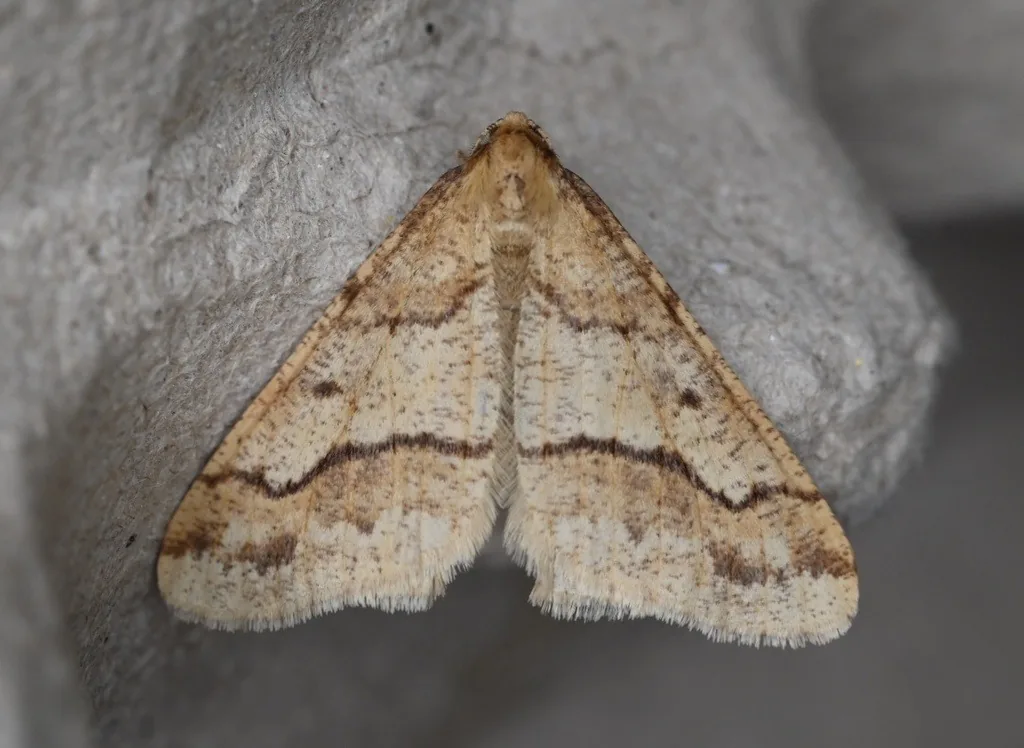
- Females are wingless, about 1/2 inch (13 mm) long, with two rows of large black spots on the back; the males fly on fall nights and can gather at lights, even in car headlights, in large numbers.[1]
Look-alikes
| Look-alike | How to tell them apart |
|---|---|
| Cankerworms | Other inchworms whose outbreaks can overlap with the linden looper's on the same trees.[1] |
| Winter moth | Some older literature also calls the linden looper a winter moth, but in Massachusetts that name belongs to Operophtera brumata, a different species.[1] |
Where it lives
A native insect of the northern half of the United States and parts of Canada; University of Missouri Extension also covers it in its yard and garden caterpillar guide.[1][2]
Biology and life cycle
Adults emerge from October to December, usually after the first frost; the wingless females crawl up the trunk and lay eggs in small clusters under loose bark, about 300 eggs each on average.[1]
The eggs hatch at bud break (late April to mid-May), and the caterpillars feed for about a month; young ones feed by day, while older ones may feed at night.[1][2]
By mid-June the caterpillars finish feeding, crawl down and burrow 2 to 6 inches into the soil to pupate; there is one generation a year.[1][2]
Sources differ on the overwintering stage: most describe the egg, while one reports pupae overwintering in the soil, possibly in the Canadian part of the range, where adults mostly emerge in spring.[1]
Damage and signs
- Caterpillars eat all of the leaf except the midrib and leaf stem, starting with elongated holes; feeding is often heaviest at the top of the tree or on lower, exposed branches.[1]
- It is a boom-and-bust species: usually present in low numbers, with occasional outbreaks, such as in 1925 and in 1962 and 1963 in Massachusetts, Connecticut and nearby states, that defoliate forests and understory shrubs.[1]
- Preferred hosts include linden, apple, birch, elm, hickory, oak, poplar and witch hazel, and it also eats maple, ash, cherry, willow, rose, blueberry and serviceberry.[1][2]
Health risk
It feeds only on plants; neither source reports any harm to people or pets.[1][2]
Control
Prevention
Look for young caterpillars ballooning or feeding on host trees from late April to mid-May; yearly monitoring usually isn't needed unless a regional outbreak is under way.[1]
Traps and physical control
Sticky tree bands in fall catch some of the wingless females climbing to lay eggs and are more useful for monitoring than control, and raking leaf litter away from the base of host plants during an outbreak can make the site less suitable for pupation.[1]
Biological control
A virus disease, tachinid flies and other natural enemies attack the caterpillars; virus-killed caterpillars turn black and shriveled and hang from leaves and branches.[1]
Pesticides
Because numbers usually stay low, treatment is rarely needed; during an outbreak, use a product labeled for caterpillars on that tree and follow the label.[1]
Common questions
- What are the yellow inchworms on my linden tree?
- Yellow inchworms with thin, wavy black lines on the back, feeding on linden, oak, maple or other trees in spring, are likely linden loopers.[1][2]
- Why are moths flying in my headlights in November?
- Male linden looper moths fly on fall nights from October to December, often after the first frost, and can gather in large numbers at lights.[1]
Sources
- UMass Extension Landscape, Nursery and Urban Forestry Program (Landscape Insect & Mite Guide), “Erannis tiliaria (Linden Looper).” www.umass.edu/agriculture-food-environment/landscape/publications-resources/insect-mite-guide/erannis-tiliaria (accessed 2026-10-17)
- University of Missouri Extension, “Caterpillars in Your Yard and Garden (IPM1019), page 28: linden looper.” extension.missouri.edu/publications/ipm1019/28 (accessed 2026-10-17)
- iNaturalist, “Erannis tiliaria taxon page (order and family).” www.inaturalist.org/taxa/219382 (accessed 2026-10-06)