How to identify it
- Caterpillars move in a looping, inchworm-like way and are about 1 inch long when grown.[1][2]
- Fall cankerworm caterpillars are light green with white lines or dark brownish-green with a black stripe down the back, and have three pairs of prolegs, the front pair much smaller.[2][1][3]
- Spring cankerworm caterpillars range from green to reddish brown or black and have only two pairs of prolegs.[1][3]
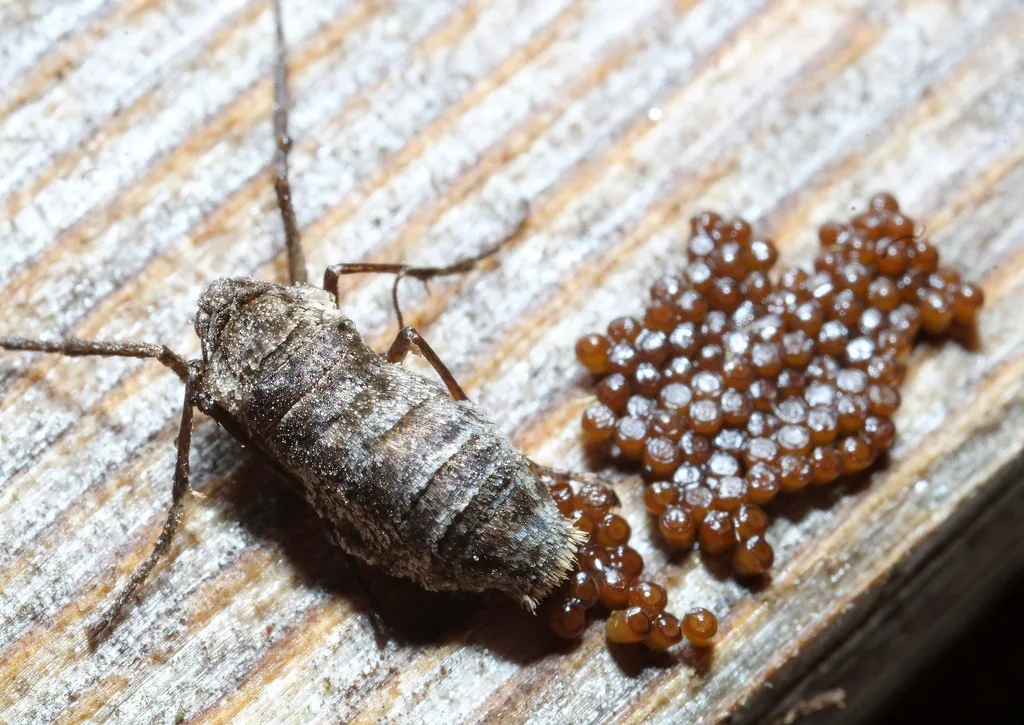
- Males of both species are small, dull, brownish-gray moths that fly; females are wingless and must crawl up tree trunks.[1][3][2]
- Fall cankerworm eggs are laid in compact rows of about 100 on small twigs; spring cankerworm eggs go in loose clusters in bark crevices on the trunk and larger branches.[2][1][3]
Look-alikes
| Look-alike | How to tell them apart |
|---|---|
| Spring cankerworm | Has two pairs of prolegs instead of three, overwinters in the soil rather than as eggs, and its moths come out in late winter or early spring instead of late fall.[1][3] |
| Spongy moth caterpillar | Spongy moth caterpillars grow to 1 1/2 to 2 1/2 inches, are hairy, and have pairs of blue and red dots on the back; cankerworms reach about 1 inch and move with an inchworm loop.[4][1] |
Where it lives
Both species are native to North America; the fall cankerworm is a common pest of hardwood trees across the continent, including Pennsylvania and North Dakota.[3][2][1]
Biology and life cycle
Both species have one generation a year, and caterpillars of both hatch at budbreak and may feed side by side on the same tree.[1][3]
Young caterpillars spin down on silk threads when disturbed, and wind can carry them a long way to new trees.[1][3]
After about four to six weeks of feeding, mature caterpillars drop to the ground and spin cocoons in the soil.[2][1]
Fall cankerworm moths come out in late fall, from about late September to December depending on the region; the females climb trees and lay eggs that overwinter.[1][2][3]
Spring cankerworms overwinter in the soil, and their moths emerge in late winter or early spring, as soon as the ground thaws.[1][3]
Damage and signs
- Early feeding makes small shot holes between leaf veins; older caterpillars skeletonize leaves and then eat all but the midrib.[1][2][3]
- Elm, hackberry and apple are the most vulnerable hosts in North Dakota; in Pennsylvania forests, ash, basswood, beech, cherry, maple and oak are favored.[1][2]
- One season of defoliation rarely hurts a large, vigorous tree, but repeated years weaken trees, and two years in a row can kill stressed trees.[1][2]
- In yards and parks, caterpillars dangling on silk can be blown onto people under infested trees.[2]
Health risk
Cankerworms are a tree pest and a nuisance when caterpillars drop on silk; the harm is defoliation and tree stress.[2][1]
Control
Prevention
Use binoculars in May to check upper branches for young caterpillars and early shot holes, since late detection usually means it's too late to treat.[1][2]
Traps and physical control
A sticky band around the trunk catches wingless females climbing to lay eggs; band in early to mid-September for fall cankerworm and mid-March for spring cankerworm, in North Dakota.[1]
Banding works best for early detection rather than control, and it fails when neighboring unbanded trees with touching canopies are infested.[1][2][3]
Biological control
Bacillus thuringiensis var. kurstaki is highly recommended where possible; apply it when caterpillars are under 1/2 inch, about 10 days after egg hatch.[1]
Pesticides
A dormant or horticultural oil applied before budbreak can smother eggs, but they must be completely covered.[1][3]
Insecticides work best on young caterpillars when defoliation is still low; once caterpillars are mature and dropping to pupate, treatment is usually not warranted.[1][2]
When to call a professional
Many residential trees are too large to cover well with homeowner sprayers, and good coverage of the canopy is critical.[1]
Common questions
- Do sticky tree bands stop cankerworms?
- Not reliably. They trap wingless females and help you spot an outbreak early, but NDSU says banding is not an effective control on its own.[1][3]
- When should I spray for cankerworms?
- While caterpillars are small, under about 1/2 inch, in spring shortly after egg hatch; spraying large caterpillars after heavy leaf loss rarely helps.[1][2]
- Why are inchworms hanging from my trees on threads?
- Cankerworms spin down on silk when disturbed, and mature caterpillars lower themselves to the ground to pupate in the soil.[1][2]
Sources
- NDSU Extension, “Cankerworms in North Dakota (E999, revised April 2026).” www.ndsu.edu/agriculture/extension/publications/cankerworms-north-dakota (accessed 2026-10-06)
- Penn State Extension, “Fall Cankerworm (updated April 10, 2026).” extension.psu.edu/fall-cankerworm (accessed 2026-10-06)
- UMass Extension Landscape, Nursery and Urban Forestry Program, “Paleacrita vernata (Spring), Alsophila pometaria (Fall): Cankerworms (Landscape Insect and Mite Guide).” www.umass.edu/agriculture-food-environment/landscape/publications-resources/insect-mite-guide/paleacrita-vernata-spring-alsophila-pometaria-fall (accessed 2026-10-06)
- Rutgers New Jersey Agricultural Experiment Station, “Spongy Moth Management in the Home Landscape, FS004.” njaes.rutgers.edu/FS004/ (accessed 2026-10-06)
- iNaturalist, “Alsophila pometaria taxon page (order and family).” www.inaturalist.org/taxa/215208 (accessed 2026-10-06)