On this page
How to identify it
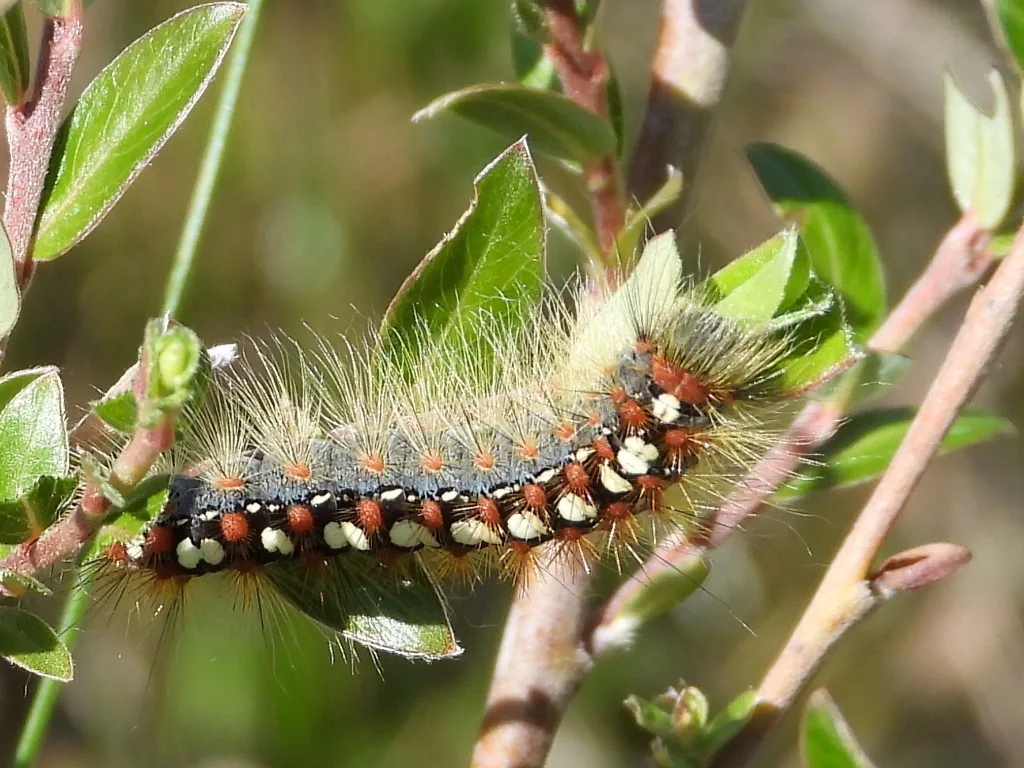
- Grown caterpillars are about 1.5 to 2 inches long, mottled gray to black, with a row of large white spots down the back and tufts of yellowish-brown hair on reddish warts.[1][2]
- Moths are satiny white with a wingspan of about 1.5 inches; the body under the white scales is black.[2]
- Females lay egg masses of up to 400 eggs covered with a frothy white material.[1]
Where it lives
First reported between Boston and Hampton, New Hampshire, in 1920; it has since spread through New England and to other parts of the United States and Canada.[1][2]
Biology and life cycle
Moths fly in July, and eggs hatch in August; the small caterpillars feed for a while, then spin silk hibernation webs in bark cracks for the winter.[1][2]
Caterpillars resume feeding in May, cause the most visible defoliation by mid-June and pupate by late June in loose cocoons on trunks, fences and buildings.[1][2]
There is one generation a year.[1]
Damage and signs
- It feeds on poplars and willows, especially eastern cottonwood, white and Lombardy poplar, bigtooth and trembling aspen and balm-of-Gilead.[1][2]
- Severe defoliation of ornamental poplars has been common in the Northeast since 1920; woodland outbreaks are less frequent, though Maine had over 10,000 acres in 1968.[2]
- Mature caterpillars wander over almost everything nearby looking for food or a place to spin cocoons, and trees usually survive defoliation.[1][2]
Health risk
UMass notes the caterpillars are not known for causing rashes but advises against handling them, especially for sensitive people.[1]
Control
Traps and physical control
Scrape egg masses off trunks when found; sticky bands put on in spring may catch wandering caterpillars, though how well they protect a tree is uncertain.[1]
Biological control
Parasites of the spongy moth also kill satin moths, along with a virus, fungi and birds.[1]
Pesticides
Maine notes Bacillus thuringiensis can be sprayed on the foliage in spring as soon as caterpillars start feeding.[2]
Common questions
Sources
- UMass Extension Landscape, Nursery and Urban Forestry Program (Landscape Insect & Mite Guide), “Leucoma salicis (Satin Moth).” www.umass.edu/agriculture-food-environment/landscape/publications-resources/insect-mite-guide/leucoma-salicis (accessed 2026-10-16)
- Maine Forest Service (Maine Department of Agriculture, Conservation and Forestry), “Satin Moth (fact sheet, April 2000).” www.maine.gov/dacf/mfs/forest_health/insects/satin_moth.htm (accessed 2026-10-16)
- iNaturalist, “Leucoma salicis taxon page (order and family).” www.inaturalist.org/taxa/209787 (accessed 2026-10-06)