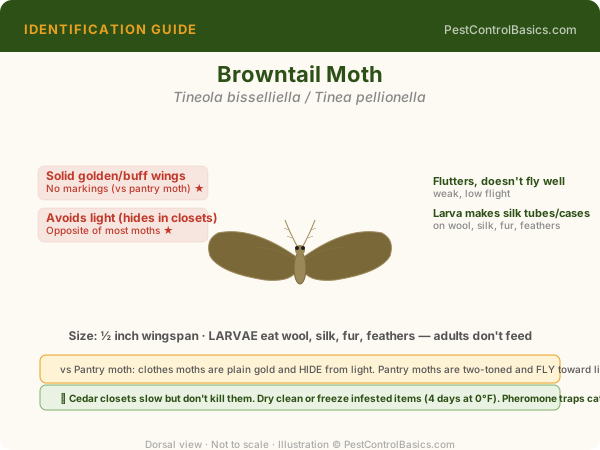
Browntail moth is unique to Maine and Cape Cod in the US — and its microscopic caterpillar hairs cause a poison-ivy-like rash that can persist for weeks, plus respiratory irritation.
Original illustration by PestControlBasics.com. Use anatomical labels above to confirm your identification.
🔬
PestControlBasics Editorial Team
Reviewed by Derek Giordano · Updated 2026
🔍 Identification
Adults: 35-42mm wingspan; white wings with distinctive white-tufted brown abdomen tip (females). Caterpillars (damaging + toxic stage): 35-40mm; dark brown with two red spots on top near tail; covered in dense, barbed hairs. Winter webs: silky white tents at branch tips on cherry, oak, and birch — persisting through winter and into spring. Range: restricted to Maine and coastal Massachusetts (Cape Cod peninsula primarily).
🧬 Biology & Behavior
Browntail moth is an invasive from Europe established in New England in the late 1800s. The toxic hairs (setae) break off and become airborne — especially during spring caterpillar development and again in late summer when the hairs disperse. The microscopic barbs lodge in skin and lungs. Adults don't cause the rash — only caterpillar hairs do.
⚠️ Damage & Health Risk
Persistent contact dermatitis (poison-ivy-like rash) lasting 1-6 weeks from airborne or direct hair contact; respiratory irritation ranging from mild to severe in sensitive individuals; potential asthma exacerbation; eye irritation. Maine public health tracks exposure incidents annually.
🔧 DIY Treatment
Winter web removal (most effective): Cut infested branch tips with long-handled pruners in winter (January-April) and carefully bag. Don't shake the webs. Don't compost — bag and seal for trash. Spring caterpillar treatment: Bt kurstaki spray in May when caterpillars are small. Spinosad spray. Wear N95 mask and long sleeves during outdoor work in infested areas. Change clothes after outdoor activity in caterpillar season.
👷 When to Call a Pro
For large trees, professional spray applications by licensed arborists provide safer coverage than homeowner ladder work. Maine Forest Service provides guidance on large-scale management.
❓ FAQ
How do I treat browntail moth rash?
Browntail moth dermatitis is treated similarly to poison ivy: calamine lotion, over-the-counter hydrocortisone cream (1%), and oral antihistamines (diphenhydramine or cetirizine). Severe cases may require prescription-strength corticosteroids. Showering immediately after outdoor exposure in caterpillar season helps.
Is browntail moth only in Maine?
Browntail moth in the US is currently established only in Maine and coastal Massachusetts (Cape Cod). It's a significant public health concern in these areas. Range expansion to adjacent states is possible — check Maine Forest Service's annual tracking maps.
DG
Derek Giordano
Certified Pest Control Operator · Former Business Owner
Derek ran his own pest control company in Florida for several years, servicing thousands of regular customers. All content is based on hands-on field experience and current EPA & university extension guidelines.
Confirming a Browntail Moth infestation in the field
Misidentification is the most common reason home treatment fails for Browntail Moth. Look-alike species often respond to completely different active ingredients, so a 30-second confirmation step before any spraying or baiting saves the most time over a season. The practical workflow begins with where you found the specimen — kitchen, bathroom, garden, attic — because habitat narrows the candidate list faster than morphology alone.
Specific cues for Browntail Moth include body proportions, leg count, antenna shape, and any wing structure if present. Adults are usually the easiest stage to identify, but most real-world infestations show juveniles or evidence (frass, shed skins, webbing, damage patterns) more often than adults themselves. Photograph the specimen against a ruler or coin for scale, then compare against a regional reference rather than a global one — range maps from state Extension services beat generic online identification sites.
When two species look genuinely similar, the deciding factor is often where they congregate at dusk versus dawn, or whether they leave a visible trail. A test of three common DIY treatments — one bait, one residual spray, one mechanical barrier — applied in different areas can also confirm identity by which works.
When to escalate Browntail Moth control beyond DIY
Most Browntail Moth situations are within the range of a careful homeowner, but a handful of scenarios genuinely warrant a licensed applicator. Multi-unit buildings are at the top of that list — shared walls, plumbing, and ductwork mean a localized treatment in one unit often just relocates the population to a neighbor. Any infestation that involves wall voids, attic insulation, or sub-slab plumbing is also harder to reach with consumer products and benefits from professional equipment and labeled product concentrations.
Health-sensitive situations are the second escalation trigger. Pregnancy, infants, immunocompromised residents, and pets with known sensitivities all narrow the available product list considerably. A licensed professional can apply restricted-use products and reduced-risk reformulations that achieve control with lower household exposure than over-the-counter alternatives. The cost difference is usually less than two seasons of DIY spending once the time investment is factored in.
The third escalation point is recurrence. If the same pest returns within six weeks of an apparently successful treatment, the source is usually structural or environmental rather than chemical, and a professional inspection often finds the cause faster than a second round of self-treatment.
Prevention strategies that actually reduce Browntail Moth pressure
Most pest pressure traces back to one or two environmental conditions that are easier to fix than the infestation itself is to spray. For Browntail Moth, the highest-leverage changes typically involve moisture management, food access, and exclusion at structural entry points. Reducing standing water within 20 feet of the foundation eliminates more pest problems than any single chemical application, and the effect persists year over year rather than requiring a rebuy every quarter.
Exclusion work is unglamorous but durable. A common entry-point audit covers door sweeps, weep holes, utility penetrations, dryer vents, soffit gaps, and the base of siding. Most homes have between five and fifteen openings larger than the minimum required for the target pest to enter, and sealing even half of them measurably reduces indoor sightings within one season. Stainless steel mesh, copper wool, and exterior-grade sealant cover most situations; expanding foam alone is not sufficient because rodents and some insects chew through it.
Storage practices matter too. Pantry pests, fabric pests, and overwintering insects all exploit cardboard, paper, and natural-fiber storage in basements and garages. Switching to sealed plastic bins for seasonal storage removes a significant amount of harborage that is otherwise impossible to spray effectively.
Why timing changes everything with Browntail Moth
The same product applied two weeks apart can produce a complete kill or near-zero effect depending on where the Browntail Moth population sits in its life cycle. Egg-stage pests are nearly immune to contact sprays, so a perfectly applied treatment during a major hatch event will leave the next generation completely unaffected. The professional standard is two applications spaced 10 to 14 days apart for most household pests — the first kills the active adults, the second catches anything that emerges from eggs in the interim.
Temperature also drives treatment success. Most residual sprays lose efficacy above 90°F or below 50°F, and pyrethroid products in particular can repel rather than kill when applied during high heat. The best window is early morning when surface temperatures are still moderate and target pests are moving but not yet at peak activity. Indoor treatment is less weather-dependent but still benefits from being applied when household air movement is low — running ceiling fans during application redistributes droplets away from the intended surface.
Seasonal pressure for Browntail Moth usually has two or three predictable peaks per year. A treatment calendar built around those peaks costs less and works better than reactive spraying after a problem is already established.
Published: Jan 1, 2025 · Updated: Apr 7, 2026
Pantry moths: source identification before treatment
Indian meal moths and similar pantry pests are nearly impossible to eliminate without identifying and discarding the source product, and most failed pantry moth treatments fail because the source product was missed. The diagnostic approach: empty the entire pantry, inspect every package of dried goods (flour, cereal, rice, grain products, dried fruit, nuts, pet food, birdseed, candy, even spices), and look specifically for webbing in the corners of packages, small caterpillars on or in the food, or the small flat-headed moths themselves. Any package showing evidence is discarded, ideally in a sealed bag taken immediately to outdoor trash. Pheromone traps (which use Plodia interpunctella pheromone) catch male moths and help confirm whether elimination has been achieved; ongoing catches after pantry cleanup indicate a remaining source. After source elimination, vacuum pantry shelves thoroughly (paying particular attention to corners, shelf-track joints, and any seams), wipe with mild soap solution, and store new dried goods in sealed glass or hard plastic containers rather than original packaging. Routine inspection of bulk-bin and warehouse-store purchases at intake (these are common introduction sources) prevents most recurrences.
Trap and bait psychology: why placement beats product choice
Across pest categories, placement is more important than the specific brand or formulation chosen, and the diagnostic data backs this up. A mediocre bait placed in the correct location outperforms a premium bait placed wrong; a basic snap trap on a runway outperforms a designer electronic trap in the middle of a room. The underlying reason is pest behavior: most pests follow predictable physical patterns — walls, edges, vertical surfaces, harborage-to-food routes — and traps or baits intersecting those patterns get encountered, while traps placed for human convenience often don't. Practical placement principles that apply across pest types: along walls rather than in open spaces, between harborage and food/water sources, near observed activity rather than in 'symmetric' patterns, and in higher density (more units, closer together) than feels intuitively right. Cockroach gels go in corners and crevices, not on open surfaces; rodent traps go perpendicular to walls with trigger toward the wall; pheromone traps for moths go where moth flight has been observed, not centrally; ant baits go on observed trails, not where ants are 'expected.' Spending time observing pest behavior before deploying traps almost always pays back.
Clothes moth treatment and the role of cleaning
Clothes moths — primarily webbing clothes moths and casemaking clothes moths — feed specifically on protein fibers including wool, cashmere, silk, fur, feathers, and pet hair accumulations. Treatment depends on cleaning more than on chemical application because adult moths don't damage textiles; damage is done by larvae feeding on protein fibers, often with the larvae concealed in case-fragments that look like lint. Effective treatment: launder or dry-clean all protein-fiber items in the affected area (heat from drying kills all life stages); vacuum thoroughly including under furniture, in closet corners, along baseboards, and inside storage containers that held affected items; address protein debris that supports populations (pet hair accumulation, dead insect collections in window sills, bird nests in eaves, animal hair carpets); store cleaned wool and protein items in sealed containers (cedar chests, sealed plastic bins) rather than open shelving. Pheromone traps for webbing clothes moths help monitor remaining adult populations and confirm treatment success. Mothballs (naphthalene or paradichlorobenzene) work by sublimation in sealed enclosures but produce indoor air quality concerns and are inappropriate for open storage.
Pheromone traps: useful for monitoring, weak for control
Pantry moth and clothes moth pheromone traps are sometimes marketed as control devices, but they're substantially more useful for monitoring than for actual population reduction. The traps attract adult males via species-specific pheromone, which makes them useful for detecting the presence of an infestation and for tracking its trajectory over time, but they don't affect females, eggs, or larvae, and they don't reduce the breeding population enough to control an established infestation. Used correctly, pheromone traps are diagnostic tools placed in pantries and closets to detect activity early — when one or two adults appear in a trap, the response is to inspect carefully and find the source product or fabric — rather than treatment tools relied on as the primary intervention. Households that buy pheromone traps and expect them to solve the problem usually experience continued infestation; households that use them as part of a broader program of source identification, disposal of infested materials, and storage practice changes get the diagnostic value the traps actually offer.
Pesticide residual life and reapplication intervals
The residual life of a pesticide is one of the most misunderstood properties in household pest management. Active ingredients vary widely in how long they remain bioavailable on a treated surface, and the same active can behave very differently depending on substrate, exposure to sunlight and rain, temperature, and the formulation it's carried in. A pyrethroid applied to a porous masonry surface in full sun will degrade in days; the same active in a microencapsulated formulation on a protected interior surface may remain effective for months. Understanding this is the difference between an evidence-based treatment schedule and one driven by superstition. Reapplying too soon wastes product and increases selection pressure for resistant individuals; reapplying too late creates gaps in coverage during which pest populations rebound. The right answer depends on specific conditions and is not the same number printed on the bottle in all circumstances. Field experience and willingness to monitor for early signs of pest return are what calibrate the schedule. The label is a guide, but conditions in front of you are the real input.
Pantry inventory rotation as preventive practice
Pantry moth infestations begin in specific products and spread from there, and the products responsible are nearly always grain-based items that have been in the pantry longer than they should have been. Flour, rice, cereals, baking mixes, pasta, dried fruit, and pet food are the typical primary sources. Items purchased and consumed within a few months almost never harbor active infestations; items that have been in the pantry for a year or more frequently do, particularly if they're in original packaging that allows moth entry through paper seams or thin plastic. Inventory rotation — first-in-first-out use of dry goods, dating items at purchase, periodic culling of items past their reasonable freshness window — is a preventive practice that addresses the source of most pantry moth problems rather than the symptom. Combined with storage of high-risk items in airtight glass or hard plastic containers, inventory rotation prevents the conditions under which pantry moths establish in the first place. The behavioral commitment is small but consistent, and households that adopt it generally have no further pantry moth issues, while households that rely on reactive treatment cycle through repeated infestations.
🗺️ US Distribution — Browntail Moth
Common Occasional Not Present
States Present
49
Occasional
2
Primary Region
All agricultural regions
📊 Source: University extension services, USDA, CDC vector data, and published entomological surveys.