On this page
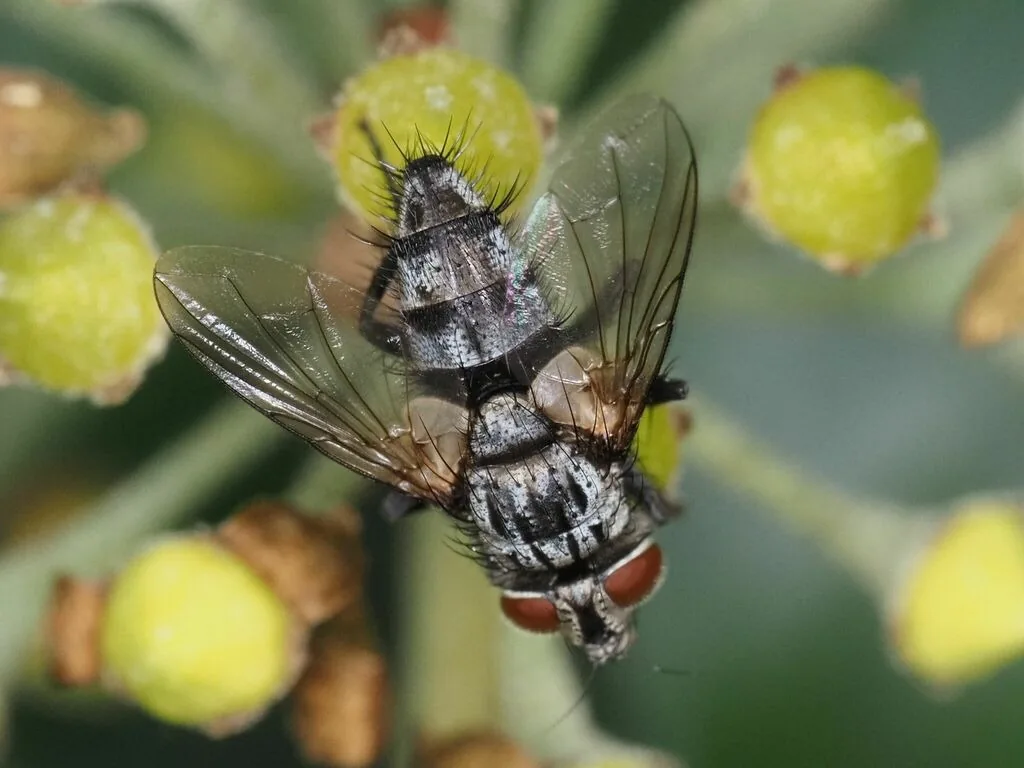
How to identify it
Look-alikes
| Look-alike | How to tell them apart |
|---|---|
| House fly | Compsilura is about the size and shape of a house fly, with a striped thorax. It is a parasite of caterpillars, not a household pest.[1] |
| Other tachinid flies | Compsilura is one member of the tachinid family of parasitic flies. It is unusual for its very broad host range: more than 200 hosts in three insect orders, the moths and butterflies, the beetles, and the Hymenoptera (bees, wasps and sawflies).[1] |
Where it lives
Native to Europe. It was introduced into North America repeatedly from 1906 to 1986, against 13 pest species, and it now attacks more than 180 native moth and butterfly species here. In Minnesota, releases began in 1937, and it has been found in cabbage fields there since 1994.[1][2][3]
Biology and life cycle
A female jumps onto a caterpillar's back, pierces its skin with a structure at the tip of her abdomen and usually injects a single live larva. She may attack the same caterpillar more than once, and in a cabbage looper study the flies readily put several maggots in one host.[1][4]
The maggot develops inside the host's gut for 10 to 17 days, then leaves the host near the time it would pupate and forms a pupa in the soil or elsewhere. The pupal stage lasts 10 to 15 days, and adults live 5 to 22 days.[1]
There are three to four generations a year, and the larvae overwinter inside host caterpillars. Because the gypsy moth has only one generation a year and overwinters as eggs, the fly must use other hosts to complete its year.[1]
It attacks more than 180 species of native moths and butterflies in North America.[3]
Damage and signs
- Its impact is on other insects. Parasitism of native giant silk moths can be very high: in Massachusetts forests it caused 81% of cecropia moth deaths in the first three larval stages, parasitized about two thirds of exposed promethea moth larvae, and killed 36% of a state-threatened buck moth population's third-stage larvae.[2][1]
- Researchers suggest that reported declines of silk moths in New England may be caused by its introduction, and they do not recommend releasing such generalist biological control agents.[2][3]
Health risk
It is a parasite of caterpillars and other insect larvae; the sources describe no harm to people.[1]
Control
Prevention
No control is needed. In gardens and farms it acts as a natural enemy of pests: in Minnesota cabbage it parasitized 11% of cabbage loopers and 28% of imported cabbageworms, and it also attacks fall cankerworm, cranberry fruitworm and Heliothis caterpillars.[1]
Biological control
It can parasitize up to 80% of gypsy moth caterpillars, although it did not stop gypsy moth outbreaks or spread. It is credited with nearly wiping out the invasive browntail moth outside two small coastal areas of New England.[1][3]
Pesticides
If you spray for caterpillar pests, note that adult Compsilura flies are relatively tolerant of carbaryl and permethrin and show some tolerance to Bt, while organophosphate insecticides are relatively toxic to them.[1]
Common questions
- Is Compsilura a beneficial insect?
- Partly. It helps control pests such as gypsy moth, cabbage looper and imported cabbageworm, but it also attacks native non-pest insects, including giant silk moths.[1][2]
- Why was it brought to North America?
- It was first released in 1906 to help control the gypsy moth, an invasive forest pest, and was later released against many other pests.[1][2]
Sources
- University of Minnesota Department of Entomology (VegEdge), “Beneficial Insect Profiles: Compsilura concinnata (R. L. Koch and W. D. Hutchison).” vegedge.umn.edu/beneficial-insect-profiles/compsilura-concinnta (accessed 2026-11-09)
- Conservation Biology (via NCBI PubMed), “Effects of a biological control introduction on three nontarget native species of saturniid moths (Conservation Biology, 2000; abstract).” pubmed.ncbi.nlm.nih.gov/35701905/ (accessed 2026-11-09)
- Ecology (via NCBI PubMed), “Implicating an introduced generalist parasitoid in the invasive browntail moth's enigmatic demise (Ecology, 2006; abstract).” pubmed.ncbi.nlm.nih.gov/17089674/ (accessed 2026-11-09)
- Bulletin of Entomological Research (via NCBI PubMed), “The failure to discriminate: superparasitism of Trichoplusia ni by a generalist tachinid parasitoid (Bulletin of Entomological Research, 2010; abstract).” pubmed.ncbi.nlm.nih.gov/19586578/ (accessed 2026-11-09)
- iNaturalist, “Compsilura concinnata taxon page (order and family).” www.inaturalist.org/taxa/467086 (accessed 2026-11-09)